

Two dead AA cells can make a wireless mouse feel broken, while a healthy 9V battery may be the only thing keeping a smoke detector ready for an alarm. You need different tools for household cells and vehicle batteries, and the right tester makes it easier to identify weak cells before they interrupt a routine task.
A Fast Comparison Of The Options

Dlyfull B2-Red and B1L Battery Testers

VDIAGTOOL BT500 6V 12V 24V Battery Load Tester for Cars, Trucks, Boats

VDIAGTOOL BT300 6V 12V Battery Load Tester for Cars, Trucks, Motorcycles

DLYPOW Magnetic Battery Tester

Smgda Mini Universal Battery Tester for AA, AAA, 9V
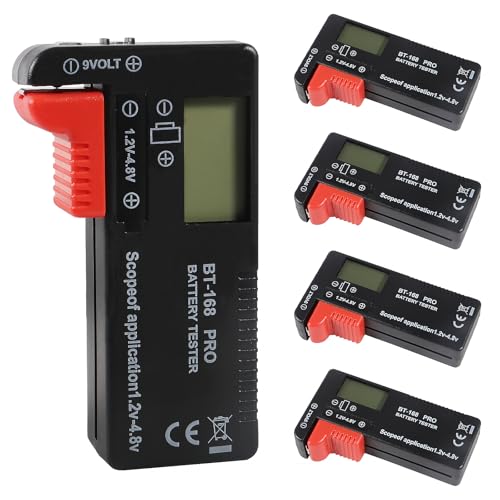
AOICRIE BT-168 PRO Digital Battery Tester 5 Pack for AA to 18650 and Button Cells

VDIAGTOOL BT600 6V 12V 24V Lead-Acid Battery Load Tester with Printer for Vehicles
A Breakdown Of The Leading Choices
The Dlyfull set serves two different parts of a household battery drawer. The B1L weighs 70 grams and gives you a lightweight option for remotes, clocks, and small electronics, while the larger B2 covers cylindrical cells, 9V batteries, and several button-cell formats.
Its LCD changes the decision from guessing to checking the displayed condition of a cell. For a busy home, the included AAA battery and two-device format may be more useful than buying a separate tester for every room, although you will have to select the correct tester for the battery format.
Positive Points
- Two tester sizes let you keep one at home and carry the lighter one in a bag.
- The B2 supports AA, AAA, C, D, 9V, N, CR2, CRV3, 2CR5, CR-P2, and CR123A batteries.
- The LCD identifies poor, weak, or good voltage condition at a glance.
- One 1.5V AAA battery and a user manual are included with the set.
Worth Noting
- Button-cell support differs between the two testers, so check your battery format first.
- The set provides more equipment than a single-purpose household checker requires.
Key Specs
Who It Suits Best
You benefit most from this set if your household contains several battery formats and you value a portable option alongside a more capable desktop unit.
Where Another Pick Suits Better
The Smgda Mini Universal Battery Tester is a more compact choice for one room with only common AA, AAA, C, D, 9V, and button-cell batteries.
The BT500 moves well beyond the AA and AAA drawer, supporting 6V, 12V, and 24V vehicle systems. That makes it a practical garage tool for checking a car before a commute, a truck battery on a job site, or a boat battery during seasonal maintenance.
Unlike the Dlyfull household set, this model examines starter and charging-system performance as well as battery condition. The wider voltage range makes it useful for mixed fleets, but the complexity and size place it outside the category of a pocket-sized household checker.
Useful Touches
- Six-, twelve-, and twenty-four-volt support covers common automotive and marine systems.
- Compatibility includes flooded, gel, EFB, and two forms of absorbed glass mat batteries.
- The 5-to-3000 CCA range allows a check across very different engine sizes.
- Starter, alternator, and charging-system analysis extends beyond a simple voltage reading.
Practical Considerations
- CCA means cold cranking amps, a measure of the current a battery can deliver while starting an engine.
- Vehicle compatibility is essential, since household cells use entirely different formats and voltages.
Feature Snapshot
Made For
This model fits garage users, mobile technicians, and households maintaining several cars, trucks, motorcycles, or boats with different battery systems.
Consider Something Else When
The Dlyfull B2-Red and B1L Battery Testers suit you better when your battery drawer contains household cells rather than vehicle batteries.
The BT300 focuses on six- and twelve-volt systems, making it a natural fit for passenger cars, motorcycles, and many trucks. Its value comes from the range of information it gathers, including voltage, load behavior, internal resistance, ripple, state of charge, state of health, and cranking or charging performance.
Compared with the BT500, you give up twenty-four-volt support in exchange for a more compact vehicle-focused option. Depending on the equipment in your garage, the omitted 24V range may be irrelevant, but it matters for larger commercial vehicles and certain marine installations.
The Good Stuff
- Reports state of charge and state of health alongside electrical measurements.
- Examines both cranking and charging-system performance.
- Supports a 5-to-3000 CCA range for widely different engine capacities.
- Internal resistance and ripple readings add detail for regular vehicle maintenance.
A Few Limitations
- Twenty-four-volt batteries fall outside its stated voltage range.
- The detailed diagnostics make it less convenient for casual household battery checks.
At A Glance
Right Fit For
You get the most from the BT300 with a six- or twelve-volt vehicle and a maintenance routine that benefits from more than a basic voltage check.
Not Your Match When
The VDIAGTOOL BT500 is the better fit for a garage that also needs twenty-four-volt battery support.
The DLYPOW approach is pleasantly direct for a kitchen drawer, office, or workshop. A magnetic tip grips the battery to hold contact in the proper position, then the analog display provides a familiar visual reading without asking you to interpret digital numbers.
The design suits people who prefer a one-step check over menu-driven equipment. Compared with the Smgda Mini Universal Battery Tester, it adds magnetic positioning, while both remain more approachable than the vehicle diagnostic models in this list.
A Few Strong Suits
- The magnetic tip helps maintain steady contact during a check.
- A large analog display makes the result visible at a glance.
- The simple procedure suits everyday household battery sorting.
- Support covers AA, AAA, C, D, 9V, and button-cell batteries.
Points To Note
- An analog needle is less precise than a digital power-level readout for fine comparisons.
- Check that the magnetic tip can hold each cell securely before relying on the reading.
Best Suited To
This tester works well for someone who wants a quick visual battery check and values stable contact over numerical detail.
Look Elsewhere When
The AOICRIE BT-168 PRO Digital Battery Tester is more suitable when you want a numeric power level and several units for different rooms.
The Smgda Mini Universal Battery Tester keeps the task simple: place the battery, read the scale, and decide whether it deserves another charge or replacement. It covers common AA, AAA, C, D, 9V, 1.5V, and button-cell batteries without requiring a separate unit for each format.
Its power comes from the cell being checked, so you do not need to maintain another internal battery. That makes the mini format useful in a junk drawer or travel bag, though its analog scale asks you to interpret a range rather than read an exact digital value.
Where It Helps
- One compact unit covers several common household formats.
- The battery under inspection powers the checker, removing the need for an additional cell.
- Color-coded areas separate replace, low, and good conditions for quick interpretation.
- The small format suits limited drawer, desk, or travel-kit space.
Trade Offs
- The analog scale provides broad condition zones rather than a precise digital percentage.
- Button cells use a separate scale, so you need to read the correct part of the display.
Quick Facts
Who Will Love This
You will appreciate the Smgda model for routine battery sorting in a small home, rental, or travel kit where simplicity matters more than a digital reading.
A Better Fit Elsewhere
The Dlyfull B2-Red and B1L Battery Testers offer a more suitable combination for broader button-cell coverage and a portable unit with an LCD.
The AOICRIE BT-168 PRO set solves a practical household problem: several people often check batteries in different parts of the home. Five compact digital units let you keep one near the kitchen, another by the computer, and more in a drawer or travel bag.
Each tester accepts AA, AAA, C, D, 18650, 9V, dry, and rechargeable cells, including button-cell formats. Unlike the Smgda Mini Universal Battery Tester, the display presents a digit for the power level, which can feel easier to compare when you are sorting several cells.
What Pays Off
- Five units allow convenient placement around a home or shared workspace.
- The digital display shows a battery’s power level as a number.
- Support includes 18650 rechargeable cells, an important addition for electronics work.
- No additional battery is required because the cell under inspection powers the device.
Minor Gripes
- Five testers may be unnecessary for a one-room apartment or a single-device routine.
- A digital power level still does not provide the detailed vehicle diagnostics found in the BT300 and BT500.
Built With In Mind
This five-unit set fits households that regularly sort batteries in several rooms, share a device collection, or keep different battery formats in use at once.
Another Choice May Suit
The DLYPOW Magnetic Battery Tester may suit you better when one analog checker with magnetic positioning is enough.
The BT600 adds something the other vehicle testers do not show you: a printed record. Its built-in printer produces three rolls of paper, giving technicians a convenient way to review or share battery, cranking, and charging-system findings without relying solely on the screen.
You also gain 6V, 12V, and 24V coverage plus support for lead-acid and lithium batteries. For a professional workshop, that combination may justify the larger setup; for a household checking AA cells, it adds far more complexity than the task requires.
The Case For It
- Printed output creates a tangible record of each diagnostic result.
- Six-, twelve-, and twenty-four-volt support suits a varied vehicle inventory.
- Lead-acid and lithium compatibility widens the battery coverage.
- The analyzer examines battery condition, cranking, and charging-system performance.
Potential Compromises
- Three paper rolls must be replaced as they are used.
- The printer and broader diagnostic functions make the BT600 unsuitable for basic household cells.
Technical Highlights
The Right Fit
The BT600 suits professional technicians, fleet maintenance staff, and serious hobbyists who want printable records alongside broad vehicle-system coverage.
Reach For A Different Pick When
The VDIAGTOOL BT500 is the more streamlined choice for vehicle diagnostics when printed records are not important to your workflow.
What To Look For In A Household Battery Tester
Start with the formats you actually use. A tester labeled for AA, AAA, C, D, and 9V cells will cover many remote controls, flashlights, clocks, and smoke detectors, but button cells and 18650 rechargeable batteries need explicit support. The Smgda Mini Universal Battery Tester and AOICRIE BT-168 PRO cover several of those less common formats.
The display should match your comfort level. Digital power readings are convenient for comparisons, while the DLYPOW analog needle provides a quick visual result and the Dlyfull B2 LCD shows poor, weak, or good condition. You do not need a complex menu for a household drawer, but you may want a separate scale for button cells.
Portability matters for batteries scattered around a home. A single lightweight checker can live in a utility drawer, while the AOICRIE five-unit set makes more sense for shared rooms or several device collections. The Dlyfull B1L offers a portable option at 70 grams without making the larger B2 unnecessary.
Vehicle batteries require a different category altogether. The VDIAGTOOL models add load, cranking, charging, and electrical measurements for 6V, 12V, or 24V systems. Check the battery chemistry and voltage before choosing one, because an automotive load tester will not replace a checker for button cells.
Common Mistakes Worth Avoiding
Common Shopping Slip Ups
A universal label can conceal important format limits, so compare the supported battery types rather than relying on the broad category. Another common mistake is choosing a complex vehicle diagnostic tool for a simple household drawer. Match the tool to the cells you own and the level of information you need.
What The Higher Tier Buys
Advanced models can provide digital readings, multiple measurements, wider battery compatibility, and printed records. The extra complexity makes sense for professional vehicle maintenance or several household battery formats. For one remote control and a few AA cells, a compact analog checker may deliver everything you need.
Frequently Asked Questions
Can A Small Battery Tester Check AA And AAA Batteries?
Yes, every household model in this list supports AA and AAA cells. The DLYPOW adds magnetic positioning, the Smgda uses a color-coded analog scale, and the AOICRIE displays a digital power level.
Do These Battery Testers Need Their Own Batteries?
The Smgda Mini Universal Battery Tester and AOICRIE BT-168 PRO draw power from the battery being checked, so neither requires an internal battery. The Dlyfull B2-Red and B1L set includes one 1.5V AAA battery for immediate use.
What Does CCA Mean In A Battery Tester?
CCA stands for cold cranking amps, which estimates the current a battery can deliver during engine startup. It matters primarily for vehicle batteries and helps compare starting capacity across different engine sizes.
Can A Household Battery Tester Check A Car Battery?
No, a household checker for AA or button cells cannot evaluate a vehicle starting or charging system. You need a dedicated 6V, 12V, or 24V automotive analyzer for that job.
Do Button-Cell Testers Use The Same Scale?
Not always. The Smgda model uses a dedicated button-battery scale, while the Dlyfull B2 and AOICRIE BT-168 PRO use their respective digital displays. Read the indicated scale or placement guidance before comparing a button cell with a cylindrical battery.
Final Verdict
For household batteries, the DLYPOW magnetic tester offers the simplest visual check, while the Smgda and AOICRIE models suit different preferences for portability, scales, and multiple units. The Dlyfull set makes sense for mixed formats and portable use. Reserve the VDIAGTOOL BT300, BT500, and BT600 for vehicle systems where cranking, charging, and voltage data justify their greater complexity.
