

A blood pressure monitor earns its place by making regular checks easy to understand and remember, especially when you live with hypertension or need to bring a record to a medical appointment. An analogue monitor traditionally uses a mechanical dial, while every model listed here is digital, with some adding app tracking, rechargeable power, or heart-rhythm features.
A Snapshot Of The Selections

OMRON Bronze Upper Arm Monitor

Lauku[m] BSX583 Large Wide-Cuff Upper Arm Monitor

CRABCLAW Upper Arm Monitor

Medline Digital Adult Upper Arm Blood Pressure Monitor

Checkme Home Bluetooth Upper Arm BP Monitor for iOS and Android

OMRON 2-in-1 BP and EKG
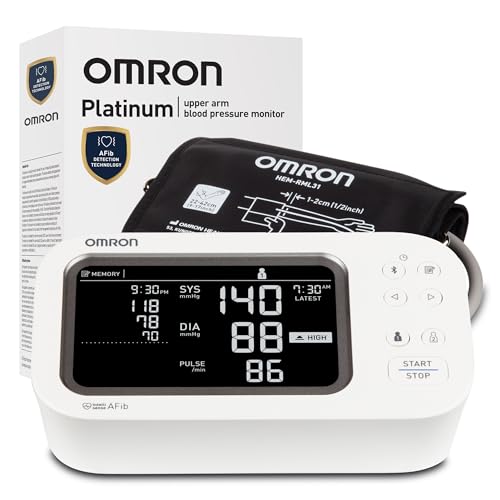
OMRON Platinum BP Monitor
Inside Each Recommended Option
Keeping track of blood pressure becomes more useful when you can see the trend rather than a single number. The OMRON Bronze stores 14 readings on the device and sends additional records to the OMRON Connect app through Bluetooth, which also works with Apple Health and Google Fit.
Its upper-arm format suits people who want familiar operation without giving up digital records. Irregular-heartbeat detection and a hypertension indicator add context to routine measurements, although the readings still belong in a broader health record. For most connected home users, the modest onboard memory is the main compromise.
Reasons It Performs
- Bluetooth syncing turns repeated measurements into a longer-term record without manual note-taking.
- The hypertension indicator provides a quick visual prompt when a result falls outside its reference range.
- Irregular-heartbeat detection flags unusual rhythms during a normal upper-arm measurement.
- Four AA batteries, a storage case, and a quick-start guide make setup straightforward.
- The wide-range D-ring cuff accommodates arms measuring 9 to 17 inches.
Points To Note
- Confirm that your arm falls within the stated 9-to-17-inch cuff range before ordering.
- Fourteen onboard readings are fewer than the storage offered by the Medline and OMRON Platinum models.
Key Specs
Made For
You benefit most from this model when you want app-supported tracking but do not need extensive on-device memory.
Where A Sibling Pick Shines
The OMRON Platinum BP Monitor offers a better fit for two people who want 100 stored readings each and atrial-fibrillation screening.
The laukum BSX583 focuses on the details that matter during a basic home check: a wide upper-arm cuff, a readable screen, and separate memory for two people. Its backlit LCD remains easy to see in a dim bedroom, while the large 22-to-32-centimeter cuff may prove useful for larger upper arms.
You get up to 99 readings for each of two users, plus a 60-second automatic shutoff. That makes it a sensible shared option for couples, although you may find the physical button layout more satisfying than an app-based routine. The included carry bag also makes storage easier.
Notable Upsides
- The wide cuff reduces the need to find a compact model for larger arms.
- Backlighting improves visibility during early-morning or late-night use.
- Two separate 99-reading memories help prevent household records from becoming mixed.
- Automatic shutoff ends the session after 60 seconds without an input.
- Simple controls and printed guidance make the monitor approachable for older adults.
Small Caveats
- The 22-centimeter cuff minimum may not suit smaller upper arms.
- Its physical storage capacity is substantial, but records remain on the device rather than syncing to a phone.
- Its broad cuff is more specialized than the adjustable-cuff approach used by the CRABCLAW model.
Who It Suits Best
This monitor fits couples or larger adults who need a 22-to-32-centimeter cuff and want simple, shared storage.
Another Choice May Suit
The Checkme Home Bluetooth Upper Arm BP Monitor for iOS and Android suits anyone who prioritizes phone syncing and a rechargeable body over separate on-device user memories.
Unlike the laukum BSX583’s fixed-size cuff, the CRABCLAW uses an adjustable upper-arm design, making it easier to accommodate different arm shapes and sizes. It can run from batteries or a USB-C cable, so you can keep it beside a desk, pack it for a trip, or avoid replacing cells during a long monitoring period.
Its two-user memory holds 199 readings for each person, a substantial amount for a device used at home. A large digital display, color-coded results, and an irregular-heartbeat indicator keep the main information easy to find. You may find the 40-second measurement routine suitably brisk for daily use.
A Few Strong Suits
- Battery and USB-C power options offer more placement flexibility.
- Two 199-reading memories suit frequent tracking by two household members.
- The color-coded display makes the latest result easier to interpret at a glance.
- USB-C charging is convenient for anyone who already uses the same cable for several devices.
Practical Considerations
- Confirm that the adjustable cuff secures comfortably around your upper arm before regular use.
- Its memory is extensive for home use, yet the CRABCLAW offers no app connection in the listed features.
Feature Snapshot
The Right Fit
You benefit most from this model when you want deep memory, flexible charging, and one device shared by two people.
Look Elsewhere When
The laukum BSX583 Large Wide-Cuff Upper Arm Monitor fits people who know they need a defined 22-to-32-centimeter cuff and prefer a backlit screen.
A family that keeps separate records gains useful flexibility from the Medline Digital Adult Upper Arm Blood Pressure Monitor. It stores 90 measurements for each of two users, producing 180 readings in total, and includes a color scale beside the display to help interpret the systolic pressure, diastolic pressure, and pulse rate.
The cuff inflates after you press the button and adjusts its inflation level for the individual wearing it. Compared with the laukum BSX583’s wider 22-to-32-centimeter cuff, this model’s 22-to-30-centimeter range is slightly narrower. For most adults within that range, the generous memory and straightforward operation are the decisive strengths.
The Upside
- Ninety readings for each of two users provide a substantial shared history.
- The colored scale gives quick context without navigating an app.
- Adjustable inflation adapts the cuff to the person taking the measurement.
- Four AA batteries are included, so the monitor is ready for home use.
- The large LCD presents blood pressure and pulse rate together.
Worth Noting
- Measure your arm before ordering because the supplied cuff ends at 30 centimeters.
Quick Facts
Who Will Love This
This model suits couples or adult family members who want extensive local records without a phone-based tracking setup.
A Better Fit Elsewhere
The OMRON Bronze Upper Arm Monitor offers a better fit for people who want Bluetooth syncing, Apple Health compatibility, and Google Fit connectivity.
A compact monitor earns its place when it can move between a bedside table, a suitcase, and a countertop without becoming a charging chore. The Checkme has a phone-like size and rechargeable battery, with one full charge stated to last three months, while Bluetooth supports its iOS and Android app.
You can review historical blood-pressure information directly on the device, and the app gives you a way to organize and share records. The listed measurement time is 30 seconds. For frequent travelers, that combination of portability, stored history, and phone connectivity is more useful than a large fixed-storage memory.
Features That Help
- The rechargeable design removes routine battery replacement from the ownership routine.
- Bluetooth connection transfers readings to an iOS or Android app.
- On-device history lets you review past measurements without opening the phone.
- Its compact body is easier to pack than a full-size home monitor.
- A 30-second measurement routine suits quick morning checks.
The Fine Print
- App-based record sharing depends on compatible phone software and a working Bluetooth connection.
- You may find three months between charges useful for travel, but infrequent home users must remember to recharge before a check.
At A Glance
Built With In Mind
This model fits frequent travelers and phone-centered users who want a compact, rechargeable monitor with app support.
Swap It Out When
The OMRON Bronze Upper Arm Monitor is a better fit for someone who prefers a wide-range cuff, four AA batteries, and compatibility with Apple Health and Google Fit.
Blood pressure gives one view of cardiovascular health, while an electrocardiogram, or EKG, records the heart’s electrical activity. The OMRON 2-in-1 BP and EKG combines those measurements in one upper-arm device, making it a practical choice for people who want more than a pressure number from each home session.
You can store up to 90 readings, giving it more local history than the OMRON Bronze’s 14. The trade-off is added complexity: this model is less minimal than a conventional pressure monitor. For regular tracking, the combined function can also provide a more useful record to discuss during a medical appointment.
Real Benefits
- Blood-pressure and EKG functions create a broader home measurement record.
- Ninety stored readings offer more local history than the Bronze model.
- The combined format reduces the need to maintain two separate devices.
- Upper-arm measurement provides a familiar position for routine checks.
Possible Compromises
- The added EKG function makes this less streamlined than a basic pressure monitor.
- Your interest in regular trend tracking and heart-rhythm records must outweigh the larger feature set for the upgrade to make sense.
Best Suited To
This model suits people who want both blood-pressure measurements and an EKG reading from a single home device.
Reach For A Different Pick When
The OMRON Platinum BP Monitor fits you better when two-user storage and atrial-fibrillation screening matter more than EKG measurement.
Two household members can each keep a substantial history with the OMRON Platinum BP Monitor. It stores 100 readings per person, compared with the Medline model’s 90 per user, and adds AFib detection to screen for unusual heart rhythms during a routine blood-pressure measurement.
That rhythm screening is the feature that moves this model beyond a straightforward pressure tracker. You may find it most useful during long-term monitoring or when you want one device to support two people. As with any screening function, the result belongs in the context of professional health guidance.
What Pays Off
- One hundred readings for each user support extended household records.
- AFib detection adds rhythm screening to standard blood-pressure measurement.
- Dual-user memory keeps each person’s figures separate.
- The extended storage reduces the need to transfer and clear records frequently.
- OMRON’s advanced measurement technology supports its premium positioning.
A Few Limitations
- The advanced rhythm function may offer little value when you only need a basic pressure reading.
Technical Highlights
Whose Shelf It Belongs On
This monitor belongs in a two-person household that values long-term records and wants an added atrial-fibrillation screening feature.
Consider Something Else When
The OMRON 2-in-1 BP and EKG suits you better when you want an electrocardiogram reading rather than AFib detection.
What Matters Most in a Home Blood Pressure Monitor
Cuff Size and Placement
The cuff must fit your upper arm properly because an unsuitable range can affect comfort and measurement consistency. The laukum BSX583 covers 22 to 32 centimeters, the Medline monitor covers 22 to 30 centimeters, and the OMRON Bronze fits 9- to 17-inch arms. Measure before ordering, especially when another family member will use the device.
Memory and App Connectivity
On-device memory keeps useful records available without a phone, while Bluetooth apps can organize trends and simplify report sharing. You trade simplicity for dependency when your routine depends on an app, so consider who manages the records and whether your phone supports the required platform.
Heart-Rhythm Features
An irregular-heartbeat indicator flags unusual rhythms, while AFib detection focuses on a specific type of atrial fibrillation. The OMRON 2-in-1 adds an EKG, which records the heart’s electrical activity. These functions can add useful context, but they do not replace professional evaluation of an unexpected result.
Power and Portability
Battery power suits a fixed bedside routine, while USB-C and rechargeable designs suit people who move the monitor between rooms or travel. The Checkme offers the most compact travel-oriented setup here, with Bluetooth, internal history, and a stated three months of use per charge.
Avoiding Common Blood Pressure Monitor Mistakes
Where Shoppers Go Wrong
A common mistake is choosing by screen size while ignoring cuff range. You may find a large display less useful than a secure, correctly sized cuff, so measure your arm first. Another error is assuming every digital upper-arm monitor is an analogue model; an analogue unit has a mechanical dial, while all seven options here use digital displays.
What Separates Premium From Basic
Higher-tier models commonly add larger memories, Bluetooth connectivity, rechargeable power, or heart-rhythm screening. The OMRON Platinum spends that premium on 100 readings per user and AFib detection, while the OMRON 2-in-1 uses it for EKG capability. The upgrade matters when you will use the added function regularly.
Frequently Asked Questions for Analogue Blood Pressure Monitor
Are Any of These Monitors Analogue?
No, all seven listed models are digital upper-arm monitors. An analogue blood pressure monitor uses a mechanical gauge instead of an electronic display.
Which Model Has the Largest Cuff?
The laukum BSX583 has a stated cuff range of 22 to 32 centimeters. The Medline monitor covers 22 to 30 centimeters, so arm measurement should guide your choice.
Which Option Supports Two Users?
The laukum BSX583, CRABCLAW, Medline, and OMRON Platinum all provide separate memories for two people. Their capacities range from 90 readings per person for the Medline to 199 for the CRABCLAW.
Which Monitor Works With a Phone?
The OMRON Bronze uses Bluetooth with its companion app, Apple Health, and Google Fit. The Checkme also supports Bluetooth and offers apps for iOS and Android.
Which Model Includes an EKG?
The OMRON 2-in-1 BP and EKG combines blood-pressure measurement with an electrocardiogram. The OMRON Platinum offers AFib detection instead, while the OMRON Bronze flags irregular heartbeats.
Closing Remarks
The right monitor depends on cuff fit, record storage, and the features you will actually use. Choose the OMRON Bronze for connected tracking, the laukum BSX583 for its broad cuff, the CRABCLAW for flexible power, or the Medline for generous two-user records. The Checkme suits mobile routines, while the two advanced OMRON models serve people who want more specialized heart-rhythm information.
