

A blood pressure check can feel frustrating when wrapping a traditional cuff is awkward, the dial is hard to read, or remembering the routine becomes more difficult than the measurement itself. Manual aneroid monitors offer a tactile alternative without electronic displays, while modern automatic models can simplify positioning and record readings for you. These options suit different routines, from clinical practice to shared family monitoring.
The Picks In Brief
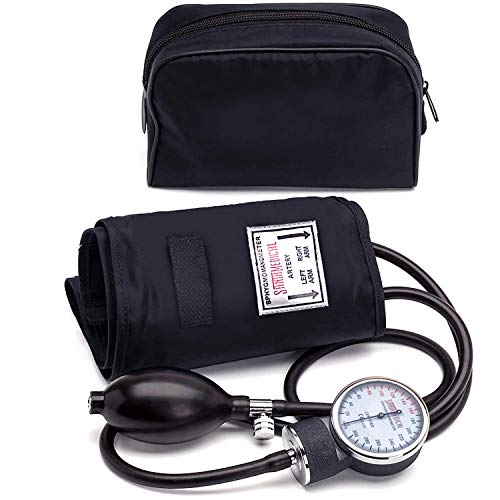
Santamedical Adult Aneroid Sphygmomanometer
CAVN No-Wrap Barrel-Type Upper Arm Monitor

LINE2design 58730-BK Manual Aneroid Cuff

CAVN One-Touch No-Wrap Blood Pressure Monitor
CAVN U90B No-Wrap Upper Arm Monitor

McKesson Large Aneroid BP Monitor

Maynovia Talking Upper Arm Monitor
What Each Pick Brings To The Table
The Santamedical Adult Aneroid Sphygmomanometer gives you a completely mechanical reading without a screen, keypad, or battery. You inflate the cuff, slow the release, and read the needle on a high-contrast dial, making it a sensible fit for anyone comfortable with manual equipment.
Its 300 mmHg range and stated deviation of ±3 mmHg give the dial a precise, purposeful feel. Compared with the automatic CAVN models, the trade-off is participation: you control inflation and deflation rather than pressing a button and waiting.
Bright Spots
- The large, high-contrast dial makes the scale easier to follow during a routine check.
- A large air-release valve supports controlled pressure reduction.
- The stated 300 mmHg range suits standard adult measurement needs.
- A ±3 mmHg deviation provides a useful specification to compare with other aneroid gauges.
Points To Keep In Mind
- Manual operation requires attention to cuff placement, inflation, and release speed.
- You must learn to read the dial and interpret the two pressure values shown.
Quick Facts
Made For
This monitor suits adults comfortable operating manual equipment who want dependable readings without electronic memory.
Consider Something Else When
The CAVN No-Wrap Barrel-Type Upper Arm Monitor offers a better fit for people who struggle with cuff wrapping or manual inflation.
Sliding your arm into the barrel changes the whole setup. The CAVN No-Wrap Barrel-Type Upper Arm Monitor uses a cylindrical cuff with an elbow-resting switch that helps establish position, reducing the need to wrap and secure a conventional cuff.
For an older adult living alone or for a caregiver assisting with daily checks, that guided placement may matter more than the hands-on operation of the Santamedical. The supported arm range of 7.1 to 16.5 inches also makes this a practical shared-family model.
The Practical Payoff
- The one-touch workflow removes the fiddly task of fastening a wraparound cuff.
- The built-in elbow switch provides a consistent placement cue.
- A three-color backlight helps distinguish the displayed information in dim rooms.
- Separate memory for two people keeps household records organized.
- The rechargeable 2000 mAh battery avoids routine disposable-battery changes.
Practical Considerations
- Your upper arm must fall within the stated 7.1-to-16.5-inch range.
- The electronic design is less suitable for people specifically seeking a fully manual aneroid gauge.
Feature Snapshot
Who Will Love This
This model suits seniors or anyone who wants a guided, independent upper-arm measurement with minimal cuff handling.
Another Choice May Suit
The CAVN U90B No-Wrap Upper Arm Monitor serves larger households better because it stores separate records for four people.
The LINE2design 58730-BK brings a portable kit to clinical training, home caregiving, or a medical bag. Its manual aneroid design gives you direct control over inflation, while the matching zippered case keeps the cuff, bulb, and gauge together between uses.
The nylon cuff includes an index line and range markings to help position it consistently. Unlike the Santamedical, which emphasizes a large release valve and D-ring-free cuff, this model focuses on carrying storage and straightforward manual components.
Noteworthy Benefits
- The included zippered carrying case supports compact storage and transport.
- Nylon construction and Velcro closure make the cuff straightforward to secure.
- Range and index markers aid consistent cuff positioning.
- The large dial reduces the visual effort required to read the needle.
Small Caveats
- Manual inflation and deflation require a practiced hand.
- The size designation deserves attention before ordering for a specific arm.
Built With In Mind
This cuff fits nursing students, healthcare providers, and caregivers who value a complete manual kit with portable storage.
Look Elsewhere When
The McKesson Large Aneroid BP Monitor offers a better choice for adults needing a clearly specified large arm range.
The CAVN One-Touch No-Wrap Blood Pressure Monitor adds either-arm use and rechargeable power to the familiar barrel design. You place your arm in the tunnel, rest your elbow on the switch, and press Start, which makes the routine approachable for shared home use.
Its stated ±3 mmHg accuracy and recent-reading average are useful for people tracking changes over time. Compared with the CAVN No-Wrap Barrel-Type Upper Arm Monitor, this version goes further with emergency stops on both sides and operation while charging.
Good Reasons To Consider
- Either-arm measurement gives families more flexibility at check time.
- Stop buttons on both sides improve control during a measurement.
- A recent-reading average supports comparison across multiple results.
- The large display includes systolic pressure, diastolic pressure, and pulse.
- You can use the monitor while it is connected to power.
Factors To Consider
- A power adapter is not included with the monitor.
- Its upper-arm range stops at 16.5 inches, so check fit before ordering.
Key Product Details
Right Fit For
This monitor suits couples or family members who want guided placement, separate histories, and flexible arm selection.
Reach For A Different Pick When
The Maynovia Talking Upper Arm Monitor is a better fit for people who benefit most from spoken results.
The CAVN U90B No-Wrap Upper Arm Monitor is built for a busy household where several people need separate records. Four user profiles hold 199 readings each, giving each person a clear history without mixing morning and evening results.
The barrel layout avoids fastening a cuff, while the large display shows pressure, pulse, averages, low-battery status, and an irregular-heartbeat alert. Compared with the rechargeable CAVN One-Touch model, this unit trades built-in battery charging for flexible AA or USB-C power.
What Helps Most
- Four separate profiles organize records for a larger family.
- A three-reading average gives you a broader view of recent results.
- The display includes pulse and several status indicators.
- You can power the monitor with AA batteries or USB-C.
- The included batteries and cable make the set ready for routine use.
Where It Is Less Suited
- The narrower 8.7-to-15.7-inch range excludes some adult arm sizes.
- USB-C provides power input, but the monitor does not store a rechargeable charge.
- Its digital operation falls outside a strictly manual aneroid setup.
Core Details
Whose Shelf It Belongs On
This monitor belongs in a shared home where up to four adults need organized readings and flexible power options.
Skip It When
The CAVN One-Touch No-Wrap Blood Pressure Monitor is the better choice for households wanting either-arm use and a built-in rechargeable battery.
The McKesson Large Aneroid BP Monitor centers on cuff size rather than electronic convenience. Its navy-blue large adult cuff fits upper arms measuring 23 to 40 centimeters, making arm fit easier to assess before purchase.
A 300 mmHg black-enamel dial and nylon cuff with range markings give this manual setup a clinical feel. Compared with the Santamedical, its most useful distinction is the explicitly documented large-cuff range and included zippered leatherette case.
The Good Stuff
- The stated 23-to-40-centimeter range supports larger upper arms.
- A navy cuff makes the size easier to distinguish in a mixed equipment bag.
- The zippered leatherette case supports compact storage.
- Range markings on the nylon cuff assist with placement.
Possible Compromises
- Manual inflation and release require more involvement than automatic models.
- The stated arm range is narrower than some barrel-style options.
Who Should Grab It
This monitor suits adults with larger arms who prefer a mechanical gauge and need a portable large cuff.
A Better Fit Elsewhere
The CAVN No-Wrap Barrel-Type Upper Arm Monitor is easier for people who dislike wrapping and fastening a manual cuff.
The Maynovia Talking Upper Arm Monitor adds spoken results to the familiar one-button routine. That feature can make a home check less dependent on reading small numbers, particularly for someone with reduced vision or another accessibility need.
The large backlit display supports visual confirmation, while the cuff covers 8.6 to 16.5 inches. Compared with the CAVN models, the key difference is simpler operation focused on one control and audible output rather than multi-user memory or guided barrel placement.
A Few Strong Suits
- The talking function adds an audible way to review results.
- A large backlit display supports low-light visibility.
- One-button operation keeps the daily routine uncomplicated.
- The 8.6-to-16.5-inch cuff covers a broad adult range.
Things That May Matter
- Confirm that your upper arm falls within the stated cuff range.
- The operation is automatic rather than a fully manual aneroid system.
Essential Details
Who Will Love This
This monitor suits people who benefit from spoken feedback and a straightforward one-button automatic routine.
Where A Sibling Pick Shines
The CAVN One-Touch No-Wrap Blood Pressure Monitor offers more value for households that need two-user memory and either-arm placement.
Matching The Monitor To Your Routine
Cuff fit comes first. A monitor cannot provide a useful result when the cuff sits loosely or does not match your arm. Compare the stated circumference range with a measurement taken around your upper arm, paying particular attention to models with different minimum and maximum sizes.
Manual and automatic routines serve different needs. An aneroid sphygmomanometer uses moving air and a mechanical needle, giving you direct control without stored readings. Automatic monitors reduce cuff handling and commonly add memory, illuminated displays, average calculations, and rechargeable power.
Think about who performs the check. A barrel-style monitor can simplify placement for seniors or anyone with limited dexterity. A traditional cuff may work well for trained users who want to control inflation and deflation themselves, while a talking display offers useful audible feedback for people who have difficulty reading small type.
Consider the storage and power setup. Manual gauges avoid battery management and fit neatly into a carrying case. Electronic monitors need charging or disposable batteries, so you should compare memory capacity, power options, and the space required for a stable home setup.
What To Check Before Ordering
Pitfalls Shoppers Hit
Do not overlook cuff size or assume every upper-arm monitor fits the same person. Measure your arm before ordering, and compare the result with the stated range. Also separate the device type from the display type, since a talking or backlit screen is still an automatic monitor.
The Upgrade Payoff
A higher-tier model may add guided positioning, rechargeable power, separate user profiles, recent-reading averages, and audible results. Those extras matter most for shared households, daily tracking, or accessibility needs, while a basic aneroid gauge can be enough for a practiced manual user.
Frequently Asked Questions
Is a manual blood pressure monitor harder to use?
Manual aneroid monitors require more steps because you inflate and release the cuff yourself. Automatic barrel-style models reduce that handling while retaining electronic readings and memory.
Which cuff size should I choose?
Select the model whose stated arm range includes your measured upper-arm circumference. A cuff that is too small or too loose may produce an unreliable reading.
Do manual monitors store readings?
Most aneroid gauges do not store measurements because they have no electronic memory. Models such as the CAVN U90B provide separate digital histories for several users.
Are automatic blood pressure monitors easier for seniors?
They can be, especially models with guided placement, a large display, spoken feedback, and simple controls. Proper posture and a supported arm still matter for consistent readings.
Which type is better for home monitoring?
A manual gauge suits confident users who want a mechanical setup without power management. An automatic monitor offers easier positioning, stored readings, and useful tracking features for shared homes.
Final Thoughts
The right monitor depends less on the label on the box than on your arm size, comfort with the controls, and need for stored readings. Manual aneroid models provide a direct, dependable approach, while barrel-style automatic monitors remove much of the fumbling. Measure your arm, review the routine, and choose the controls that you will actually use consistently.
