

Your feet roll inward with each step when overpronation is present, and that motion can make shoes feel unstable or leave your arches tired by the end of a long shift. The right insert should manage that inward roll without crowding the shoe, so these six options cover different needs ranging from structured arch control to cushioned all-day comfort.
A Snapshot Of The Selections

MUNA Relief Arch Support Insoles
Dr. Scholl’s Work All-Day Gel Insoles

PowerStep Pinnacle Plantar Fasciitis Insoles

PowerStep Pinnacle Maxx Overpronation Insoles
RooRuns FitFeet 3/4-Length Overpronation Insoles

WalkHero Arch Support Insoles
Taking A Closer Look At The Options
Your arch bears more than your body weight during the workday, so excessive inward rolling can leave the supporting tissue feeling strained. MUNA addresses that issue with an anatomical arch, a stabilizing heel cup, and a semi-rigid shell designed to limit further flattening without feeling completely rigid.
That makes these insoles a practical choice for boots, running shoes, and sneakers where arch control matters. Compared with the massaging-gel approach of the Dr. Scholl’s option later in the list, MUNA places more emphasis on holding the foot’s position.
The Helpful Details
- The semi-rigid arch shell offers a firmer response than basic foam while retaining some flex as you walk.
- The heel cup helps center the heel, which matters during long periods of standing or walking.
- The built-to-size format avoids the trimming step required by some insert designs.
- Your choice of boots, running shoes, or sneakers does not need to be limited by one insert profile.
- The support is specifically positioned for plantar fascia discomfort and morning heel pain.
Trade Offs
- The structured shell may feel more substantial than the comfort-focused alternatives in this list.
- You still need adequate shoe volume, since additional heel and arch structure can reduce room inside a close-fitting shoe.
Quick Facts
Made For
You benefit most from MUNA Relief Arch Support Insoles when heel discomfort accompanies an arch that rolls inward and you wear several types of shoes throughout the week.
A Better Fit Elsewhere
Dr. Scholl’s Work All-Day Gel Insoles suit you better when cushioned pressure distribution matters more than a structured arch shell.
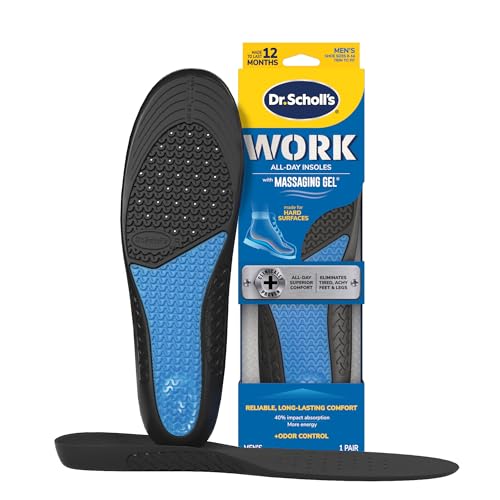
Your workday can become uncomfortable long before your feet feel genuinely tired, especially when shoes keep absorbing repeated impact. Dr. Scholl’s Work All-Day Gel Insoles spread pressure across the foot with massaging gel cushioning for people who spend much of the day standing or moving around.
Compared with MUNA Relief’s semi-rigid arch control, this design puts comfort and pressure management first. It may suit warehouse staff, hospitality workers, teachers, and anyone whose shoes need a softer landing between shifts.
Points In Its Favor
- Massaging gel adds cushioning at contact points where your foot repeatedly meets the shoe.
- Even pressure distribution can reduce the sensation of concentrated pressure during extended walking.
- The trim-to-fit format lets you shorten the insert to suit different work shoes.
- Its comfort-led construction suits a physically demanding day better than a strongly rigid insert.
Practical Considerations
- You need to follow the trim line carefully so the insert remains flat and secure.
- The gel-centered design offers less explicit arch control than the MUNA and PowerStep Maxx options.
- Your shoes need enough internal space to accommodate the cushioned insert without making the heel feel crowded.
Who Will Love This
You benefit most from Dr. Scholl’s Work All-Day Gel Insoles when foot fatigue comes from prolonged standing and you value soft cushioning over a pronounced correction device.
Another Choice May Suit
PowerStep Pinnacle Maxx Overpronation Insoles suit you better when managing inward foot roll takes priority over gel-based comfort.
Your foot needs support without turning every step into a lesson in rigidity. PowerStep Pinnacle combines a shaped arch area with substantial cushioning, giving you a more structured platform than the Dr. Scholl’s gel insert while remaining less aggressively corrective than the Pinnacle Maxx model.
The design is aimed at people managing plantar fascia discomfort, particularly during active or moderately active days. The listed size pairing is unusual enough to check carefully: men’s 10 to 10.5 and women’s 12 to 12.5 are the only sizes shown.
Benefits That Matter
- The arch shape supports foot and ankle positioning during walking and standing.
- Deep cushioning gives your heel a softer landing than a thin, foam-only insole.
- The structured profile can serve as a middle ground between gel cushioning and firm correction.
- Polyester construction gives the insert a defined material and a consistent feel.
- The plantar fascia focus makes the design more targeted than a general comfort insert.
Worth Noting
- You must verify that the listed men’s and women’s size options actually fit your shoes.
- A structured arch and added cushioning require more shoe space than a low-profile insert.
Key Specs
Best Suited To
You benefit most from PowerStep Pinnacle Plantar Fasciitis Insoles when you want structured arch support and cushioning in the same insert.
Reach For A Different Pick When
Dr. Scholl’s Work All-Day Gel Insoles suit you better when a softer pressure-spreading feel matters more than a shaped arch platform.
Your heel angle influences how your weight travels through the foot, and an angled heel can add stability when the foot rolls inward. PowerStep Pinnacle Maxx uses a firm yet flexible heel to manage overpronation and flat-foot positioning, making it a sensible choice for sturdy footwear and active schedules.
Unlike the regular PowerStep Pinnacle model, which balances shaped support with cushioning, the Maxx places greater emphasis on stability. You may find that stronger structure useful during long walks, while the firmer feel can take some adjustment.
The Upside
- The angled heel addresses the inward rotation associated with overpronation.
- Firm construction can hold the foot more securely than a largely gel-based design.
- Flexible material allows the insert to move with your foot rather than remaining completely rigid.
- The profile is designed for both flat feet and overpronation, narrowing its target use.
- Made in the USA, with men’s and women’s size options listed separately.
Small Caveats
- You need a roomy shoe because the stability-focused construction can take up more space than a slim insert.
Built With In Mind
You benefit most from PowerStep Pinnacle Maxx Overpronation Insoles when your foot rolls inward noticeably and you wear supportive shoes with enough room for a structured insert.
Swap It Out When
MUNA Relief Arch Support Insoles suit you better when you want arch control without the Maxx model’s stronger stability emphasis.
Your arch may need more height than a standard footbed provides, particularly during walking or running. RooRuns FitFeet uses a three-quarter-length design with an arch that reaches up to 35 millimeters, giving your midfoot a pronounced support point without extending through the entire shoe.
Compared with the PowerStep Pinnacle Maxx’s angled-heel approach, RooRuns concentrates on high arch support through firm EVA material. The shorter format can make it easier to accommodate in footwear with a removable footbed, though less of your foot receives support.
Everyday Perks
- The substantial 35-millimeter arch offers a strong support profile for flat or fallen arches.
- Firm EVA helps absorb impact while retaining a defined shape.
- The three-quarter length fits many removable-footed walking and running shoes.
- Even pressure distribution can reduce concentrated stress during repetitive steps.
Factors To Consider
- The shorter design leaves the heel area without a separate heel cup or insert coverage.
- A high arch can feel too pronounced during the first few walks, particularly in stiff shoes.
- You need footwear with a removable insole and enough depth for the raised arch.
Technical Highlights
The Right Fit
You benefit most from RooRuns FitFeet 3/4-Length Overpronation Insoles when a high, firm arch fits your foot and your shoes have removable footbeds.
Where A Sibling Pick Shines
WalkHero Arch Support Insoles suit you better when a deep heel cup matters more than RooRuns’ unusually high arch.
Your heel needs support that keeps the foot centered as you walk, and WalkHero approaches that need with a deep heel cup and shaped arch support. The design is positioned for people dealing with flat-foot pronation, plantar fascia discomfort, heel spurs, or Achilles tendonitis.
Compared with RooRuns’ three-quarter-length, high-arch format, WalkHero concentrates more attention on heel positioning. That makes it a practical choice for shoes where cushioning and a supportive heel cup feel more useful than an especially tall arch.
Noteworthy Benefits
- The deep heel cup helps maintain the heel’s position during repeated walking or running steps.
- Shaped arch support targets the inward roll associated with flat feet and pronation.
- The support profile is designed to ease everyday strain around the heel, arch, and Achilles area.
Points To Watch
- You need enough room inside your shoes to accommodate the heel cup and raised arch.
- Shoppers seeking a very tall, firm arch may find RooRuns FitFeet more aligned with that preference.
Feature Snapshot
Whose Shelf It Belongs On
You benefit most from WalkHero Arch Support Insoles when heel centering and everyday arch support matter more than a tall or rigid orthotic profile.
Look Elsewhere When
PowerStep Pinnacle Maxx Overpronation Insoles suit you better when a firm angled heel gives you more direct control over inward foot roll.
What Actually Matters In Overpronation Support
Start With The Type Of Control
Overpronation support generally means limiting excessive inward rolling at the foot. PowerStep Pinnacle Maxx uses an angled heel for that purpose, while MUNA Relief uses a semi-rigid arch shell and RooRuns FitFeet uses a tall, firm arch. Your shoe type and comfort response should guide the choice.
Match Support To Your Schedule
Long shifts call for cushioning that remains comfortable through repeated pressure, making the Dr. Scholl’s gel option or PowerStep Pinnacle worth considering. High-activity routines place greater importance on stability and impact management, so a more structured insert may feel more appropriate.
Check The Space Inside Your Shoes
Arch height, heel depth, and overall thickness all affect fit. A three-quarter insert such as RooRuns FitFeet can work with removable footbeds, while deeper heel cups and semi-rigid shells may require roomier shoes. Trim-to-fit options offer some flexibility, but the insert still needs to lie flat.
Consider Firmness Without Forcing It
A rigid insert can provide strong control but may feel uncomfortable during long wear. Semi-rigid or firm-but-flexible construction offers a middle ground, whereas gel cushioning prioritizes a softer landing. Start with the support level that matches your daily activity and footwear, not simply the strongest design.
Before You Commit To An Insert
Wrong Turns To Avoid
A tall arch does not automatically suit every overpronating foot, and extra cushioning does not necessarily correct inward rolling. Check the shoe’s removable footbed, available toe and heel space, and the width of the insert before ordering.
What Separates Premium From Basic
Higher-tier inserts often use firmer structural shells, deeper heel cups, or more targeted arch geometry. The added material and construction may help with demanding schedules, but a carefully matched basic insert can still provide more useful comfort than an advanced model that crowds your shoe.
Frequently Asked Questions
How Can I Tell Whether My Feet Overpronate?
Worn shoe heels can offer a clue, but they cannot confirm your foot mechanics by themselves. A footwear professional can assess your gait and recommend the level of control you actually need.
Should You Choose Full-Length Or Three-Quarter Inserts?
Three-quarter inserts, such as RooRuns FitFeet, can work well in shoes with removable footbeds. Full-length models may suit dress shoes, boots, or footwear where you want coverage across more of the foot.
Can Arch Support Resolve Heel Pain?
Not necessarily. Support may change load and comfort, but persistent heel pain deserves an appropriate professional assessment rather than repeated changes to footwear.
How Firm Should Your Inserts Feel?
Choose firmer support when managing inward foot roll is your main concern. Gel cushioning or a moderate arch profile may feel better for all-day comfort, particularly in less structured shoes.
Can You Trim Inserts to Match Your Shoes?
Only trim an insert when the manufacturer provides a trim line, as with Dr. Scholl’s Work All-Day Gel Insoles. For built-to-size models, confirm the listed dimensions and available shoe space before ordering.
Final Verdict
The right shoe insert depends on your gait, footwear, and tolerance for firmness. MUNA Relief offers focused arch control, PowerStep Pinnacle Maxx prioritizes stability, and RooRuns FitFeet delivers the tallest arch profile in this group. Check the fit, begin with the structure your feet need, and give any new insert time to become familiar.
