

Your feet absorb every step, but office floors, concrete, and long shifts can leave your arches feeling sore by evening. The right insole adds support where your foot needs it without making your shoe feel wrong, so your decision should start with arch shape, daily routine, and fit.
A Snapshot Of The Selections

Dr. Scholl’s Custom Fit Insoles CF 210

LEADER Double Air Foam Insoles, Pack of 2

Vasyli Custom Full Length Insoles, Medium, Blue
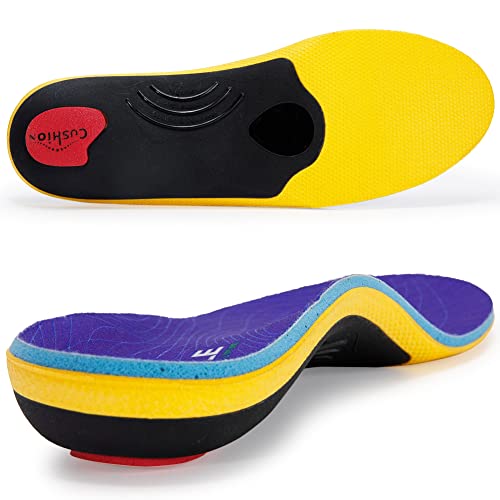
VALSOLE Heavy Duty Orthotics 220+ lbs, High Arch

CRUVHEAL 220+ lbs High Arch Insoles, Medium, Black

CRUVHEAL Work Orthotic Boot Insoles, XL, Blue
The Strengths Of Each Pick
Personalized support is the central reason to notice Dr. Scholl’s Custom Fit Insoles CF 210. The insert is matched to your arch type, body weight, and shoe size, which makes it a sensible starting point for daily walking, work shoes, and casual footwear.
Unlike LEADER’s generic one-size foam design, this model aims its support more precisely at the person wearing it. You may find the fit especially useful across several pairs of shoes, provided each has enough room to accommodate the insert.
What Earns Its Place
- Accounts for arch type, body weight, and shoe size for a more personal fit.
- Works across everyday shoes without requiring heat molding.
- Offers support for the heel and forefoot rather than adding uniform thickness alone.
- Suits people who want structured support without a complicated fitting process.
Practical Considerations
- You should remove the stock insert when the shoe already has a substantial footbed.
- A close-fitting pair may need a fit check because a custom insert can change how the shoe feels.
Quick Facts
Made For
You benefit most from this model when you wear several shoe types and need support tailored to your arch, weight, and shoe size.
Where Another Pick Suits Better
LEADER Double Air Foam Insoles suit people who prioritize thick cushioning and a trim-to-fit design over personalized arch selection.
A soft landing matters most after long walks or hours in shoes with minimal cushioning, and LEADER Double Air Foam Insoles focus on that kind of comfort. The extra-thick, two-layer construction adds cushioning without asking you to determine an arch type or complete a molding process.
Compared with Dr. Scholl’s CF 210, this pair is less about personalized support and more about flexible, removable padding. The two-pair pack also lets you keep separate insoles in casual shoes and work sneakers, which is convenient for daily changes.
A Few Strong Suits
- The dual-layer foam provides generous cushioning for prolonged wear.
- Trim-to-fit construction allows adjustment for different shoes.
- Two pairs support multiple shoes without constant removal.
- The unisex format suits a wide range of everyday footwear.
Points To Note
- The extra thickness may crowd low-volume shoes or narrow work styles.
- A uniform foam profile offers less arch-specific shaping than an orthotic insert.
- Trimming creates a DIY fitting task, so avoid cutting below the intended outline.
At A Glance
The Right Fit
This model fits you best when soft cushioning and easy trimming matter more than a precisely molded arch profile.
Another Choice May Suit
Vasyli Custom Full Length Insoles suit people who can heat-mold a medium-density insert for a closer, more individualized fit.
Vasyli Custom Full Length Insoles add a heat-molding option that sets them apart from LEADER’s simple trim-to-fit foam. Heating the medium-density insert allows it to form around your foot, creating a more personal shape before it goes back into the shoe.
That process takes more involvement than Dr. Scholl’s CF 210, but it may suit someone who wants a custom profile without moving to a much more structured high-arch model. Full-length coverage also gives the heel and forefoot a shared cushioning base.
What It Does Well
- Heat molding creates a shape based on the contours of your foot.
- Full-length coverage supports the entire area from heel to toe.
- Medium density offers a practical middle ground between soft foam and rigid support.
- The blue medium model covers a clearly defined footwear size range.
Trade Offs
- You must follow the heat-molding instructions to shape the insert properly.
- The medium size does not cover smaller or larger feet listed for other models.
Feature Snapshot
Built With In Mind
You benefit most from this model when your feet fall within the medium size range and you want a custom shape with moderate density.
Look Elsewhere When
CRUVHEAL Work Orthotic Boot Insoles suit people whose main need is standing-work support inside a roomier boot.
VALSOLE Heavy Duty Orthotics are designed around a more substantial support profile, with a high-arch format intended for users above 220 pounds. The work-boot positioning and shock-absorbing design make sense for people who spend substantial time walking or standing on hard surfaces.
CRUVHEAL 220+ lbs High Arch Insoles share a similar weight-based use case, but VALSOLE places more emphasis on flat-foot support and work shoes. You may find this model more relevant when your footwear has room for a pronounced insert.
Strengths Worth Knowing
- The high-arch profile targets substantial support rather than light cushioning.
- The 220-pound guidance helps narrow the choice for heavier users.
- Flat-foot support gives the design a clear fit for that arch pattern.
- Shock absorption adds comfort during long walks and standing shifts.
Things To Consider
- Its pronounced support may take more space than a slim, low-profile insert.
- Work shoes with fixed insoles may not leave enough room for a replacement.
Who It Suits Best
This model serves adults over 220 pounds who have a high or flat arch and regularly wear supportive work footwear.
A Better Fit Elsewhere
LEADER Double Air Foam Insoles suit lighter-duty situations where soft cushioning and adjustable trimming are easier to accommodate.
CRUVHEAL 220+ lbs High Arch Insoles use a 1.4-inch arch section to create a taller support profile. That height gives high arches something substantial to rest against, particularly useful in work shoes during long shifts or extended walks.
Compared with VALSOLE Heavy Duty Orthotics, this model states its arch height more clearly and uses the same 220-pound threshold. For someone with a high arch, that specific measurement can make the decision more direct, although the medium size still needs to match your footwear.
What Pays Off
- A 1.4-inch arch section provides a pronounced support profile.
- The 220-pound designation targets a specific support need.
- The design is intended for work boots and extended periods on your feet.
- Height across the arch may feel more substantial than a low-profile foam insert.
Smaller Caveats
- The medium size must accommodate both your foot and the insert inside your work boot.
- Its substantial arch height may feel excessive for a low or neutral arch.
Who Will Love This
You benefit most from this model when you weigh more than 220 pounds, have high arches, and need support in roomy work footwear.
Where A Sibling Pick Shines
CRUVHEAL Work Orthotic Boot Insoles suit people who prioritize standing-shift cushioning, a deep heel cup, and shock-absorbing pads over a 1.4-inch arch.
CRUVHEAL Work Orthotic Boot Insoles are built around a demanding day on your feet, with cushioning, arch support, a deep heel cup, and shock-absorbing pads. The XL version gives you a larger starting point than the medium CRUVHEAL model, with the same blue work-focused design.
Your main consideration is boot space. This multi-layer construction may feel fuller than Vasyli’s heat-molded profile, but the added heel structure and cushioning make more sense for long standing shifts than for lightweight casual shoes.
A Strong Showing
- A cushioning layer adds comfort during extended standing shifts.
- The deep U-shaped heel cup helps keep the foot centered.
- Shock-absorbing pads soften the impact of repeated steps.
- Arch support adds structure for a full work shift.
- The XL size serves people needing a larger boot insert.
One Detail To Watch
- You should remove the stock boot insert and confirm that the remaining space accommodates this multi-layer design.
Core Details
Whose Shelf It Belongs On
This model fits you best when you stand for long hours, wear roomy boots, and want combined arch support, heel structure, and cushioning.
Reach For A Different Pick When
CRUVHEAL 220+ lbs High Arch Insoles suit people who need a clearly defined 1.4-inch arch profile for a high-arch foot.
What Matters Before You Buy Arch Support
Match the Arch Profile
Your arch shape influences the insert profile you need. A high arch often looks for more vertical support, while a flat foot may benefit from a broader shape that spreads pressure across the middle of the foot. Start with how your foot feels in a familiar shoe, not with the severity of a label.
Check the Inside of the Shoe
Remove the existing footbed and measure the space left behind. Full-length orthotics, thick foam, heel cups, and added arch sections can change the fit of sneakers or boots, so a shoe that already feels snug may not have room for another layer.
Consider Your Daily Hours
A cushioned foam insert may suit casual days and long walks, while a structured orthotic makes more sense for substantial standing or walking. Heat-molded inserts add a fitting step, while pre-shaped models suit people who want a quicker swap between shoes.
Pay Attention to Sizing
One-size inserts offer convenience, but trimming provides a more useful fit than simply dropping a flat sheet into a shoe. Sized models, such as the Vasyli medium or CRUVHEAL XL, suit people who already know the measurements of their footwear and want a more predictable starting point.
Common Mistakes Worth Avoiding
Wrong Turns To Avoid
Buying solely for cushioning can leave out the support profile your foot needs. Check the arch height, shoe space, and intended hours before buying, and remove the original insole so you can see how much room remains.
The Upgrade Payoff
Higher-tier models often add heat molding, stronger arch structure, heel cups, or shock-absorbing layers. Those features are worthwhile when you stand for many hours or need a defined high-arch profile, but a basic foam insert may be enough for lighter-duty wear.
Frequently Asked Questions
How do I know which arch support I need?
Look at how your foot feels and how it sits in your usual shoes, not just your arch height. A podiatry or healthcare professional can help assess persistent discomfort.
Are thicker insoles always better?
No. Thickness can improve cushioning, but a bulky insert may crowd a narrow shoe or feel uncomfortable under a low arch.
Can I use the same insoles in multiple shoes?
You can, provided each shoe has enough space and you are comfortable changing between them. Insoles shaped for boots may feel too substantial in lightweight sneakers.
How long should I adjust to new insoles?
Give yourself several days of light wear before evaluating comfort, and increase use gradually. Persistent pain or swelling deserves attention from a qualified healthcare professional.
Should I remove the original shoe insert?
Usually, removing it creates more room and prevents two footbeds from competing. Check your shoe manufacturer’s guidance before removing any built-in component.
Final Verdict
Your best choice comes down to daily demands and fit. Personalized models suit varied footwear, thick foam handles lighter-duty cushioning, and high-arch or work-focused inserts address more substantial support needs. Choose the pair that matches your shoes and schedule, then give it a fair fit check before making it part of every day.
