

A bunion can make ordinary shoes feel awkward, especially after a full day of walking, standing, or working on hard floors. The right insert may add cushioning, support your arch, or reduce pressure around sensitive forefoot areas, but the most useful choice depends on whether you need an insole, sock, or toe brace and how your shoes fit.
The Essentials At A Glance

FLYSTORY 4D Cloud Insoles, Arch Support and Shock Absorption for Men and Women

ARIAT Women’s ATS Gel Insole
GoSkala Medium Arch Insoles for 230+ lbs

WalkHero High Arch Support Insoles for Standing
Deepballfeet Metatarsalgia Insoles with Metatarsal Pad

OS1st Bunion Relief Split-Toe Socks

OS1st HV3 Bunion Brace and Toe Straightener
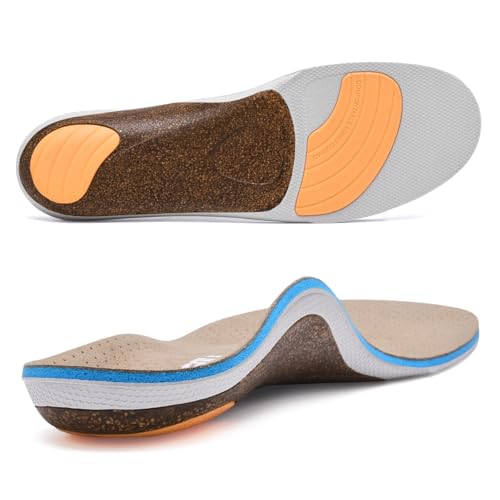
VALSOLE Cork Support Insoles for Men and Women, Shock Absorption for Standing All Day
Inside Each Recommended Option
Cloud-like PU cushioning makes these inserts appealing for long shifts, long errands, and shoes that leave your feet tired. Their four-part contour provides arch support while absorbing impact, so you get more than a simple extra layer of foam underfoot.
Unlike the more specialized Deepballfeet Metatarsalgia Insoles with Metatarsal Pad, FLYSTORY balances general arch support and softness rather than concentrating on one forefoot zone. The two-pair package is practical for keeping a spare pair in your work bag or rotating between several pairs of shoes.
What Stands Out
- Soft PU material feels more accommodating than a rigid orthotic insert.
- The 4D contour supports the arch while cushioning heel-to-toe impact.
- Two pairs make rotation between work, running, and casual shoes easy.
- Men’s and women’s size ranges cover several common combinations.
Practical Considerations
- Check the listed size ranges carefully, including the different men’s and women’s conversions.
- A bulky supportive profile may need more room inside structured shoes than a thin gel footbed.
Key Specs
Who It Suits Best
You benefit most from these inserts during long workdays, frequent standing, or walks in shoes that need extra cushioning.
Consider Something Else When
GoSkala Medium Arch Insoles for 230+ lbs suit you better when firmer support and responsive cushioning matter more than a very soft feel.
Footwear feels better when the insert adds cushioning without turning into a bulky orthotic. This ARIAT footbed uses gel cushioning and has a round-toe shape, making it a straightforward choice for women seeking a low-profile layer inside compatible footwear.
The ATS designation points toward ARIAT’s footwear platform, so existing boot or shoe users may find the shape more familiar. Compared with FLYSTORY 4D Cloud Insoles, this option focuses on a thinner, less structured cushioning experience rather than deep contouring.
Reasons It Performs
- Gel cushioning helps soften the feel of prolonged walking and standing.
- The round-toe outline can work smoothly with footwear that follows the natural shape of the foot.
- A footbed format is easier to add to established shoes than a bulky toe brace or split-toe sock.
Less Ideal Details
- You need to confirm compatibility with your ARIAT footwear and available interior space.
- The cushioning-focused design offers less arch shaping than the WalkHero or VALSOLE options in this roundup.
Made For
Women already wearing ARIAT footwear will likely appreciate the familiar round-toe shape and uncomplicated gel cushioning.
Where Another Pick Suits Better
WalkHero High Arch Support Insoles for Standing suit you better when a structured support profile matters more for long shifts on hard surfaces.
GoSkala combines PORON and EVA foam to create a responsive insert for walking, running, basketball, hiking, or a day spent standing. The stated 230-pound-plus sizing points toward people who want a more substantial medium-arch support profile than a thin replacement footbed.
That middle ground differs from the very soft FLYSTORY 4D Cloud Insoles. You may find this firmer construction more supportive during active use, although some casual footwear may require a little extra room around the heel and forefoot.
What Works In Its Favor
- PORON foam provides responsive cushioning that returns to shape between steps.
- EVA foam adds a supportive base for running, hiking, and standing routines.
- Medium arch support targets a common middle ground rather than one extreme.
- The listed 230-plus-pound sizing helps identify a more substantial fit.
- Pressure distribution between heel and forefoot can improve comfort during long activities.
Some Limits To Know
- The listed fit is aimed at people over 230 pounds, so it may not align with lighter users’ footwear.
- Unlike the FLYSTORY pair, the support level may feel more pronounced underfoot.
Feature Snapshot
Right Fit For
You benefit most from these insoles during active routines or long days on your feet, especially with a medium arch profile.
Not Your Match When
FLYSTORY 4D Cloud Insoles suit you better when maximum softness and a two-pair package matter more than firmer active support.
WalkHero is built for the kind of day spent moving around a shop floor, warehouse, classroom, or kitchen. Its support profile is firm yet flexible, which gives the arch more structure without feeling completely rigid underfoot.
The product description actually positions the design for medium arches, so the “high arch support” name deserves careful attention. Compared with GoSkala Medium Arch Insoles for 230+ lbs, this option presents a similarly active orientation but emphasizes standing work rather than sports and hiking.
Bright Spots
- Firm, flexible support balances stability with a less rigid feel.
- Pressure distribution can make long periods of walking feel more even.
- The design is aimed at flat feet, heel discomfort, and bunion-related pressure around the forefoot.
- Men’s and women’s sizing options appear in the product listing.
The Fine Print
- The design description points to medium arches despite the high-arch wording in the title.
- Available sizes include men’s 4–4.5 and 5–5.5, with corresponding women’s 6–6.5 and 7–7.5 options.
Quick Facts
Built With In Mind
Your work shoes will benefit most from these insoles when you spend long shifts standing on hard flooring or concrete.
A Better Fit Elsewhere
ARIAT Women’s ATS Gel Insole suits you better when discreet cushioning inside compatible footwear matters more than structured arch support.
Pressure across the ball of your foot calls for a more targeted insert than a general-purpose cushion. Deepballfeet places a metatarsal pad beneath the forefoot, a raised area designed to spread pressure across the metatarsal heads rather than concentrating it in one place.
That focused approach makes this a sensible match for narrow or uncomfortable forefoot areas, including discomfort associated with metatarsalgia and Morton’s neuroma. The arch support adds a broader foundation, but the metatarsal pad remains the defining feature.
The Value In It
- The built-in metatarsal cushioning targets pressure directly under the ball of the foot.
- Weight distribution across the forefoot can make prolonged walking feel more comfortable.
- Arch support makes the insert more useful than a loose forefoot pad alone.
- Two width options accommodate different foot shapes.
Where It May Fall Short
- Size C covers men’s 5–6 or women’s 6–7 at 250 millimeters, while size D covers men’s 6.5–7.5 or women’s 7.5–8.5 at 262 millimeters.
- This focused design is less useful than a general cushioning insole when your main concern is heel comfort.
Best Suited To
You benefit most from these insoles when pressure concentrates beneath the metatarsal heads during long walks or standing periods.
Reach For A Different Pick When
VALSOLE Cork Support Insoles suit you better when arch stability and shock absorption across a full workday are the main priorities.
Not every bunion-related problem needs a thick insert. These OS1st socks use a split-toe layout to give the big toe its own space, while a cushioned area adds padding where rubbing tends to occur.
You may find the socks especially useful in roomy walking shoes or casual footwear where an insole changes the fit too much. Compared with the OS1st HV3 Bunion Brace and Toe Straightener, they feel like the lower-profile option, although they provide less structural support.
What It Does Well
- The split-toe design keeps the big toe separated from the smaller toes.
- Cushioning adds padding around a sensitive forefoot area without changing the shoe’s insole space.
- Compression-style construction gives the sock a close fit around the foot.
- You can wear them with many roomy shoes without adding a full-length insert.
Small Caveats
- They are socks rather than insoles, so they cannot provide arch support or full-foot cushioning.
- The split-toe shape may not suit narrow footwear that already constrains the toes.
Technical Notes
Who Will Love This
You benefit most from these socks when toe friction is the issue and your shoes cannot comfortably accommodate a thicker insole.
Swap It Out When
GoSkala Medium Arch Insoles for 230+ lbs suit you better when active cushioning and medium-arch support are required throughout the foot.
The HV3 brace adds structure to the split-toe approach used by OS1st Bunion Relief Split-Toe Socks. A soft-flex section beside the big toe is designed to support toe alignment while keeping the device lighter and less rigid than a hard splint.
That makes it a more structured option for walking shoes with enough room, rather than a simple sock or cushioning insert. The brace separates the big toe and supports the forefoot, but it should not be expected to change the underlying bone position on its own.
What Makes Sense
- The split-toe construction keeps the big toe separate from the other toes.
- A flexible side support adds more structure than a cushioned sock.
- Lightweight construction supports daily wear without the weight of a rigid brace.
- Compression around the foot gives the brace a close, secure feel.
Factors To Consider
- A structured brace takes more room than an ordinary sock and may not fit every narrow shoe.
- It is less suitable for someone who only wants general arch cushioning across the whole foot.
The Right Fit
You benefit most from this brace when you want more toe separation and lateral support than a split-toe sock provides.
Where A Sibling Pick Shines
OS1st Bunion Relief Split-Toe Socks suit you better when low-profile cushioning and easier shoe compatibility matter more than structured support.
Cork support gives these insoles a different feel from foam-only designs. The cork section gradually takes on the shape of your foot, while the surrounding construction provides arch support and shock absorption for walking, exercise, or long periods of standing.
They look especially practical inside work boots, where a stable base and reduced pressure matter during a full shift. Compared with FLYSTORY 4D Cloud Insoles, the approach is firmer and more adaptive, while the listed lengths help you compare the insert with your boot’s internal measurements.
Key Advantages
- The cork support section gradually conforms to your foot’s shape.
- Shock-absorbing construction softens the feel of walking and standing.
- Arch support improves stability across the full foot.
- Work-boot sizing makes the fit easier to assess before ordering.
- Men’s and women’s versions cover several common shoe sizes.
Points To Keep In Mind
- Cork support may need a period of wear before it settles into your foot’s shape.
- Size C provides a 236-millimeter insole, while size D provides 244 millimeters.
- A more structured insert may require footwear with a removable insole and adequate interior depth.
Core Details
Whose Shelf It Belongs On
Your work boots will benefit most from these insoles when you need adaptive cork support and cushioning during long shifts.
Look Elsewhere When
Deepballfeet Metatarsalgia Insoles with Metatarsal Pad suit you better when focused cushioning beneath the ball of the foot is the main concern.
Match Support to Your Foot and Schedule
Arch support describes the contouring that helps distribute pressure through the middle of your foot. Medium support offers a middle ground, while high support creates a more pronounced arch shape, so matching the insert to your foot type matters more than choosing by color or style.
Choose the Support Level Carefully
A medium profile, such as the design used by GoSkala, may work well for active days and moderate arches. WalkHero is also described for medium arches despite its high-support title, while VALSOLE uses a cork section that gradually adapts to your shape. You may prefer softer cushioning, as in FLYSTORY, when comfort matters more than a structured profile.
Match the Insert to Your Footwear
Removable insoles work best in shoes with enough interior room and a footbed that can be removed. Structured boots usually accommodate deeper inserts better than low-cut fashion shoes, while a gel replacement like ARIAT’s may suit compatible ARIAT footwear more closely. Measure both the shoe and your foot before ordering.
Target the Discomfort You Actually Have
A metatarsal pad is intended for concentrated pressure beneath the ball of the foot. Split-toe socks address rubbing and toe overlap with less bulk, while a brace adds more lateral structure around the big toe. A full-length insole makes more sense when heel, arch, and forefoot support are all part of your daily comfort needs.
Account for Long Workdays
Soft foam is appealing during a long shift, but a firmer insert may feel more stable on hard flooring. Work boots often benefit from a deeper profile and stronger base, while athletic shoes may have less room for a thick insert. Try a pair with your intended footwear and avoid adding several cushioning layers at once.
Buying Bunion Insoles Without Second Guessing
Mistakes Worth Dodging
Do not assume every bunion-related issue calls for the same product. A toe brace, split-toe sock, metatarsal insert, and full-length arch insole serve different purposes. Measure shoe length, check whether the existing footbed comes out, and compare the stated size before placing an order.
What Separates Premium From Basic
A higher-tier insert may use more responsive foam, layered materials, or an adaptive cork section rather than a single piece of foam. That extra construction can provide better support or durability, but it may also change the fit. Paying more makes sense when you have a specific support need, not simply because a product carries a premium label.
Frequently Asked Questions
Are bunion insoles supposed to straighten the big toe?
Bunion insoles primarily cushion the foot and manage pressure, so they should not be expected to straighten the toe by themselves. A separate toe straightener or brace may provide more structure, though an appropriate specialist can advise whether a particular approach suits your foot.
Can bunion insoles be used in any shoe?
Bunion insoles fit best in shoes with enough room and a removable footbed. Heels, narrow shoes, and boots with fixed interiors may restrict the insert, so compare the shoe’s internal measurements with the insole dimensions.
Are split-toe socks better than insoles for bunion discomfort?
Split-toe socks are better suited to toe friction and mild pressure from adjacent toes because they add little bulk. Full-length insoles make more sense when your feet also need arch support, heel cushioning, or forefoot pressure distribution.
What arch support should I look for in work shoes?
Medium or adaptive arch support is a practical starting point for many work shoes because it provides structure without an extreme contour. You should also account for shoe depth, the type of floor underfoot, and whether your foot begins to feel uncomfortable during the first hour.
When should I see a specialist about bunion pain?
Persistent pain, worsening redness, swelling, or difficulty walking deserves attention from an appropriate foot specialist. An insole may provide comfort, but it cannot address every structural or foot-health concern.
Final Thoughts
The right bunion support depends on where your discomfort appears and how much room your shoes offer. General walkers may prefer the balanced cushioning of FLYSTORY, active users may favor GoSkala, and targeted forefoot pressure may point to Deepballfeet, while OS1st offers two different levels of toe separation. Check the size, consider your footwear, and choose the format that addresses the problem you actually have.
