

Flat feet and overpronation can make every step feel less controlled, especially during a long workday or a run. Overpronation means the foot rolls inward more than expected, while flatter feet often need extra support through the arch. These orthotic insoles range from full-length corrective designs to slimmer inserts that fit more easily into everyday shoes.
The Lineup, Simplified

PowerStep Pinnacle Maxx Orthotic Insoles for Flat Feet & Overpronation
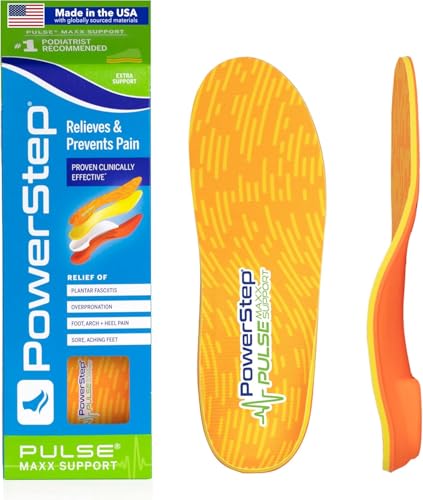
PowerStep Pulse Maxx Running Insoles for Overpronation Control

PowerStep Pinnacle Pink Orthotics for Women with Pronation Support

Vionic Women’s Relief Full Orthotic

Spenco Rx Orthotic 3/4-Length Insoles
PowerStep Pinnacle Low Arch Support Insoles for Flat Feet
Pedag Heat-Moldable Orthotic Insoles for Flat Feet and High Arches

Pedag Viva Sport Women’s Arch Support Insoles
Taking A Closer Look At The Options
Standing-heavy routines call for more than a lightly cushioned insert. The PowerStep Pinnacle Maxx uses a firm yet flexible construction and an angled heel to support alignment as your foot bears weight. That makes it a sensible option for flat feet and noticeable inward rolling during workdays or long walks.
Compared with the shorter Spenco Rx Orthotic 3/4-Length Insoles, this design takes a more structured approach. You may notice more guidance through the heel, although a roomy shoe is important because rigid support can change how the upper feels.
Well-Handled Touches
- The angled heel gives overpronation a clear correction-focused design.
- Flexible construction may feel more adaptable than a completely rigid shell.
- The firm platform suits shoes used through long periods of standing.
- Men’s and women’s sizing options cover several adjacent shoe sizes.
- Made in the USA for shoppers prioritizing domestic production.
Trade-Offs To Consider
- Check that your shoe has enough depth for the structured heel.
- Corrective geometry may feel more noticeable than a basic cushioning insert.
- Confirm the listed size against both shoes before ordering.
Key Specs
Made For
You benefit most from this model during long standing days or walks that place repeated stress on your feet.
Where Another Pick Suits Better
PowerStep Pinnacle Low Arch Support Insoles for Flat Feet suit people who prioritize a lower profile and layered cushioning.
Running shoes present a different support challenge from office footwear because each landing creates repeated impact. The PowerStep Pulse Maxx was developed for running shoes and uses a more rigid shell plus an angled heel for motion control. It is a focused choice for overpronation during faster training and distance work.
Unlike the PowerStep Pinnacle Maxx Orthotic Insoles for Flat Feet & Overpronation, this model centers the running application rather than general daily wear. You may appreciate the firmer platform, though a break-in period and adequate shoe volume are sensible precautions.
Real-World Strengths
- Designed specifically for the movement of running shoes.
- A rigid shell offers more pronounced motion control.
- The angled heel supports alignment during repeated landings.
- Polyester construction keeps the insert focused on functional support.
Worth Noting
- The rigid shell may feel pronounced during early wear.
- Remove any factory insole that competes for interior space.
- Match the size to the running shoe, not only your everyday footwear.
Who It Suits Best
You get the most relevant support from this insert when running regularly and recognizing inward rolling during stride.
Consider Something Else When
PowerStep Pinnacle Maxx Orthotic Insoles for Flat Feet & Overpronation suit people who need correction for all-day shoes rather than running shoes alone.
This full-length insert combines neutral arch support with generous cushioning and a deep heel cup. The result is aimed at women with flat feet or pronation concerns who want more support than a thin gel liner provides. Its complete coverage makes it especially relevant to everyday walking shoes with removable factory insoles.
Compared with the PowerStep Pulse Maxx Running Insoles for Overpronation Control, this option is less narrowly focused on running. You may find its cushioned construction more natural across work shoes and casual footwear, provided the shoe is deep enough.
The Practical Payoff
- Full-length coverage supports the arch and heel together.
- Deep heel cup provides a secure landing area.
- Layered cushioning suits long periods of standing.
- Pronation support targets inward rolling.
Small Caveats
- Your shoe must have a removable factory insole.
- Full-length coverage takes more space than a three-quarter insert.
At A Glance
The Right Fit
This model suits women who need full-foot correction and cushioning in shoes that accept a substantial insert.
Look Elsewhere When
Pedag Viva Sport Women’s Arch Support Insoles suit people who want a sport-oriented design with dedicated forefoot support.
A full-day office schedule calls for support that can move comfortably between sitting, standing, and walking. The Vionic Women’s Relief Full Orthotic uses a deep heel cup and a three-zone comfort design to provide structured support for casual walks, workdays, and active routines. It offers a more lifestyle-focused alternative to the overtly athletic PowerStep models.
That broader daily use does not make the heel structure insignificant. Compared with the Spenco Rx Orthotic 3/4-Length Insoles, this insert covers more of the foot, so check your shoe’s interior depth and removable insole design before committing.
What It Does Well
- The deep heel cup gives your heel a supported landing area.
- Three-zone comfort accommodates varied daily activities.
- Full-length coverage supports more of the arch.
- The design suits both workwear and casual footwear.
Practical Considerations
- Full-length support requires sufficient room inside the shoe.
- Confirm that the existing insole can be removed.
Who Will Love This
You benefit most from this orthotic during mixed days that move between work, walking, and casual activity.
A Better Fit Elsewhere
Spenco Rx Orthotic 3/4-Length Insoles suit people whose shoes lack space for a full-foot insert.
Not every supportive insert needs to cover the entire foot. The Spenco Rx Orthotic 3/4-Length Insoles stop short of the toes, leaving more room in shoes such as loafers, work shoes, and casual sneakers. A nylon construction, cushioning core, and adaptable heel-and-arch plate make this a practical choice when shoe volume matters.
Compared with the PowerStep Pinnacle Pink Orthotics for Women with Pronation Support, this design sacrifices forefoot coverage for a slimmer fit. You may find that trade-off worthwhile, especially when switching insoles changes the fit of a favorite pair.
A Favorable Mix
- Three-quarter length fits neatly into many casual shoes.
- Spencore cushioning softens the feel under each step.
- The heel and arch plate can adapt to your foot shape.
- Nylon construction keeps the insert light.
Things To Weigh
- Forefoot coverage is less extensive than a full-length insert.
- Check the listed size against your larger shoe to prevent bunching.
Quick Facts
Best Suited To
These insoles suit people who need arch support but need to preserve space in loafers, work shoes, or narrow sneakers.
Not Your Match When
PowerStep Pinnacle Pink Orthotics for Women with Pronation Support suit people who want full-length coverage and a deeper heel cup.
Not every flat foot needs a pronounced arch build. The PowerStep Pinnacle Low uses a firm, flexible, contoured low-arch profile with a deep heel cradle and dual-layer cushioning. It is designed for flat feet and overpronation while remaining focused on a practical everyday footprint. People carrying higher body weights may find the stated capacity particularly relevant.
Compared with the more aggressively structured PowerStep Pinnacle Maxx Orthotic Insoles for Flat Feet & Overpronation, this model emphasizes a lower arch profile and layered cushioning. You may find that balance easier to wear for extended periods, though the heel cradle still needs adequate shoe depth.
Points In Its Favor
- The low-arch profile directly addresses flatter foot shapes.
- Dual-layer cushioning adds comfort under standing loads.
- A deep heel cradle supports the heel and pronation control.
- Listed capacity extends beyond 250 pounds.
- Made in the USA.
Details To Watch
- Allow enough room for the contoured heel section.
- A gradual break-in may help your foot adjust.
Technical Sheet
Built With In Mind
You benefit most from this model when flatter arches, prolonged standing, and higher body weight are part of your daily pattern.
Another Choice May Suit
PowerStep Pinnacle Maxx Orthotic Insoles for Flat Feet & Overpronation suit people seeking a more pronounced angled-heel correction.
Some feet change noticeably between shoes, and a fixed arch height can leave you adjusting the fit repeatedly. The Pedag Heat-Moldable Orthotic Insoles let you warm and shape the footbed, then trim it for your shoe. Natural latex and activated carbon charcoal combine with a medium-to-high arch design, giving this model a tailored feel.
Unlike the ready-made PowerStep Pinnacle Low Arch Support Insoles for Flat Feet, this insert is meant to be shaped around your own foot. You take on more of the fitting process, but you also gain control over the final dimensions.
The Upside
- Heat molding lets you adjust the arch shape.
- Trimming helps prevent excess material from crowding the toe area.
- Latex provides a natural-material footbed surface.
- Activated carbon charcoal supports odor management.
- The design accommodates medium and high arch profiles.
Possible Compromises
- Heating and trimming require care and a little extra time.
- Follow the shaping directions and avoid excessive heat.
Whose Shelf It Belongs On
These insoles suit people who want a custom fit and can devote a few minutes to shaping and trimming the footbed.
Swap It Out When
Spenco Rx Orthotic 3/4-Length Insoles suit people who prefer a ready-made insert and a shorter profile.
The Pedag Viva Sport Women’s Arch Support Insoles use an anatomically shaped footbed to support both the long arch and the area across the forefoot. A diagonal bridge handles the longitudinal arch, which runs along the foot’s length, while a metatarsal pad supports the transverse arch across the forefoot. That combination gives this model a distinct sports-oriented profile.
Compared with the PowerStep Pulse Maxx Running Insoles for Overpronation Control, the Viva Sport emphasizes forefoot support and foam cushioning rather than a rigid running-specific shell. It may suit everyday athletic shoes where a more sculpted footbed feels appropriate.
Where It Excels
- The diagonal bridge supports the lengthwise arch.
- A metatarsal pad adds structured forefoot support.
- Foam cushioning suits active daily routines.
- The women’s sizing is listed as US 7 and EU 37.
Areas To Watch
- Confirm the exact women’s size before ordering.
- Check that your sport shoes have room for the contoured footbed.
Feature Snapshot
The Right Match For
You benefit most from this design when arch support and forefoot stability matter equally during active daily wear.
Reach For A Different Pick When
PowerStep Pulse Maxx Running Insoles for Overpronation Control suit runners who want a rigid shell and angled heel for motion control.
What Actually Determines Your Insole Fit
Arch Profile And Motion Control
A flat foot has little visible arch, while overpronation describes excessive inward rolling during movement. Your chosen insert should match both the shape of your foot and the amount of guidance you want. A low profile may feel more natural for flatter arches, whereas a more structured heel suits pronounced motion-control needs.
The Space Inside Your Shoes
Measure the shoe before choosing a profile. Full-length inserts generally need more toe room, while three-quarter models suit loafers, work shoes, and narrow sneakers. Removable factory insoles create the cleanest fit because the replacement does not have to sit on top of another layer.
Materials, Shape, And Daily Use
Rigid shells provide stronger guidance, while flexible or heat-moldable designs can conform more closely to your foot. Fabric, foam, and latex each create a different feel under long periods of wear. You can compare the listed dimensions and sizes, then reserve judgment on comfort for a short trial.
When Foot Discomfort Persists
Persistent heel, arch, or forefoot discomfort deserves attention beyond an insert. Follow the guidance of an appropriate specialist doctor or podiatrist, particularly when symptoms affect walking or exercise. An orthotic can support positioning, but it should not distract you from a proper assessment.
Two Details That Shape the Decision
Wrong Turns To Avoid
Avoid choosing solely by arch label, because shoe volume and your walking pattern matter too. Do not force a thick insert into a closed shoe or assume more correction always feels better. Start with the activity you do most, then check the size and removable-insole requirement.
What Separates Premium From Basic
A higher-tier insert may add a rigid motion-control shell, deeper heel support, premium cushioning, or heat-moldable customization. Those features are worthwhile for demanding routines or difficult shoe fit. Simpler designs remain sensible for light daily wear.
Frequently Asked Questions
Do I need arch support for flat feet?
A supportive insert can help manage foot position and improve comfort during daily movement. The right arch profile depends on your foot shape, shoe fit, and activity level.
How do I know my shoe accepts a full-length orthotic?
Remove the factory insole and compare the available space with the insert’s dimensions. A loose toe area and secure heel position provide the most practical fit.
Are stiffer insoles always better?
No. A rigid shell offers stronger guidance, while a flexible or customizable design may suit daily wear better. Choose the structure that matches your foot and the support you actually need.
How should I introduce new orthotic insoles?
Wear them for shorter periods at first and increase use as your foot adjusts. Stop and seek specialist advice if discomfort becomes persistent or affects your normal movement.
Can orthotic insoles correct overpronation?
They can support a more controlled foot position, but they do not change the underlying structure of your foot. A specialist can help determine whether your rolling pattern needs additional attention.
Final Verdict
The strongest starting point depends on your shoes and routine. PowerStep Pinnacle Maxx suits pronounced daily correction, Pulse Maxx focuses on running, and Spenco Rx preserves interior space. Choose the fit you can comfortably maintain, and give any new orthotic time to feel natural.
