

Is cooking with olive oil truly healthy, especially for high-heat cooking? Olive oil is a highly stable and beneficial choice for most cooking methods. Many people worry about its smoke point or potential nutrient loss. However, an oil’s stability during cooking depends more on its oxidative stability and fatty acid profile than just its smoke point. This post provides factual information about olive oil’s stability and health benefits when heated.
Key Takeaways
Olive oil is a stable cooking oil. It has monounsaturated fats and antioxidants. These protect it from heat damage.
Extra virgin olive oil is safe for high-heat cooking. It stays stable and makes fewer harmful compounds than other oils.
Heating olive oil does not destroy its health benefits. It keeps most of its good nutrients, even when deep-fried.
Choose extra virgin olive oil for most cooking. Store it in a dark bottle in a cool place. This keeps it fresh and good.
Olive Oil’s Composition and Stability
Olive oil stands out as a highly stable cooking oil. Its fundamental composition provides excellent resistance to heat. This stability comes from its unique blend of fatty acids and protective compounds. Olive oil is considered one of the most stable cooking oils under heat.
Monounsaturated Fats: Heat Resistance
Olive oil contains many monounsaturated fatty acids (MUFAs). Oleic acid is a primary example. This high content of MUFAs makes olive oil resistant to heat. MUFAs are more stable than polyunsaturated fatty acids (PUFAs), which are common in other plant oils. This higher MUFA content gives olive oil superior oxidative stability during heat treatment. While saturated fatty acids are even more stable, the significant proportion of monounsaturated fat in olive oil contributes to its heat resistance. This fatty acid profile is a key reason for its benefits during cooking.
Antioxidants: Natural Protection
Olive oil also contains many antioxidant compounds. These compounds enhance its resistance to degradation during heating. They include tocopherols, which are a form of vitamin E, and various phenolic compounds. Specific antioxidants like hydroxytyrosol, tyrosol, and oleuropein are present. These natural antioxidants provide significant benefits. They protect the oil from damage caused by oxidation. For example, tocopherols, especially α-tocopherol, donate a hydrogen atom to stop auto-oxidation reactions. Phenols like o-diphenol hydroxytyrosol also contribute to this protection. These antioxidants work by scavenging free radicals. They prevent the formation of unstable hydroperoxides, which can lead to degradation. This natural protection ensures the cooking oil stability.
Smoke Point Facts for Cooking with Olive Oil
Many people consider an oil’s smoke point when choosing a cooking oil. Understanding what the smoke point means helps clarify its relevance to olive oil.
Understanding Smoke Point
The smoke point, also known as the burning point, is the temperature at which an oil or fat begins to emit a continuous, clearly visible bluish smoke. This occurs when substances within the oil, such as the oil itself, proteins, sugars, or other organic materials, chemically react with oxygen and start to burn. This phenomenon is distinct from the flash point, which refers to temperatures where vaporized oil ignites. An oil’s smoke point represents its resistance to heat. It is the temperature at which it transitions from glistening to burning and smoking. Exceeding this temperature causes the oil’s compounds to break down. This results in an acrid, burnt flavor that can spoil the food being cooked.
Several factors influence a cooking oil’s smoke point:
Purity: More refined oils have higher smoke points. Refining removes impurities that cause smoking.
Age: The smoke point of an oil depends significantly on its age.
Color: Lighter-colored oils tend to have higher smoke points.
Refining: Refined oils have a higher smoke point because refining removes impurities and free fatty acids that cause smoking.
Type of fat: Oils high in polyunsaturated fats tend to have lower smoke points. Monounsaturated fats have medium smoke points. Saturated fats are high smoke point oils.
Sedimentation: Solids remaining from processing in unrefined oils smoke at lower temperatures. This lowers the oil’s smoke point.
Free Fatty Acid (FFA) content: FFAs are less stable than triglycerides. They smoke at lower temperatures. Higher FFA content reduces the smoke point.
Storage: Proper storage helps maintain lower FFA levels and thus a higher smoke point.
Olive Oil’s Range for Most Cooking
Olive oil offers a versatile smoke point range suitable for most cooking methods. Its smoke point typically falls between 374-405°F (190-207°C). This range makes it appropriate for sautéing, baking, and even some frying.
Here is a comparison of olive oil’s smoke points with other common cooking oils:
Oil Type | Smoke Point (°F) |
|---|---|
Olive Oil (Unrefined) | 320 |
Olive Oil (Pomace) | 460 |
Olive Oil (Extra Light) | 468 |
Olive Oil | 438 |
Olive Oil (Virgin) | 420 |
Olive Oil (Extra Virgin) | 420 |
Canola Oil (Unrefined) | 225 |
Canola Oil (Expeller Press, High Oleic or Refined) | 464-475 |
Peanut Oil (Unrefined) | 320 |
Peanut Oil (Refined) | 440 |
Rice Bran Oil | 490 |
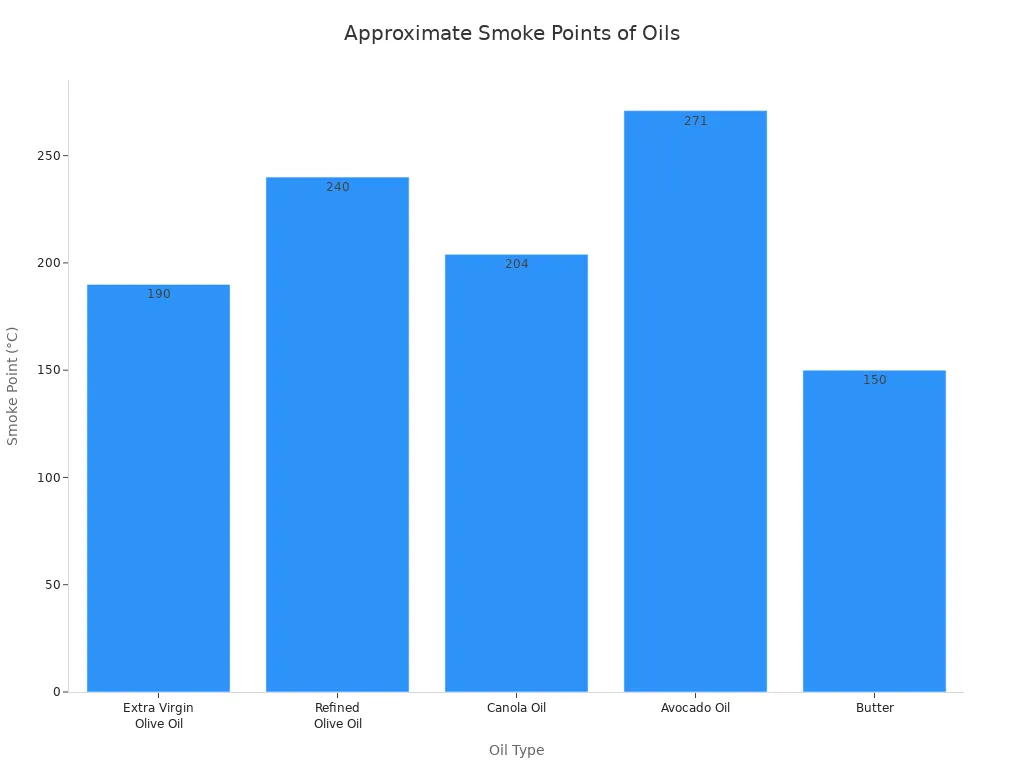
This chart further illustrates the smoke points of various oils:
A common misconception suggests that heating oil past its smoke point creates trans fats, leading to negative health consequences. However, research indicates this is largely untrue for olive oil. An investigation published in the International Journal of Fats and Oils found that frying potatoes in olive oil eight times at 356°F for 15 minutes resulted in the formation of less than 0.002% trans fatty acids. Another study demonstrated that even after frying olive oil eight consecutive times, the trans fat content only marginally increased from 0.045% to 0.082%. This is considered a negligible amount. Therefore, minor smoking does not automatically mean the oil becomes unhealthy due to trans fat formation.
Extra Virgin Olive Oil: High Heat Stability
Many people believe extra virgin olive oil is unsuitable for high-heat cooking due to its lower smoke point compared to refined oils. However, recent research confirms that extra virgin olive oil demonstrates excellent performance in high-temperature cooking. This is due to its oxidative stability, outperforming many other oils. Australian researchers conducted a comprehensive study, published in Acta Scientific Nutritional Health. They compared extra-virgin olive oil with various other common cooking oils under high heat. The study concluded that extra virgin olive oil was the safest and most stable, even at temperatures exceeding typical domestic cooking methods. For example, it remained stable at 180℃/350℉ over 6 hours and gradually up to 240℃/475℉.
A primary finding was that extra virgin olive oil generated the lowest quantity of harmful polar compounds among all tested oils. This included virgin olive oil, refined olive oil, canola, grapeseed, coconut, avocado, peanut, rice bran, and sunflower oils. Lead author Florencia de Alzaa emphasized that the testing temperatures were higher than those typically used in home cooking, further validating extra-virgin olive oil’s stability. This stability is attributed to its rich content of antioxidants, monounsaturated fats, and polyphenols. Even after prolonged heating, such as 36 hours at 180°C/356°F, extra virgin olive oil retains a substantial amount of its beneficial compounds. These include stable monounsaturated fats, polyphenols, and vitamin E.
Extra virgin olive oil’s superior heat stability compared to refined olive oil is primarily attributed to its higher content of phenols (antioxidants). These phenols actively protect the oil from oxidation when heated. They prevent the formation of toxic aldehydes. Unlike refined oils, which undergo processes that strip away natural antioxidants, extra virgin olive oils are not refined. They retain these protective compounds. This preservation of natural antioxidants allows them to ‘sacrifice’ themselves during heating. This diminishes the creation of harmful substances and enhances the oil’s stability. A study published in ScienceDirect highlights that extra virgin olive oil’s fatty acid profile and minor constituents contribute to its stability at high temperatures. This stability not only protects the oil itself but also the food cooked in it from oxidation. It also enriches the food with extra virgin olive oil’s health-promoting bioactive compounds.
Heat’s Impact on Health Benefits
People often wonder how heat affects olive oil’s beneficial compounds. While some changes occur, olive oil generally preserves most of its benefits, even under extreme conditions like deep frying. This section explores how heat impacts olive oil’s health properties.
Nutrient Retention When Heated
Olive oil, especially extra virgin olive oil (EVOO), retains most of its nutritional benefits even after significant heating. Research shows this retention. For example, one study found that EVOO heated to 356°F (180 °C) for 36 hours kept most of its nutritional value. While some tocopherols and polyphenols degraded, other compounds remained stable. These stable compounds include oleic acid, sterols, squalene, and triterpenic alcohols and acids. Another study showed EVOO performed better than sunflower oil when heated in an industrial fryer at 374°F for 40 hours. This demonstrated its high stability and quality retention.
Deep frying with olive oil does not significantly reduce its health benefits during cooking. A 2020 study from the University of Barcelona found that EVOO kept substantial amounts of polyphenols and antioxidants. This was true even at cooking temperatures between 258°F and 338°F. The polyphenol content decreased by 40% at 258°F and 75% at 338°F compared to raw EVOO. However, the levels of these beneficial compounds remained relatively high. Furthermore, research showed that phenols and antioxidants from EVOO can transfer to foods cooked in it. This enriches the food with compounds like oleuropein, pinoresinol, hydroxytyrosol, and tyrosol. The USDA also supports cooking with olive oil for deep frying. They list it as a recommended oil with a high smoke point. Dr. Guy Crosby, a Harvard professor, noted that antioxidants in EVOO protect fatty acids against oxidation during frying. This shows their continued effectiveness.
Prolonged heating of olive oil generally leads to the degradation or modification of phenolic compounds. For example, olive oil samples heated at various temperatures (90, 170, 220°C) for up to 150 minutes showed this effect. However, a gradual increase in temperature during olive oil extraction can actually enhance phenolic compounds. This happens during the malaxation phase, from 21°C to 27°C over 25 minutes. This process can increase phenolic compounds by about 15%. This is due to improved enzymatic activity and increased solubility. This is different from heating the oil itself. Prolonged heating can also increase hydroxytyrosol acetate content. This occurs because secoiridoids break down into simpler phenols. This phenomenon has been observed when roasting vegetables with olive oil.
Oxidation Resistance
Olive oil shows strong resistance to oxidation when heated. Scientists use several markers to measure this resistance:
Hexanal/nonanal ratio: This is a good marker for oxidation. Scientists examine it using a dynamic headspace technique.
p-anisidine value (PAV): This measures carbonyl compounds, such as aldehydes. It reacts with p-anisidine reagent.
Thiobarbituric acid-related substances (TBARs): This assesses lipid peroxidation. It determines malonaldehyde.
Rancimat: This automated test measures the increase in conductivity from acid formation during oxidation.
Swift Test: This measures the induction time of oxidation. This is the period before oxidation rapidly increases.
Other markers include:
Biochemical compounds: ECN44, ECN46, ECN48, ECN50. ECN44 and ECN46 decrease, while ECN48 and ECN50 increase with heat.
Primary and secondary oxidation products
Peroxide value
Conjugated dienes and trienes: Measured by K232 and K270 specific absorptivity.
Tocopherols and pigments profile
Total phenol content
Pyropheophytin evolution
Fatty acid composition
Diacylglycerols content
Rancidity marker volatile compounds: Identified through gas chromatography analysis.
2-ethylhexanol, 2-undecenal, and 2-dodecenal: These compounds appear in higher concentrations after oleic acid degrades during frying.
EVOO shows higher oxidation stability compared to some other oils. For example, it is more stable than Colliguaya integerrima oil (CIO). It shows similar stability to Cynara cardunculus oil (CO). The stability order under similar heating conditions is CO ≥ EVOO > CIO. EVOO and CO maintain thermal stability up to 200 °C. This is relevant for common cooking methods like stir-frying and deep-frying (160-191 °C). EVOO’s higher oxidation stability comes from its lower content of polyunsaturated fatty acids. The polyphenols in EVOO also contribute to its stability. They act as antioxidants and stabilize vitamin E during heating.
No Toxic Compounds Formed
Olive oil can produce harmful compounds if heated past its smoke point. This is the temperature at which it begins to break down and release smoke. However, olive oil, especially high-quality extra virgin olive oil (EVOO), is one of the most stable fats for cooking. This is due to its high antioxidant content (polyphenols) and low polyunsaturated fat content. Studies show EVOO resists oxidation, even during deep frying. Most stovetop cooking occurs between 250–365°F. This is well within the safe range for EVOO.
Here is a comparison of smoke points for various oils:
Oil Type | Approximate Smoke Point (°F) | Approximate Smoke Point (°C) |
|---|---|---|
Extra Virgin Olive Oil | 374–405 | 190–207 |
Refined Olive Oil | 465 | 240 |
Canola Oil | 400 | 204 |
Avocado Oil | 520 | 271 |
Butter | 300–350 | 150–177 |
A 2018 study published in the journal Acta Scientific Nutritional Health found that extra virgin olive oil was the most stable cooking oil when heated. This means it maintained its nutritional integrity and produced the fewest harmful compounds.
This research confirms that olive oil does not readily form toxic compounds under normal cooking conditions. Its natural composition protects it.
Best Practices for Olive Oil Use
Using olive oil effectively in the kitchen enhances both the taste and health benefits of your meals. Following simple guidelines helps maximize its potential.
Choosing the Right Type
Different olive oils suit different cooking needs. Extra virgin olive oil (EVOO) contains the highest percentage of beneficial compounds like polyphenols and antioxidants. Minimal processing preserves these. Virgin olive oil (VOO) is slightly more processed. It contains most, but not as many, polyphenolic and antioxidant compounds. ‘Light,’ ‘pure,’ and refined olive oils are more processed. They have fewer beneficial compounds.
Consider these factors when choosing olive oil:
Freshness: Look for a harvest date on the bottle. This shows when olives were picked. If unavailable, check the ‘best by’ date. Choose the one furthest from the purchase date. Consume opened olive oil within a few months to preserve its fresh flavor.
Packaging: Choose olive oil in amber, black, or green glass bottles, or cans. These protect the oil from light, heat, and oxygen. These elements degrade flavor and antioxidants.
Sensory Characteristics: Good extra virgin olive oil tastes fresh. It has an olive fruit flavor, bitterness, and pungency. This pungency creates a peppery, warm sensation. Avoid oils with off-notes like musty or stale flavors.
Olive Oil Type | Quality/Processing | Acidity (Free Fatty Acid) | Smoke Point (°F) | Recommended Uses |
|---|---|---|---|---|
Extra Virgin Olive Oil (EVOO) | Highest quality, cold-pressed, no heat/chemicals, rich in polyphenols | ≤ 0.8% | 375-405 | Drizzling, bread dipping, vinaigrettes, finishing over cooked foods (low-heat) |
Virgin Olive Oil | Slightly lower quality than EVOO, cold-pressed, may have slight defects | Higher than EVOO | 390-420 | Vinaigrettes, marinades, light cooking |
Refined Olive Oil / Pure Olive Oil | Blend of refined and EVOO, processed to neutralize defects | Higher than virgin | 390-470 | Frying, sautéing (lacks EVOO health benefits) |
Light Olive Oil | Highly refined, milder taste (refers to flavor, not calories) | Not specified | High | Baking, high-heat cooking (lacks health benefits) |
Use the best quality olive oil you can afford. Extra-virgin olive oil is excellent for most cooking methods. For shallow frying, good-quality EVOO is recommended. The most aromatic EVOO is best for raw uses or as a finishing condiment. Its rich flavor enhances dishes.
Optimal Cooking Temperatures
Olive oil is suitable for various cooking temperatures. A study found that extra virgin olive oil remained stable even after heating to 240°C and holding at 180°C for 6 hours. This is due to its fatty acid profile and natural antioxidant content. Smoke point is not the only reliable indicator of cooking oil stability.
Cooking Method | Optimal Temperature Range |
|---|---|
Sautéing | Generally does not exceed 320⁰ F |
Deep Frying | Around 325⁰ – 375⁰ F |
Roasting | Food’s water content keeps temperature below oven setting, safe even at high oven temperatures (e.g., 425⁰ F oven with 385⁰ F smoke point oil) |
When sautéing vegetables, their moisture content helps keep pan temperatures lower. This preserves EVOO’s flavors and attributes. This makes cooking with olive oil a versatile choice.
Proper Storage for Longevity
Proper storage maintains olive oil’s quality and extends its shelf life. Packaging directly influences quality. It protects the oil from oxidative deterioration caused by oxygen and light. Avoid contact with inadequate materials. Modern metal containers are coated with resins to prevent corrosion. Transparent glass bottles can lead to photo-oxidation. Dark glass or glass with low UV light transmittance is preferred. Storage stability is highest in tin, stainless containers, or dark glass. Store olive oil in the dark at temperatures lower than 22 °C. This improves shelf life and preserves its fresh flavor.
Cooking with olive oil is a healthy choice, even at higher temperatures. Its unique composition, rich in monounsaturated fat and antioxidants, provides excellent heat stability. This preserves most health benefits. Readers can confidently use extra virgin olive oil for various cooking methods. This includes sautéing and deep frying. Extra-virgin olive oil plays a vital role in a healthy diet. It offers many benefits.
FAQ
Can people deep fry with olive oil?
Yes, people can deep fry with olive oil. Extra virgin olive oil (EVOO) shows good heat stability. Its antioxidants protect it during frying. It maintains its beneficial compounds well. Studies confirm its safety for deep frying.
Does heating olive oil destroy its health benefits?
Most health benefits of olive oil remain even when heated. While some antioxidants may decrease, the monounsaturated fats stay stable. They continue to offer health advantages. Research shows significant nutrient retention, even after prolonged heating.
What is the best type of olive oil for cooking?
Extra virgin olive oil is best for most cooking. It has the most nutrients and best flavor. Refined olive oils are suitable for very high-heat cooking. They lack the same rich flavor. Choose EVOO for its health benefits and taste.
How does olive oil’s smoke point compare to other oils?
Olive oil’s smoke point is 374-405°F (190-207°C). This range suits most cooking methods. Some refined oils have higher smoke points. However, olive oil’s stability is often superior due to its composition and flavor. It performs well under heat.
