

A home blood pressure monitor becomes easier to use when it fits your arm, displays numbers clearly, and stores readings in a way that suits your routine. These affordable options range from simple one-button models to connected monitors with two-user support, rechargeable power, and additional heart-rhythm flags, giving you practical choices without unnecessary extras.
An Overview Of The Picks

Greater Goods Upper Arm BP Monitor

OMRON Iron Upper Arm Monitor

OMRON Bronze Upper Arm Monitor

easy@Home Upper Arm BP Monitor

Checkme Upper Arm Bluetooth BP Monitor, App Enabled for iOS & Android

OMRON Complete 2-in-1 Monitor
OMRON Platinum BP Monitor
Meet The Standout Selections
The Greater Goods Upper Arm BP Monitor takes a practical approach to home monitoring, supplying both a wall adapter and four AAA batteries. That flexibility matters in a busy home because you can keep the monitor plugged in during regular checks or pack it for travel without waiting for a battery charge.
Unlike the connected OMRON models farther down the list, this option focuses on a complete physical kit rather than app-based recordkeeping. It also checks for irregular pulse patterns during a measurement and displays an indicator when one appears, giving you a little more context around the displayed numbers.
Useful Strengths
- Two power options support a permanent bedside setup and portable use.
- The included travel case keeps the monitor and cuff together.
- Additional cuff sizes can be arranged through the manufacturer’s support team.
- The irregular pulse indicator adds information without changing the basic measurement process.
Things To Consider
- Check your arm size against the available cuff options before ordering, since fit directly affects comfort and measurement consistency.
- The wall adapter and four AAA batteries add items to store, but the flexibility may justify the extra space for you.
Quick Facts
Made For
You benefit most from this kit-style option if you want both plug-in and battery-powered use without managing a phone app.
Where Another Pick Suits Better
The OMRON Bronze Upper Arm Monitor suits you better when automatic Bluetooth syncing and unlimited app storage matter more than portable power options.
A single-button routine makes the OMRON Iron Upper Arm Monitor approachable for anyone starting a home monitoring habit. The wide-range D-ring cuff accommodates upper arms from 9 to 17 inches, covering many adult arm sizes without requiring a separate cuff purchase.
Compared with the Greater Goods kit, this monitor puts more emphasis on guided measurement features. Body movement detection alerts you when movement could affect the result, while irregular heartbeat detection looks for unusual patterns as the cuff inflates. Neither feature is a diagnosis, so any recurring concerns still belong in a conversation with a healthcare professional.
Everyday Wins
- One-touch operation reduces the number of steps in a daily check.
- The broad 9-to-17-inch cuff range simplifies fit for many adults.
- Movement detection gives you useful feedback when your arm or body shifts.
- Irregular heartbeat detection adds context to routine blood pressure readings.
Worth Noting
- Measure from the same arm and follow the same positioning each time, since consistency matters more than occasional changes in technique.
- The listing does not outline app syncing, so treat this as a stand-alone monitor rather than a connected tracking system.
Key Specs
The Right Fit
You’ll appreciate this model most if you want a simple upper-arm monitor with guided alerts and a wide cuff range.
Consider Something Else When
The easy@Home Upper Arm BP Monitor offers a better fit for you when separate records for two household members matter more than movement alerts.
The OMRON Bronze Upper Arm Monitor turns ordinary measurements into connected records through Bluetooth. Its app can hold unlimited readings, show trends, and generate reports for sharing, which makes it useful when you want a longer view of your numbers rather than isolated results on the display.
That connected workflow sets it apart from the easy@Home model, which requires manual app entry. The Bronze also keeps 14 readings directly on the monitor, includes a storage case and four AA batteries, and supports both Apple Health and Google Fit. The trade-off is a more phone-centered setup, which may feel unnecessary for a simple bedroom check.
Features That Help
- Automatic Bluetooth syncing reduces the work of transferring readings manually.
- Unlimited app storage gives you room to review longer-term patterns.
- The 14-entry monitor memory keeps recent results accessible without a phone.
- Apple Health and Google Fit support fit neatly into existing health-data routines.
Points To Note
- Bluetooth syncing depends on phone and app compatibility, so check your device before committing.
- The app expands the feature set but adds account setup and connectivity steps to your routine.
Who Should Grab It
This model suits you if you want connected blood pressure records, trend reports, and phone syncing without giving up on-device memory.
Swap It Out When
The OMRON Iron Upper Arm Monitor is a more practical choice when you prefer one-button operation without app-based recordkeeping.
Two people can keep separate records on the easy@Home Upper Arm BP Monitor, with 60 stored measurements assigned to each user. A color-coded hypertension indicator and irregular heart-rate alert add quick context, while a backlit display makes the numbers easier to read in a dim bedroom or early morning.
The largest practical drawback is also clearly stated: this model is not Bluetooth-enabled. You can enter readings into the MyHeartPal app manually, and the app can hold unlimited records, but that step differs from the automatic syncing offered by the OMRON Bronze Upper Arm Monitor.
What Makes Sense
- Separate 60-entry profiles prevent two household members from mixing records.
- The backlit screen supports quick readings at different times of day.
- Automatic inflation and averaging of the last three readings simplify repeated checks.
- The adjustable cuff covers upper arms from 8.66 to 16.53 inches.
- A storage case and four included AA batteries support a portable setup.
Small Caveats
- Manual app entry may become tiresome during frequent monitoring.
- Confirm your arm circumference falls within the 8.66-to-16.53-inch cuff range before ordering.
Feature Snapshot
Shared-Space Pick
You’ll get strong value from this model if two people need separate on-device histories without sharing one app account.
Another Choice May Suit
The OMRON Bronze Upper Arm Monitor suits you better when automatic Bluetooth transfer and Apple Health or Google Fit syncing are priorities.
The Checkme Upper Arm Bluetooth BP Monitor is built around portability, using a rechargeable design and a phone-like size that suits a suitcase or carry-on. A full charge can last around three months according to the product information, making it a practical option for people who routinely monitor away from home.
Bluetooth connectivity supports iOS and Android use, while built-in storage lets you review historical readings directly on the device. The listed measurement time of 30 seconds keeps the active portion of a check brief. Compared with the OMRON Bronze, you trade four AA batteries for rechargeable power and a more compact profile.
Noteworthy Benefits
- Rechargeable power removes the need to carry replacement batteries.
- Compact dimensions make packing and storage easier for travel.
- Built-in history provides a backup when your phone is unavailable.
- App support for both iOS and Android broadens phone compatibility.
Where It May Fall Short
- Confirm app compatibility with your specific phone before relying on connected records.
- A rechargeable monitor needs a charging routine, so keep the cable accessible when traveling.
On-The-Go Choice
This model suits you if you frequently check blood pressure away from home and prefer rechargeable power over disposable batteries.
Reach For A Different Pick When
The Greater Goods Upper Arm BP Monitor offers a better fit when you want batteries and a wall adapter for use at both home and away.
The OMRON Complete 2-in-1 Monitor combines blood pressure measurement with an EKG function. An EKG, or electrocardiogram, records the heart’s electrical activity through sensors, giving you a second type of measurement beyond the usual blood pressure numbers.
That makes this model more substantial than the OMRON Iron for anyone who wants a combined home routine. It stores up to 90 readings for trend tracking. The honest read is that this extra capability may feel unnecessary for basic blood pressure checks, so your decision depends on whether you want both measurement types in one device.
A Strong Showing
- Combines blood pressure and EKG functions in one home device.
- Stores up to 90 readings for ongoing recordkeeping.
- The two-in-1 format reduces the need for separate equipment for both measurements.
- Advanced Accuracy Technology supports the product’s measurement focus.
Possible Compromises
- The broader feature set may be more than you need for routine blood pressure tracking alone.
- Review the EKG setup steps before purchase so the additional function fits your routine.
Technical Reference
Built With In Mind
This monitor suits you if you want blood pressure and EKG measurements in one home setup rather than separate devices.
Where A Sibling Pick Shines
The OMRON Iron Upper Arm Monitor is a simpler choice for you when routine blood pressure readings are your only requirement.
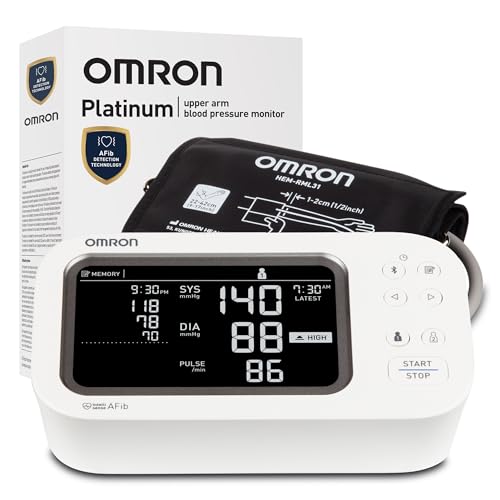
The OMRON Platinum BP Monitor brings dual-user storage and atrial fibrillation, or AFib, detection to the upper-arm format. AFib detection screens for unusual heart rhythms during a blood pressure measurement, giving you another signal to discuss with a healthcare professional when appropriate.
Each user can store up to 100 readings, making this a natural fit for couples or roommates who monitor at different times. Compared with the OMRON Complete 2-in-1 Monitor, the Platinum focuses on blood pressure and AFib screening rather than adding a separate EKG measurement mode.
The Upside
- Separate storage keeps each user’s records organized.
- Up to 100 readings per user provide a substantial on-device history.
- AFib detection adds heart-rhythm screening to routine measurements.
- Advanced Accuracy Technology supports the product’s measurement system.
Details To Watch
- The added AFib screening may be unnecessary if you only want a basic upper-arm reading.
- Make sure two-user support matches your household, since separate profiles are central to its value.
Core Details
Whose Shelf It Belongs On
This model suits you if two people need separate histories and you value AFib screening alongside blood pressure readings.
Not Your Match When
The Checkme Upper Arm Bluetooth BP Monitor is a better fit for you when rechargeable portability and app compatibility matter more than dual-user storage.
Start With the Features You Will Actually Use
Get the Cuff Right
Cuff fit affects both comfort and consistency. The easy@Home Upper Arm BP Monitor fits arms from 8.66 to 16.53 inches, while the OMRON Iron and Bronze models use 9-to-17-inch cuffs. Measure your upper arm before ordering, and plan to use the same arm and position for each reading.
Decide How Records Should Work
Local memory works well for quick reference without an app. The easy@Home stores 120 readings for two users, the Bronze holds 14 readings, and the Platinum keeps up to 100 per person. Automatic Bluetooth syncing adds convenience, while the easy@Home app requires manual entry.
Match Power to Your Routine
AAA and AA batteries are useful for fixed setups and travel without charging cables. The Checkme offers rechargeable power, with one full charge stated to last around three months. Choose the power method that you can manage consistently rather than the one that sounds more convenient in principle.
Look for Useful Flags
Irregular heartbeat, hypertension, movement, and AFib indicators provide different types of feedback. These displays are prompts for attention, not diagnoses, and each can appear differently across the models. Read the instructions for each indicator before deciding whether it adds value to your routine.
Affordable Monitors, Different Priorities
Mistakes Worth Dodging
A low purchase price does not offset a cuff that sits poorly or an app you cannot use. Check arm range, power requirements, connection method, and local memory before buying. For a shared household, confirm that separate user profiles are included rather than assuming every model stores two people’s readings independently.
What Separates Premium From Basic
Higher-tier models tend to add connected storage, larger memory, multiple users, or heart-rhythm features. Those additions help when you need longer histories or a more detailed routine, but they can complicate a simple check. Pay for a feature you will use regularly, not one that merely sounds impressive on a feature list.
Frequently Asked Questions
Which type of blood pressure monitor appears in this roundup?
Every listed monitor uses an upper-arm cuff. This format places the inflatable cuff around your upper arm and is easier to size than a wrist-based alternative for many adults.
Can an affordable monitor store readings for two people?
Yes. The easy@Home Upper Arm BP Monitor and OMRON Platinum BP Monitor both support two-user storage, with separate records for each person.
Do all of these monitors connect automatically to a phone?
No. The OMRON Bronze and Checkme use Bluetooth connectivity, while the easy@Home model requires manual entry into its app.
How do I choose the correct cuff size?
Measure your upper-arm circumference and compare it with the stated cuff range. The listed ranges are 8.66 to 16.53 inches for easy@Home and 9 to 17 inches for the OMRON Iron and Bronze.
Do irregular heartbeat or AFib indicators diagnose a condition?
No. They flag patterns or unusual readings during a measurement, so recurring concerns should be discussed with a healthcare professional.
Final Verdict
The easy@Home Upper Arm BP Monitor offers the most practical shared-household setup, while the OMRON Iron keeps daily checks simple. Choose the Bronze for automatic app syncing, Checkme for rechargeable portability, or the Complete 2-in-1 and Platinum models for broader heart-rhythm features. Start with cuff fit and your recordkeeping habits, then choose the monitor that matches your routine.
