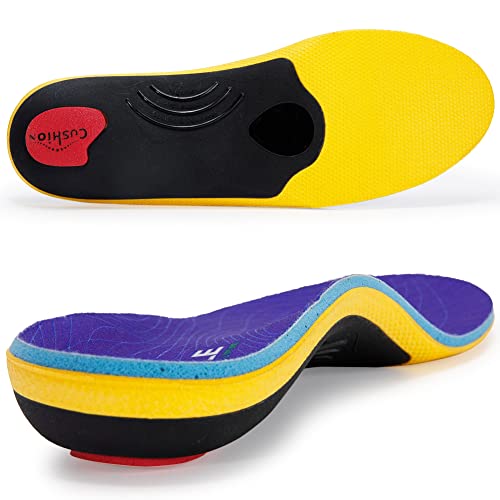
A sharp ache across the ball of your foot can make every walk feel uneven, especially after a long shift, a hard hike, or hours in dress shoes. The right insert should cushion the forefoot, support the arch, and fit comfortably inside the footwear you already wear. These eight options cover everything from cushioned walking inserts to rigid orthotic designs for demanding workdays and specific big-toe concerns.
A Closer Look At The Lineup
PickWhy We Picked ItBest ForAction
Editor’s Choice
PowerStep Pinnacle High Arch Orthotics Insoles for Supination
A rigid shape can be useful when your foot rolls outward, a pattern called supination, but the insert must also manage pressure under the forefoot. PowerStep Pinnacle High combines a firm, flexible arch with a deep heel cradle, giving the heel a secure landing area without losing the layered cushioning underfoot.
For long walks across hard floors or a workday spent moving between rooms, the deep heel cup and responsive cushioning may feel more substantial than a simple foam insert. Compared with PowerStep Pinnacle Plus Met, this model prioritizes high-arch support rather than placing its main emphasis on a metatarsal pad.
What Pays Off
✓Firm high-arch support suits feet that roll outward or need structured stability.
✓Dual-layer cushioning adds comfort from heel to toe during long periods of walking.
✓The deep heel cradle helps center the foot during each step.
✓Full-length sizing works across walking, running, work, and casual shoes with removable factory insoles.
Trade Offs
•The structured profile may feel firmer than a plush insert during casual wear.
•Shoes need removable factory insoles for the best fit and least bulk.
Key Specs
Feature
Specification
Why It Matters
Arch design
Firm, flexible high arch
Provides structured support without a completely rigid feel.
Heel section
Deep heel cradle
Encourages a centered landing and adds rearfoot stability.
Cushioning
Dual-layer construction
Spreads cushioning across the full length of the insert.
Origin
Made in the USA
Provides a clear manufacturing detail for shoppers comparing construction.
Who It Suits Best
You benefit most from this option if you have high arches, notice outward rolling, or need firm support through work and walking shoes.
Consider Something Else When
PowerStep Pinnacle Plus Met is a better fit for a shopper whose main priority is a built-in metatarsal pad and neutral arch support.
Some discomfort under the forefoot comes from pressure concentrating around the metatarsal heads, the rounded bones at the ball of the foot. ProTech Met places a dedicated metatarsal pad in that area and adds a separate heel pad, creating cushioning at both ends of each step.
Its full-length, total-contact design is the key difference from the shorter-feeling cushioning of Dr. Scholl’s Walk Longer. The structure may suit someone whose foot rolls inward, known as pronation, but you may notice the firmer platform immediately rather than gradually.
Everyday Advantages
✓The metatarsal pad targets the area most commonly associated with forefoot pressure.
✓A separate heel pad cushions the initial contact with the ground.
✓Full-length coverage supports the arch, heel, and forefoot as one connected structure.
✓Maximum cushioning is useful in shoes worn throughout a demanding workday.
Things To Consider
•The full-contact shape can require more room than a slim foam insert.
•This listed version fits men’s US 8 to 8.5, so check the size carefully.
Made For
This model makes sense for men who need a structured insert with concentrated metatarsal and heel cushioning in supportive footwear.
Another Choice May Suit
Sof Sole Airr Performance is a better fit for athletic activity, where breathable fabric and impact-focused cushioning take priority over total-contact support.
Pinnacle Plus Met brings together two familiar goals: cushioning beneath the metatarsal heads and supporting the middle of the arch. That combination makes it a practical middle ground for someone who wants more structure than soft foam but less rigidity than a carbon fiber orthotic.
Its neutral arch design is a clear difference from PowerStep Pinnacle High’s pronounced high-arch construction. Shoes with removable factory insoles give this model a better chance of sitting flat, which matters when a raised section creates rubbing or bunching.
Useful Strengths
✓Built-in metatarsal pads provide focused cushioning under the forefoot.
✓Neutral arch support suits a broader range of everyday foot shapes.
✓A contoured arch and deep heel cradle add stability without relying on a rigid plate.
✓Polyester construction keeps the listed listed material straightforward and easy to identify.
Points To Keep In Mind
•It needs enough shoe volume to accommodate the shaped heel and forefoot sections.
•The listed size covers men’s US 8 to 8.5 and women’s US 10 to 10.5.
Feature Snapshot
Feature
Specification
Why It Matters
Forefoot support
Built-in metatarsal pads
Adds cushioning exactly where forefoot pressure tends to build.
Arch profile
Neutral, firm but flexible
Balances support with a less specialized fit.
Material
Polyester
Defines the primary construction material of the insert.
Origin
Made in the USA
Offers a clear point of comparison with imported options.
Right Fit For
You benefit most from this option when you want forefoot cushioning and moderate arch support in removable-insule walking or work shoes.
Where Another Pick Shines
PowerStep ProTech Met offers a more structured, total-contact design for shoppers who prefer stronger heel and arch control.
Long walks rarely place the same demand on your feet as a full shift on concrete or a hard court. Dr. Scholl’s Walk Longer focuses on plush foam cushioning, arch support, and comfort for walking, hiking, and extended standing rather than rigid motion control.
That softer approach may be easier to adjust to than PowerStep ProTech Met, particularly for someone trying an insert for the first time. You may also find the design less distracting in casual shoes, though the trade-off is less structured support beneath the arch.
What Works In Its Favor
✓Plush foam gives the foot a softer landing than rigid orthotic designs.
✓Arch support adds structure without making the insert the dominant feature.
✓The stated use cases cover walking, hiking, and long periods of standing.
✓It works well for shoppers who want cushioning first and specialized support second.
Worth Noting
•Soft cushioning offers less control than the PowerStep models in this roundup.
•Shoes with narrow toe boxes may limit the usable space for a cushioned insert.
Best Suited To
This option suits casual walkers, hikers, and people who spend much of the day standing on relatively forgiving surfaces.
Reach For A Different Pick When
VALSOLE Heavy Duty is a better choice for heavier users who need a more substantial orthotic profile inside work boots.
Impact matters most when your footwear repeatedly meets pavement rather than carpet. Sof Sole Airr Performance places small air-filled cushioning sections beneath the heel and arch, while a gel forefoot area adds softness where running shoes commonly create pressure.
The athletic design sets it apart from Dr. Scholl’s Walk Longer, which centers on plush foam for walking and standing. For a walker who occasionally runs or cross-trains, Airr may be a better compromise, especially when moisture control matters during longer sessions.
Useful Touches
✓Air cushioning beneath the heel and arch softens repeated ground contact.
✓Gel in the forefoot adds targeted cushioning beneath the ball of the foot.
✓COOLMAX fabric helps move moisture away from the foot during activity.
✓The full-length design suits running, walking, and cross-training shoes.
Small Caveats
•The listed version fits men’s US 11 to 12.5, limiting its immediate fit range.
•Its athletic cushioning does not provide the same rigid arch control as an orthotic model.
Quick Facts
Feature
Specification
Why It Matters
Heel and arch
Air-filled cushioning
Adds compressible support at two major impact zones.
Forefoot
Gel cushioning
Provides a softer landing under the metatarsal area.
Top cover
COOLMAX fabric
Wicks moisture to help the foot feel drier.
Size
Men’s US 11-12.5
Defines the listed shoe-size range.
Who Will Love This
You benefit most from this insert when you run, cross-train, or walk in athletic shoes and want cushioning with moisture management.
Look Elsewhere When
PowerStep Pinnacle Plus Met is a better fit for everyday shoes that need a defined metatarsal pad and firmer neutral arch support.
A metatarsal pad is a raised or cushioned section placed beneath the ball of the foot. KtreaFeet builds that feature into the insert, giving the forefoot a specific support point without relying on the full rigid profile seen in PowerStep Morton’s Extension.
That focused design can appeal to someone who knows exactly where pressure builds but does not need substantial heel control. Compared with Dr. Scholl’s Walk Longer, it places more emphasis on structured forefoot support, although the exact amount of cushioning depends on the insert’s overall profile.
Real-World Strengths
✓The built-in pad concentrates support under the metatarsal heads.
✓Arch support adds a connected foundation beneath the middle of the foot.
✓The focused forefoot design suits shoes where excess heel structure would be unnecessary.
✓Multiple men’s and women’s size options broaden the available fit range.
Practical Considerations
•Choose the listed size carefully, as the range notation differs for men’s and women’s shoes.
•The insert may not provide the heel stabilization of a full orthotic.
Built With In Mind
This model suits shoppers who want a straightforward metatarsal pad and arch support for everyday footwear without a rigid carbon fiber plate.
Swap It Out When
Sof Sole Airr Performance is a better fit for athletic shoes where impact cushioning and moisture-wicking fabric matter more than a raised metatarsal support area.
Work boots leave little room for a soft insert that compresses after a few hours, and heavier users may want a more substantial support platform. VALSOLE Heavy Duty is designed around high-arch support, flat-foot support, and shock absorption for people weighing 220 pounds or more.
Its heavy-duty positioning separates it from the slimmer Dr. Scholl’s option. The tradeoff is volume, so footwear fit deserves attention, especially in closed work boots where a full orthotic can change how the foot sits inside the upper.
The Upside
✓Built for users weighing 220 pounds or more.
✓High-arch and flat-foot support address opposite arch tendencies within one design.
✓Shock-absorbing construction suits repeated walking on hard surfaces.
✓The work-boot focus matches warehouse, construction, and other physically demanding routines.
Factors To Consider
•A substantial orthotic may need a roomier boot or removable factory insole.
•Its rigid support profile is less appropriate for shoppers seeking barely-there cushioning.
Technical Highlights
Feature
Specification
Why It Matters
Weight range
Designed for 220+ lbs
Matches the insert to a higher body-weight range.
Arch support
High-arch and flat-foot support
Provides a structured foundation for differing arch profiles.
Use case
Work boots
Addresses footwear that commonly withstands heavy use.
Impact handling
Shock-absorbing design
Adds cushioning beneath repeated walking impacts.
Whose Shelf It Belongs On
You benefit most from this option if you weigh 220 pounds or more, stand throughout the day, or need substantial support inside a work boot.
Where It Is Less Suited
Dr. Scholl’s Walk Longer is a better fit for a casual walker who values soft foam and minimal structure over heavy-duty support.
Big-toe stiffness changes how you walk and which part of the forefoot carries pressure. PowerStep Morton’s Extension uses a lightweight carbon fiber plate to limit movement at the big-toe joint, an approach designed for turf toe, hallux rigidus, bunions, and related foot concerns.
Unlike the flexible arch and deep heel cradle in PowerStep Pinnacle Plus Met, this design is deliberately restrictive. For the right footwear and foot profile, that rigidity can provide control, though a standard-arch foot may find the structure less accommodating.
Bright Spots
✓The carbon fiber plate provides lightweight structural control beneath the foot.
✓Big-toe movement restriction targets a specific source of forefoot pressure.
✓The design addresses turf toe, hallux rigidus, and bunion-related concerns.
✓Firm support is intended for standard arches rather than low or high arch profiles.
Potential Drawbacks
•Big-toe control can feel overly restrictive without the right shoe fit.
•The listed size covers men’s US 8 to 8.5 and women’s US 10 to 10.5.
Core Details
Feature
Specification
Why It Matters
Structural layer
Lightweight carbon fiber plate
Adds firm control without making the full insert excessively heavy.
Motion control
Limits big-toe movement
Reduces motion at a joint associated with several forefoot concerns.
Arch profile
Firm support for standard arches
Targets a neutral arch rather than a pronounced high or low profile.
Origin
Made in the USA
Provides a defined manufacturing detail for comparison.
Perfect Match For
You benefit most from this option if you have standard arches and need firm control over big-toe movement in supportive shoes.
Not Your Match When
PowerStep Pinnacle High is a better fit for a high arch and an outward-rolling foot that needs flexible support instead of toe restriction.
Start by noticing where discomfort appears. Pain across the metatarsal heads calls for a raised metatarsal pad or concentrated forefoot cushioning, while discomfort through the arch may point toward a shaped arch support. A combination model can cover both areas, but each feature adds a little bulk.
Choose the Support Level
Soft foam inserts suit casual walking and shoes with limited room. Semi-rigid options add a contoured arch and heel cradle, while carbon fiber designs provide firmer control for specific big-toe or motion concerns. You may find the rigid approach less comfortable in a narrow or flexible shoe.
Check the Shoe Before the Insert
Removable factory insoles create the most useful space for a full-length insert. Shoes with permanent insoles, tight toe boxes, or shallow footbeds can leave an insert compressed or poorly positioned. Compare the listed size with the size printed inside your shoe rather than relying on a general size conversion.
Persistent Discomfort Deserves Professional Advice
Foot discomfort that persists, returns repeatedly, or changes how you walk deserves attention from an appropriate specialist doctor or podiatrist. An insole may provide useful support, but it cannot replace a proper assessment of the foot, gait, or footwear.
Shop Smarter, Fit Smarter
Common Shopping Slip Ups
Buying by color or by the word “orthotic” alone can leave you with the wrong support level. Check the arch profile, cushioning placement, and listed size together. Most importantly, consider the shoe: an insert that crowds the toe box will not offer the comfort you expect.
What Separates Premium From Basic
Higher-tier inserts usually add specialized materials, deeper shaping, or targeted support systems. A carbon fiber plate or a more structured heel cradle may matter for a specific foot concern, while basic foam can be plenty for casual walking. Pay more for a feature that matches your foot and routine, not simply for a longer feature list.
Frequently Asked Questions
What type of insole is best for ball of foot pain?
An insole with a metatarsal pad and cushioned forefoot is often the most practical match because it supports the area where pressure concentrates. Arch support and heel cushioning can also improve comfort across the entire foot.
How do I know which insole size to choose?
Use the size printed inside your shoe and compare it with the insert’s listed men’s or women’s size range. The listed size matters, and you also need enough room inside the shoe for the insert’s arch and heel shaping.
Can I use ball of foot insoles in work shoes?
Yes, provided the shoe has enough room and a removable factory insole. Heavier-duty designs such as VALSOLE Heavy Duty are intended for work boots, while structured models like PowerStep ProTech Met may suit supportive work footwear.
Should ball of foot insoles feel hard or soft?
A supportive insert may feel firm under the arch while remaining cushioned under the forefoot and heel. Pressure that feels uncomfortable rather than supportive, or persists after several days of use, is a reason to reconsider the fit and seek professional guidance.
How long do ball of foot insoles take to feel comfortable?
Adjustment depends on your footwear, activity level, and the insert’s structure. A softer foam may feel familiar quickly, while a rigid orthotic often needs a gradual introduction, starting with shorter periods of wear.
Closing Remarks
The right insert depends less on a general label than on where your foot feels pressure, how much room your shoes provide, and the amount of control you want. Match the arch profile and cushioning to your routine, then give any new insert a fair chance to settle in. Persistent pain or altered walking deserves professional attention rather than repeated insert swapping.
Staff
Our team brings together health and food enthusiasts who are passionate about discovering reliable health information, nutritious choices, and enjoyable food experiences. From everyday nutrition and healthy eating ideas to recipes, ingredients, food trends, and standout dishes, we share carefully researched and thoughtfully curated content to help readers make informed choices about what they eat and enjoy.