

A 3 a.m. glance at the nursery display can make subtle breathing movement difficult to judge, especially with a dark room and a low camera angle. The right monitor depends on what you need: crib-movement detection, contactless wellness data, clearer night vision, or two-room video coverage. These options serve different situations, so the most useful choice is the one that matches your setup and the kind of reassurance you want.
The Picks In Brief

Babysense True Sleep HD No-WiFi Baby Monitor and Movement Sensors

bebon Reflective Baby Strap

iBaby i20 Contactless Wellness Monitor

GoodBaby 5″ No-WiFi Monitor

GoodBaby No-WiFi Monitor System
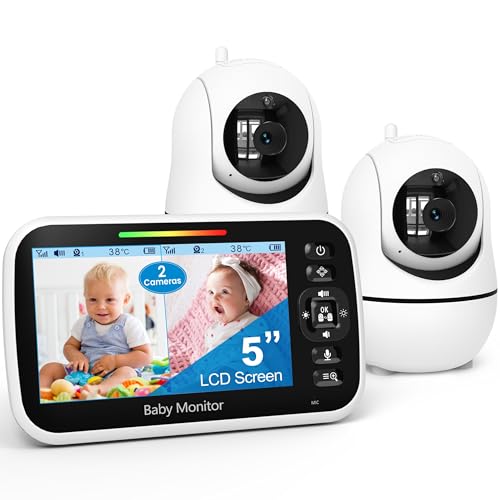
GoodBaby Split-Screen Monitor

Monai Pro 4K Smart WiFi Monitor
More On The Choices That Made The List
A dark nursery and a restless newborn can make video checks less reassuring than you would like. The Babysense True Sleep HD combines a 5-inch display with two under-mattress sensor pads, giving you both a live view and a separate movement-reading layer without placing anything on your baby.
The sensors pick up small movements through the mattress, while the camera offers pan-tilt-zoom control, infrared night vision, and an adjustable night light. For a single crib and a straightforward nightstand setup, this is the most complete match on the list.
A Favorable Mix
- Two sensor pads extend movement detection across the crib area.
- The non-contact design leaves your baby’s body free of straps, bands, or socks.
- Two-way audio, white noise, and lullabies let you respond without entering the nursery.
- No-WiFi operation avoids dependence on a home network during nighttime checks.
Trade Offs
- The pads must sit beneath the mattress, so crib size and sensor placement affect coverage.
- Movement detection gives you an additional signal, but it is not a diagnosis of breathing problems.
Key Specs
Made For
You benefit most from this setup when your baby sleeps in a standard crib and you want both video and under-mattress movement information.
Where A Sibling Pick Shines
The iBaby i20 Contactless Wellness Monitor suits you better when phone-based breathing and heart-rate trends matter more than a dedicated crib sensor system.
Sometimes the difficulty is simply seeing a small chest rise against a dark, noisy video image. The bebon Reflective Baby Strap adds a reflective area around your baby’s upper body, making subtle movement easier for a standard night-vision camera to pick up.
Unlike the Babysense True Sleep HD, this is a visibility accessory rather than a complete monitoring system. It fits neatly into a setup you already own, with no pairing process, separate display, charging routine, or dedicated app.
Positive Points
- Works with standard baby monitors operating in night-vision mode.
- Passive reflective material needs no batteries or electronics.
- The lightweight cotton construction feels gentle against delicate skin.
- Machine washing keeps the routine manageable for daily wear.
Small Caveats
- The adjustable upper-body strap needs enough tension and correct positioning to remain visible.
- It improves contrast but does not record breathing data or issue alerts on its own.
Feature Snapshot
Right Fit For
This accessory works well for you when you already own a night-vision monitor and want a low-complexity way to improve upper-body visibility.
Consider Something Else When
The Babysense True Sleep HD No-WiFi Baby Monitor and Movement Sensors make more sense when you want a complete system with separate movement sensing.
Your phone becomes the central display when your priority is organized sleep and wellness information rather than a simple nursery camera. The iBaby i20 uses contactless sensing to track breathing frequency, heart rate, eye movement, and nighttime awakenings without a wearable band or sock.
Its 1080p camera adds 360-degree horizontal movement, 33-degree vertical tilt, night vision, two-way audio, and built-in lullabies. Compared with the bebon Reflective Baby Strap, which only improves visual contrast, the iBaby i20 builds an app-based record around the camera feed.
Strengths Worth Knowing
- Contactless monitoring removes the need to fit a wearable as your baby grows.
- Sleep reports combine eye movement and awakening information with breathing frequency.
- Customizable alerts cover crying, temperature, humidity, heart rate, and breathing deviations.
- Face tracking follows a crawling or rolling baby as the camera repositions.
- Built-in storage supports seven days of local video playback without a subscription fee.
Points To Keep In Mind
- Setting useful alert ranges takes time to understand through the app.
- Sleep reports and trend data take more interpretation than a plain camera view.
Core Details
Who Will Love This
You will find this most useful when you want detailed sleep trends, breathing frequency, and configurable phone alerts in one contactless setup.
Another Choice May Suit
The bebon Reflective Baby Strap better fits you when simplicity matters more than reports, alerts, and camera automation.
A separate parent unit can make night checks feel less dependent on phones, shared screens, or an internet connection. The GoodBaby 5″ No-WiFi Monitor gives you a dedicated display and a camera with 355-degree pan, 120-degree tilt, 2x zoom, and a stated range of 1,000 feet.
Its 3,500mAh battery is listed for up to 30 hours in VOX mode, where the camera activates with sound, or up to 10 hours of continuous video. That makes it a straightforward option for one nursery, though it gives you visibility rather than dedicated breathing measurements.
What Stands Out
- The 5-inch display provides a dedicated screen for frequent checks.
- Wide pan and tilt help you check the entire crib and nearby floor area.
- No-WiFi operation keeps the system independent of your home network.
- Sound-activated VOX mode can reduce unnecessary screen viewing.
Worth Noting
- You will need a separate motion-tracking accessory or a product like the iBaby i20 for breathing-related data.
- The 1,000-foot range is only useful when your home has a clear path between camera and display.
Best Suited To
This monitor suits you when you want a conventional no-WiFi video system for one nursery and prefer a standalone display.
Reach For A Different Pick When
The GoodBaby Split-Screen Monitor serves you better when you need to watch two sleeping spaces from one parent unit.
Camera position matters when your baby moves around a crib, and the GoodBaby No-WiFi Monitor System offers broad adjustment without relying on an app. Its camera rotates 355 degrees, tilts 120 degrees, and offers 2x zoom across a stated 1,000-foot range.
The 5-inch LCD keeps the view manageable on a nightstand, while two-way audio handles quick check-ins. Compared with the iBaby i20 Contactless Wellness Monitor, this system stays focused on visual monitoring, which may suit you better when fewer data points make the routine easier to understand.
Everyday Advantages
- Extensive camera movement reduces the need to reposition the unit manually.
- The 5-inch screen offers a dedicated view without occupying a phone.
- Two-way audio lets you speak to your baby from across the room.
- No-WiFi operation keeps the monitor independent of network changes.
Trade-Offs To Consider
- Continuous video is listed at up to 10 hours, while VOX mode extends the stated battery duration.
- The monitor does not provide a dedicated breathing-frequency reading.
Quick Facts
The Right Fit
This system fits you best for single-room nursery monitoring with frequent camera repositioning and no need for app-based wellness reports.
Look Elsewhere When
The iBaby i20 Contactless Wellness Monitor better fits data-focused households that want breathing frequency, heart-rate alerts, and sleep analysis.
Two sleeping spaces change the viewing problem because a full-screen single camera leaves one room unattended. The GoodBaby Split-Screen Monitor places two camera feeds on one 5-inch HD display, with an audio focus option and a scan mode that changes the listening feed every 15 seconds.
You can also expand the system to as many as four cameras on the parent unit. Unlike the Babysense True Sleep HD No-WiFi Baby Monitor and Movement Sensors, this model focuses on visual coverage, making it more appropriate for watching two cribs or a crib and play area.
Notable Upsides
- Two feeds appear together, reducing the need to switch views manually.
- Audio focus lets you direct listening to one camera.
- The system can expand from two to four connected cameras.
- One parent unit keeps the display arrangement compact.
Practical Considerations
- Split-screen images are smaller than a full-screen view from the same 5-inch display.
- Scan mode moves audio between cameras every 15 seconds rather than keeping one feed continuously active.
Built With In Mind
This setup works for you when two children, two cribs, or a nursery and adjoining play space need visual coverage from one screen.
Skip It When
The Babysense True Sleep HD No-WiFi Baby Monitor and Movement Sensors suit you better when a dedicated under-mattress movement layer matters more than multiple camera views.
Fine image detail can make a nursery easier to inspect from another room, especially when you want to zoom in without cropping the app view. The Monai Pro 4K Smart WiFi Monitor combines an 8-megapixel camera, 6x zoom, a flexible crib mount, and app-based control in one setup.
Dual-band WiFi on 2.4GHz and 5GHz networks supports a modern connected setup, while 950nm infrared night vision is designed to limit the visible red glow associated with some infrared illumination. Compared with the iBaby i20, you gain higher-resolution video, but not its contactless breathing-frequency data.
A Strong Showing
- The 4K camera provides finer visual detail than a standard definition feed.
- Six-times zoom helps you inspect the crib from a fixed mount.
- Dual-band WiFi offers more connection options than a single-band system.
- The included mounting kit helps place the camera above or beside the crib.
Details To Watch
- Phone access depends on a functioning home network and the companion app.
- Camera resolution alone does not add breathing-frequency measurement or health alerts.
Technical Highlights
Who Should Grab It
This monitor suits you when detailed video, app-based control, flexible mounting, and modern WiFi connectivity drive your decision.
A Better Fit Elsewhere
The iBaby i20 Contactless Wellness Monitor makes more sense for you when breathing frequency, heart-rate alerts, and sleep reports are your main priorities.
What Matters Before You Bring a Monitor Home
Start With The Monitoring Method
The options here measure different things. The Babysense True Sleep HD uses under-mattress sensors, the iBaby i20 gathers contactless wellness data, and the remaining systems primarily improve video visibility. Choose the method that matches the information you actually want to see rather than expecting a camera to perform like a dedicated sensor.
Check Nighttime Readability
Night vision, camera angle, and infrared illumination determine how much detail you can see after dark. The bebon Reflective Baby Strap can improve upper-body contrast on a compatible night-vision camera, while the Monai Pro uses 950nm infrared to limit visible red glow. Check your monitor’s compatibility and view the nursery from the position where you plan to place the display.
Match Setup To Your Space
Measure the crib before choosing sensor pads, and note the distance to the parent unit. A no-WiFi model removes network dependence, a WiFi monitor adds phone-based access, and a split-screen system needs enough outlet and viewing space for two feeds. Positioning matters more than a long specification list.
Before You Decide
Mistakes Worth Dodging
Don’t treat every camera as a breathing-rate monitor or assume under-mattress sensors provide the same information as contactless wellness tracking. Check what the device measures, what it only displays, and whether its placement matches your baby’s sleep space.
What Separates Premium From Basic
Higher-resolution video, automated tracking, broader sensor data, and more connection options require additional hardware and processing. Those additions suit you when you will actively use the extra detail; a simple no-WiFi camera system may be more appropriate for one basic nursery view.
Frequently Asked Questions
Which breathing monitor for newborns is easiest to set up?
The Babysense True Sleep HD No-WiFi Baby Monitor and Movement Sensors offers the most direct setup for a standard crib. It combines a dedicated parent unit with two under-mattress pads and requires no home-network connection.
Can a baby monitor measure newborn breathing?
Only certain options track breathing-related data. The iBaby i20 reports breathing frequency, while the Babysense True Sleep HD detects crib movement and most of the other products improve visual monitoring without providing that reading.
Do I need a wearable monitor for a newborn?
You do not need one with the iBaby i20 because its contactless approach avoids bands, socks, and skin contact. The Babysense True Sleep HD also keeps sensing pads beneath the mattress rather than on your baby.
Which option works with an existing baby camera?
The bebon Reflective Baby Strap is designed for standard monitors using night-vision mode. It has no electronics or pairing process and improves upper-body contrast through its reflective panel.
Which monitor suits two sleeping spaces?
The GoodBaby Split-Screen Monitor shows two camera feeds on one 5-inch display. Its scan mode changes the audio feed every 15 seconds, and the system can expand to as many as four cameras.
The Takeaway
The most useful monitor depends on your actual question. Choose under-mattress sensing for a dedicated crib-movement layer, contactless wellness tracking for breathing frequency and alerts, or a camera system for clearer video across one or two rooms. Match the device to your space, check the method of detection, and keep the system close enough to use consistently.
