

Funny enough, you could pick a jar of coconut shortening at the store and realize it’s the one thing in the pantry that actually makes baking feel manageable, so let’s talk about the five best options that’ll keep your cookies and crusts reliable. You’ll want a balance of pure coconut aroma for flavor, refined tubs for neutral heat, and sizes that fit your baking habits, and I’ll guide you through which to choose next.
| Viva Naturals Organic Extra Virgin Coconut Oil (16 fl oz) |

| Versatile All-Rounder | Product Type: Organic extra virgin coconut oil | Certifications: USDA Organic, Non-GMO Project Verified, Gluten Free | Cosmetic / Personal-care Use: Suitable for skin, hair, makeup removal, massage oil | VIEW LATEST PRICE | Read Our Analysis |
| BetterBody Foods Organic Unrefined Coconut Oil (28 fl oz) |

| Energy-Boosting Pick | Product Type: Organic unrefined (virgin) coconut oil | Certifications: USDA Organic, Non-GMO, Gluten Free, Kosher | Cosmetic / Personal-care Use: Usable as skin and hair moisturizer, makeup remover, shave oil | VIEW LATEST PRICE | Read Our Analysis |
| BetterBody Foods Organic Refined Coconut Oil (56 fl oz) |
| High-Heat Performer | Product Type: Organic refined coconut oil | Certifications: USDA Organic, Non-GMO, Gluten Free, Kosher | Cosmetic / Personal-care Use: Usable on skin and hair for wellness and beauty applications | VIEW LATEST PRICE | Read Our Analysis |
| BetterBody Foods Organic Refined Coconut Oil (28 fl oz) |

| Neutral Flavor Choice | Product Type: Organic refined coconut oil | Certifications: USDA Organic, Non-GMO, Gluten Free, Kosher | Cosmetic / Personal-care Use: Usable on skin and hair for cosmetic applications | VIEW LATEST PRICE | Read Our Analysis |
| BetterBody Foods Organic Refined Coconut Oil (15.5 oz) |

| Compact & Convenient | Product Type: Organic refined coconut oil | Certifications: USDA Organic, Non-GMO, Gluten Free, Kosher | Cosmetic / Personal-care Use: Usable on skin and hair as moisturizer and cosmetic oil | VIEW LATEST PRICE | Read Our Analysis |
More Details on Our Top Picks
Viva Naturals Organic Extra Virgin Coconut Oil (16 fl oz)
Whenever you want a single jar that works in your kitchen and your beauty shelf, Viva Naturals Organic Extra Virgin Coconut Oil fits the bill. You’ll get unrefined, cold-pressed oil that keeps a warm coconut aroma and rich flavor for baking, frying, and sautéing at about a 350°F smoke point. It’s USDA organic, Non-GMO Verified, and gluten free, so you can feel safe using it on Keto or Paleo plans. Use it as a hair mask to hydrate strands or as a gentle facial moisturizer and makeup remover. The jar simplifies routines and saves space while staying all natural.
- Product Type:Organic extra virgin coconut oil
- Certifications:USDA Organic, Non-GMO Project Verified, Gluten Free
- Cosmetic / Personal-care Use:Suitable for skin, hair, makeup removal, massage oil
- MCT Content / Fat Type:Naturally rich in coconut fats (MCTs implied)
- Culinary Uses / Heat Suitability:Baking, frying, sautéing; smoke point ~350°F (medium-heat)
- Dietary Suitability:Keto- and Paleo-friendly; cholesterol-free
- Additional Feature:Unrefined cold-pressed flavor
- Additional Feature:Strong coconut aroma
- Additional Feature:Compact 16 fl oz
BetterBody Foods Organic Unrefined Coconut Oil (28 fl oz)
In case you want a natural baking fat that often works well as a straight swap for butter or shortening, BetterBody Foods Organic Unrefined Coconut Oil is a friendly pick you’ll appreciate. You’ll find it cold pressed from fresh coconut meat, with a light coconut aroma that blends nicely into cookies, brownies, and popcorn. It’s USDA Organic, Non GMO, Gluten Free, and Kosher, so you can feel good using it. Because it’s about 60% MCTs, it gives quick energy and melts smoothly for creaming or stirring. Use it up to 350°F for medium heat cooking and topical moisturizing too.
- Product Type:Organic unrefined (virgin) coconut oil
- Certifications:USDA Organic, Non-GMO, Gluten Free, Kosher
- Cosmetic / Personal-care Use:Usable as skin and hair moisturizer, makeup remover, shave oil
- MCT Content / Fat Type:~60% Medium Chain Triglycerides (MCTs)
- Culinary Uses / Heat Suitability:Medium-heat cooking up to 350°F; baking, frying, desserts
- Dietary Suitability:Keto/Paleo implied; cholesterol-free
- Additional Feature:Light coconut aroma
- Additional Feature:~60% MCTs content
- Additional Feature:Large 28 fl oz jar
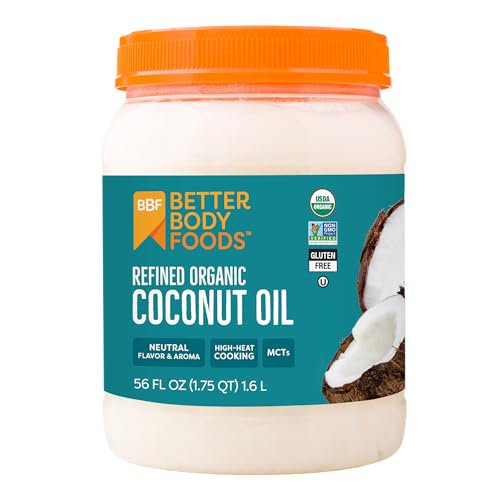
BetterBody Foods Organic Refined Coconut Oil (56 fl oz)
Should you want a single, versatile oil that swaps into many baking recipes without changing taste, BetterBody Foods Organic Refined Coconut Oil is a great pick for home bakers and small-batch pros alike. You’ll like that it comes in a large 56 fl oz tub, so you don’t run out mid-batch. It’s refined and neutral, so it won’t alter flavors, and it handles frying, sautéing, and baking up to a 425 °F smoke point. It’s USDA Organic, Non-GMO, gluten-free, and kosher. With about 60% MCTs, it can give a little energy lift. You can also use it on skin and hair.
- Product Type:Organic refined coconut oil
- Certifications:USDA Organic, Non-GMO, Gluten Free, Kosher
- Cosmetic / Personal-care Use:Usable on skin and hair for wellness and beauty applications
- MCT Content / Fat Type:~60% Medium Chain Triglycerides (MCTs)
- Culinary Uses / Heat Suitability:Frying, sautéing, baking; suitable for medium-high heat; smoke point 425°F
- Dietary Suitability:Suitable for Keto/Paleo implied; cholesterol-free
- Additional Feature:Neutral taste/odor
- Additional Feature:High smoke point 425°F
- Additional Feature:Extra-large 56 fl oz
BetterBody Foods Organic Refined Coconut Oil (28 fl oz)
Should you want a neutral, reliable baking fat that behaves like butter but won’t add a coconut taste, BetterBody Foods Organic Refined Coconut Oil is a smart pick for home bakers and small-scale cooks. You’ll like its neutral profile because it won’t mask delicate flavors. It contains about 60% MCTs, so it might give you a gentle energy lift whenever you use it. With a 425°F smoke point, you can fry, sauté, or bake confidently. It’s USDA Organic, Non-GMO, gluten-free, and kosher, and it can replace butter, oil, margarine, or shortening. You can also try it on skin or hair, but cosmetic safety isn’t determined.
- Product Type:Organic refined coconut oil
- Certifications:USDA Organic, Non-GMO, Gluten Free, Kosher
- Cosmetic / Personal-care Use:Usable on skin and hair for cosmetic applications
- MCT Content / Fat Type:~60% Medium Chain Triglycerides (MCTs)
- Culinary Uses / Heat Suitability:Frying, sautéing, baking; suitable for medium-high heat; smoke point 425°F
- Dietary Suitability:Suitable for Keto/Paleo implied; cholesterol-free
- Additional Feature:Neutral flavor profile
- Additional Feature:425°F smoke point
- Additional Feature:Mid-size 28 fl oz
BetterBody Foods Organic Refined Coconut Oil (15.5 oz)
Pick BetterBody Foods Organic Refined Coconut Oil provided you want a neutral, high-heat baking fat that behaves like shortening but keeps flavors gentle and clean. You’ll get 15.5 fl oz of organic, non GMO oil with about 60% MCTs and no cholesterol. It’s refined so you won’t smell coconut, and it stands up to 425 °F for frying, sautéing, and baking. You can swap it for butter, margarine, or shortening in many recipes. It’s USDA Organic, Gluten Free, and Kosher. You can also use it on skin or hair, though cosmetic safety isn’t fully determined.
- Product Type:Organic refined coconut oil
- Certifications:USDA Organic, Non-GMO, Gluten Free, Kosher
- Cosmetic / Personal-care Use:Usable on skin and hair as moisturizer and cosmetic oil
- MCT Content / Fat Type:~60% Medium Chain Triglycerides (MCTs)
- Culinary Uses / Heat Suitability:Frying, sautéing, baking; suitable for medium-high heat; smoke point 425°F
- Dietary Suitability:Suitable for Keto/Paleo implied; cholesterol-free
- Additional Feature:Small 15.5 fl oz jar
- Additional Feature:Neutral smell/taste
- Additional Feature:~60% MCTs content
Factors to Consider When Choosing Coconut Shortenings
When you pick a coconut shortening for baking, consider about how smoke point and whether it’s refined or unrefined will affect your recipe and kitchen safety. Also regard MCT content for energy, how the oil’s flavor and aroma will change your finished bake, and whether the product is handled and labeled for both culinary and cosmetic safety. These factors are linked, so as you weigh one point you’ll see how it changes the others and help you choose the best option for your needs.
Smoke Point Considerations
Because oils start to decompose at different temperatures, grasping the smoke point of a coconut shortening helps you avoid ruined flavor and health worries in the kitchen. You’ll notice smoke whenever the fat breaks down and starts to taste bitter or chemical. Choose refined coconut shortening for high heat cooking because it usually handles 400 to 450°F. In case you plan to sauté, sear, or deep-fry, pick a shortening with a smoke point 25 to 50°F above your target temperature so you don’t edge into breakdown. Avoid reusing shortening that darkens, smokes, or smells off because repeated heating speeds oxidation and off flavors. For most baking, smoke point matters less, so balance heat resistance with the flavor you want.
Refined Vs. Unrefined
You’ve just learned how smoke point shapes what a shortening can handle in the pan, and that idea helps you pick between refined and unrefined coconut shortenings. When you need a neutral base for high-heat baking or frying, refined coconut shortening works well because processors remove aroma and raise the smoke point to about 425°F. That gives you stability and a blank canvas for delicate recipes. If you want coconut scent and a more natural product, choose unrefined, cold-pressed shortening. It keeps the coconut flavor, some micronutrients, and a softer identity for low-heat baking or raw applications. Consider taste, heat, and processing. You’ll balance flavor against performance, and pick the type that eases your baking goals.
MCT Content And Energy
Should you want a shortening that boosts quick energy and supports low-carb cooking, look closely at MCT content and chain length. You’ll find many coconut shortenings contain about 50 to 70 percent MCTs, which absorb fast and give quick fuel. Check labels for caprylic C8 and capric C10 acids because those convert to usable energy more readily than longer chains. Shorter MCTs travel straight to the liver through the portal vein, so they’re less likely to be stored as fat and more likely to become immediate energy or ketones. Keep in mind that higher MCT levels raise caloric density, so you’ll get more calories per gram while also getting faster energy. Read percentages and chain profiles to pick a shortening that fits your baking and energy goals.
Flavor And Aroma Impact
At the point you pick a coconut shortening, think about how its flavor and aroma will change your baking, because these traits often decide whether a recipe sings or falls flat. You’ll notice refined options taste neutral and show little coconut scent, so they keep cookies, pies, and savory dishes true to the original. In contrast, unrefined or virgin shortenings carry a clear tropical note and mild sweetness that will come through in delicate pastries and frostings. Processing level directly links to how strong that coconut character is, since refining strips aroma compounds. Also keep in mind that melting behavior matters, because heat releases volatile flavors and can amplify coconut in the oven. Choose based on whether you want a quiet supporting fat or a bright coconut presence.
Cosmetic And Culinary Safety
As you select a coconut shortening, consider both kitchen safety and skin safety because the same jar can end up in a pie or on your hands. Choose refined versions for high-heat baking since they smoke around 400–425°F and behave predictably. In case you prefer unrefined types, know they smoke nearer 350°F and add coconut aroma. Also contemplate topical use. Unrefined shortenings keep skin conditioning fatty acids and lauric acid, which can soothe and fight microbes, but they might clog pores or irritate sensitive skin. Always check labels for food grade or cosmetic grade and look for third-party seals like USDA Organic or Non GMO. Patch test before regular skin use. Bear in mind processing changes allergens and impurities, so pick one suited to how you’ll use it.
