

A fallout-related survey starts with a practical question: what kind of radiation do you expect to find, and how much detail do you need from the instrument? Home preparedness shoppers may want simple alerts and dose tracking, while field technicians often need multi-unit readings, data logging, or remote sharing. The instruments below cover different priorities, from compact Gamma, Beta, and X-ray detection to dedicated long-term radon monitoring.
How The Shortlist Stacks Up
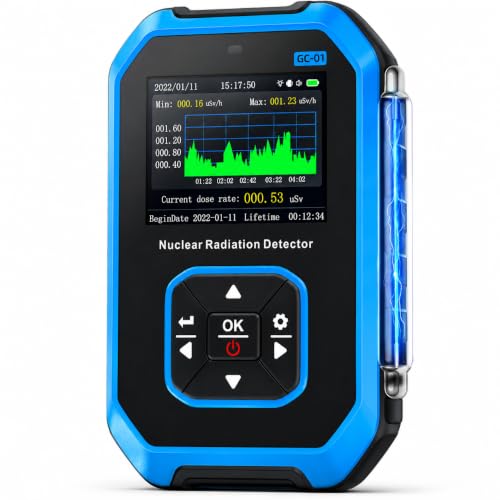
FNIRSI GC-01 Curve Display

AEGTEST Radar-9989 LND7311 Alpha Beta Gamma X-ray Detector, Blue

GQ GMC-320+V4 Digital Data Logger

GQ GMC-800 Color LCD Geiger Counter with 5 Alarms and Data Save

GQ GMC-300S Digital Radiation Monitor

AKSTEST RM-60 Long-Term Radon Monitor with TFT Display, Alarms, Type-C
The Picks, Examined More Closely
The FNIRSI GC-01 suits a quick check of a home, vehicle, work area, or collection of uranium-containing glass. Its built-in GM sensor, meaning a Geiger-Müller tube that counts radiation-induced electrical pulses, covers Gamma, Beta, and X-rays. For most preparedness shoppers, that combination provides useful coverage without requiring separate probes.
The curve display turns changing readings into a visual trend, while one-handed operation keeps it practical during a room-by-room survey. Unlike the GQ GMC-320+V4, this model concentrates on immediate readings and configurable alerts rather than extensive recorded data.
Where It Delivers
- Light, vibration, and sound alarms let you choose a notification style that suits a quiet home or an active field session.
- Separate alarm thresholds cover the current dose rate and accumulated dose, giving you more control than a single-limit alert.
- The 0.00 µSv to 500.0 mSv cumulative range supports both routine readings and longer exposure tracking.
- English and Chinese menu options make setup straightforward for different households.
Points To Note
- Its Gamma, Beta, and X-ray coverage does not include Alpha detection, so it cannot replace an Alpha-sensitive surface contamination meter.
- For long sessions, you may find the lack of a documented PC data export less useful than the logging features on the GQ GMC-300S.
Quick Facts
Made For
This model fits homeowners and field-oriented hobbyists who need portable radiation alerts and a simple dose trend.
Another Choice May Suit
Technicians needing Alpha sensitivity, multiple measurement units, and a trend graph may prefer the AEGTEST Radar-9989.
The AEGTEST Radar-9989 brings the broadest radiation coverage in this group, including Alpha, Beta, Gamma, and X-ray measurements. Its LND7311 mica end-window sensor is designed to support detailed work, including surface-contamination checks. That makes it more relevant to laboratories, industrial teams, and trained collectors than a basic home survey meter.
The 3.5-inch color LCD provides room for six measurement units, including CPS, CPM, µSv/h, µR/h, µSv, and Bq/cm². A 270-second waveform graph adds context to a live reading, so you can distinguish a brief change from a sustained pattern.
Everyday Advantages
- The sliding energy-compensation cap supports more consistent measurements across the sensor’s response range.
- Six selectable units let you compare count rates, dose rates, accumulated dose, and surface activity.
- Customizable visual and audible alarms remain active while the screen sleeps, reducing the chance of missing a threshold crossing.
- The telescopic rod improves positioning during floor, tabletop, and elevated-area surveys.
- A storage box and lanyard make the larger instrument easier to organize and carry.
Worth Noting
- The broad menu and measurement options may feel excessive for a quick household check.
- Alpha-sensitive measurements still require suitable placement and careful technique, so a surface reading depends on correct use.
Feature Snapshot
Right Fit For
This instrument best serves laboratory staff, industrial technicians, and serious collectors who need broad radiation-type coverage.
Look Elsewhere When
A straightforward preparedness shopper who only needs Gamma, Beta, and X-ray alerts will find the FNIRSI GC-01 easier to manage.
Recorded measurements make the GQ GMC-320+V4 useful when a single spot reading is not enough. Its expanded internal flash memory provides room for processing survey data, while the temperature sensor, electronic gyroscope, analog data output, and front LED indicator round out a field-oriented instrument.
Compared with the FNIRSI GC-01, this model offers a deeper record of changing conditions rather than simply displaying a live curve. For most technical users, that documentation matters more than the GC-01’s selectable alert styles.
What Earns Its Place
- Internal flash memory supports stored radiation data and later processing.
- The analog data port allows readings to feed compatible recording equipment.
- Temperature and gyroscope sensors add context beyond the radiation measurement itself.
- Adjustable LCD contrast improves readability across changing ambient light.
Small Caveats
- Its sensor and data features are less approachable than the FNIRSI GC-01 for straightforward household checks.
- The listed package weight of 8 pounds and compact package dimensions can make storage and transport less convenient than its feature list suggests.
Technical Highlights
Built With In Mind
This model suits technical users who need saved survey records and extra sensor data during repeated measurements.
A Better Fit Elsewhere
Home preparedness shoppers wanting fewer controls and more immediate alarm choices may prefer the FNIRSI GC-01.
A large color display is the GMC-800’s clearest advantage during outdoor fallout-related surveys. Its screen is designed to remain readable in direct sunlight, while shortcut controls move you among four function screens without digging through a complicated menu. For group demonstrations or site checks, that visibility reduces awkwardness.
The meter detects Beta, Gamma, and X-ray radiation, with five alarm types, saved data, and global sharing features added to the portable design. Unlike the AEGTEST Radar-9989, it does not advertise Alpha sensitivity, so the AEGTEST remains the stronger choice for surface-contamination work.
Features That Help
- The large color LCD makes live values easier to interpret outdoors.
- Five alarm types provide more ways to notify you during different monitoring situations.
- Data saving creates a record for later comparison.
- Global sharing supports collaborative monitoring across locations.
Practical Considerations
- Confirm that global sharing and its setup process suit your intended network and privacy requirements.
- The four-screen layout is convenient for quick surveys, but detailed data analysis may still require careful menu navigation.
Best Suited To
This model fits preparedness groups, educators, and field users who value a large readable screen and saved measurements.
Reach For A Different Pick When
Surface-contamination specialists who require Alpha detection should select the AEGTEST Radar-9989 instead.
The GQ GMC-300S sits in a useful middle ground between a live meter and a full data-logging system. It records a reading every second in internal memory, allowing you to review how a location changes rather than relying on one number. Downloadable history and the included PC viewer make the stored information easier to examine.
Its rechargeable battery suits repeated checks around a home, workshop, or collection. Compared with the GQ GMC-500Plus, however, the GMC-300S keeps the focus on local records rather than connected map sharing.
Good Reasons To Consider
- One-second internal logging captures short fluctuations during a survey.
- Downloadable history supports later review and comparison between locations.
- Dosimeter, CPM count, and graph modes cover both dose-focused and count-based workflows.
- Rechargeable power is convenient for repeated monitoring sessions.
Some Limits To Know
- PC software is required to move recorded history to a computer for closer analysis.
- Local logging offers no built-in connection to a shared world map, unlike the GQ GMC-500Plus.
Core Details
Who Will Love This
This model suits home collectors and preparedness shoppers who want downloadable history without a connected mapping service.
Swap It Out When
Users who regularly share readings with a remote group will find more value in the GQ GMC-500Plus.

The GQ GMC-500Plus is built around shared monitoring rather than isolated use. It stores data internally and can submit readings to a world-map service, allowing people in different locations to follow the same radiation picture. The software sends information every minute, which provides regular updates without constant manual intervention.
For a preparedness network or family monitoring several properties, that connected view adds context that the GQ GMC-300S cannot provide locally. You will need a suitable internet connection and an interest in maintaining the service, so the feature is most useful to coordinated users.
What It Does Well
- Automatic map sharing supports coordination across distant locations.
- Internal storage preserves data even between submissions.
- One-minute software updates create a regular monitoring rhythm.
Trade Offs
- Remote access depends on connectivity and compatible software services.
- Connected features add complexity that a simple household meter may not need.
Whose Shelf It Belongs On
This model fits preparedness groups, clubs, and families that want a shared map of readings from multiple locations.
Consider Something Else When
A single-location user who only needs downloadable records may prefer the simpler GQ GMC-300S.
Radon is a radioactive gas that can accumulate indoors, especially in lower levels, so the AKSTEST RM-60 addresses a different exposure from Gamma, Beta, and X-ray fallout particles. Its semiconductor sensor and vented housing support continuous radon concentration monitoring, which makes the device relevant to long-term basement and home checks.
The TFT screen displays results in either pCi/L or Bq/m³, while audible and flashing visual alarms react to a preset limit. USB Type-C recharging simplifies routine charging, and the stated measurement range spans 0.09 to 1,000 pCi/L.
Everyday Wins
- Dual-unit display helps you compare radon readings in the units used by different references.
- The broad stated range accommodates residential monitoring and more concentrated readings.
- Visual and audible alerts provide two ways to notice a threshold crossing.
- Type-C charging makes it easier to keep the monitor ready between sessions.
Where It May Fall Short
- This is a radon monitor, not a Geiger counter, so it cannot replace one of the Gamma, Beta, and X-ray instruments in this shortlist.
- Long-term monitoring depends on placing the unit in a representative, well-ventilated area and maintaining power.
Feature Facts
Made For
This monitor suits homeowners, landlords, and basement occupants who want a dedicated long-term radon reading.
Skip It When
You need a direct Gamma, Beta, or X-ray detector rather than a gas-specific radon instrument.
What Matters Before You Buy a Radiation Meter
Start with the radiation type. Gamma, Beta, and X-ray readings cover many common survey tasks, while Alpha detection matters for surface contamination. The AEGTEST Radar-9989 covers all four, whereas most models in this shortlist focus on Gamma, Beta, and X-ray radiation.
Next, decide how you will use the records. Live curves and alarms suit quick room checks, internal logging supports later analysis, and world-map sharing helps groups compare readings across locations. You gain more from advanced records when your monitoring is repeated or coordinated.
Display and control design also affect field use. A large color screen helps in bright conditions, while a one-handed layout and selectable alert styles matter during a quick scan. The FNIRSI GC-01 takes a compact approach, while the AEGTEST Radar-9989 dedicates more screen space to units and graphs.
Finally, check the intended environment and power needs. Rechargeable models suit recurring sessions, and Type-C charging reduces cable friction. For radon, use a dedicated radon monitor such as the AKSTEST RM-60 rather than expecting a general radiation meter to cover that gas.
Common Missteps and Premium Differences
Mistakes Worth Dodging
Do not treat every radiation alarm as the same measurement, because different sensors and units describe different phenomena. Confirm Alpha coverage, compare readings in one unit, and check the placement guidance for the instrument you select. A dedicated radon monitor also serves a different purpose from a Gamma, Beta, and X-ray detector.
What Separates Premium From Basic
The added cost often buys a wider sensor range, larger display, better logging, or remote sharing. Those features matter most for repeated surveys and coordinated monitoring. A simple alert meter can be more sensible for occasional checks where a clear live reading is enough.
Frequently Asked Questions
Can a Geiger counter measure nuclear fallout?
Geiger counters can measure ionizing radiation such as Gamma and Beta, including radiation associated with fallout. The useful result depends on your location, shielding, sensor range, and the radiation present.
Which type detects the most radiation?
No single type covers every situation. The Radar-9989 includes Alpha, Beta, Gamma, and X-ray detection, while most general-purpose meters in this list omit Alpha.
Do these devices record measurements over time?
Several models can store readings, including the GQ GMC-320+V4, GMC-300S, GMC-500Plus, and GMC-800. Logging and sharing features vary, so check the required software and connection method.
Is a radon detector a substitute for a Geiger counter?
No. The AKSTEST RM-60 targets radioactive radon gas, while the other instruments measure Gamma, Beta, X-ray, or Alpha radiation through different sensing methods.
How should you choose between live readings and data logging?
Choose live readings for quick checks and immediate alerts. Choose data logging for repeated surveys, comparisons, and records you may need to review later.
Final Verdict
Your best fit depends on the job: the FNIRSI GC-01 favors compact alerts, the AEGTEST Radar-9989 covers the widest radiation types, and the GQ models serve recording and sharing needs. For a long-term indoor radon concern, the AKSTEST RM-60 handles a different measurement altogether. Match the sensor to the radiation first, then choose the display and logging features you will actually use.
