

A home blood pressure monitor turns a quick upper-arm reading into a record you can review over time. That makes cuff fit, readable numbers, memory, and easy controls more useful than extra features you’ll rarely open. These seven options cover everything from two-person households to voice-guided readings, phone-based tracking, and combined blood pressure and EKG measurements.
The Leading Options At A Glance

OMRON Bronze Upper Arm Blood Pressure Monitor

HealthTree Upper Arm Monitor with Large Cuff

Double love Home Blood Pressure Monitor Blue

LotFancy Automatic Upper Arm Blood Pressure Monitor

OMRON Complete 2-in-1 Blood Pressure Monitor
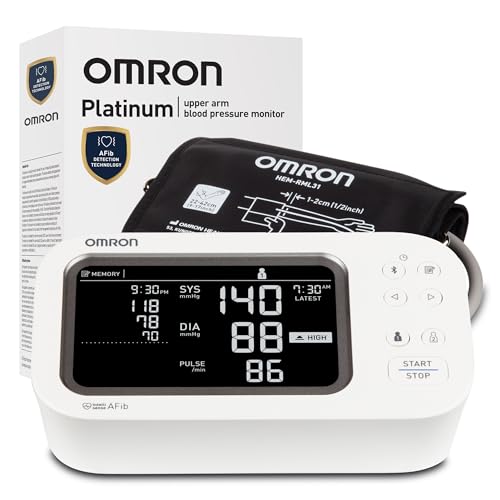
OMRON Platinum Upper Arm Blood Pressure Monitor

iHealth Track Pro Upper Arm Blood Pressure Monitor
The Picks, Examined More Closely
Your morning readings become easier to organize when the monitor can place them in a phone app and preserve a longer history. The OMRON Bronze stores up to 14 readings on the device, while Bluetooth connectivity extends record-keeping through the OMRON connect app. Compatibility with Apple Health and Google Fit makes this a natural fit for people who already review health data on a phone.
It also provides irregular heartbeat detection and a hypertension indicator, which flag notable results without replacing the full numbers. The included wide-range D-ring cuff fits arms from 9 to 17 inches, and the storage case, guide, manual, and four AA batteries cover the basics.
Useful Highlights
- App-based storage makes long-term trend review easier than relying on 14 device readings alone.
- Irregular heartbeat detection adds context to each upper-arm measurement.
- The included cuff and batteries reduce setup hassles in a new home.
- A storage case helps protect the monitor between uses.
Small Caveats
- Phone-based organization adds value for connected users, but the 9-to-17-inch cuff still needs to match your arm.
Key Specs
Built With In Mind
This monitor suits a single adult who wants organized readings, app access, and on-device health alerts without a large collection of controls.
Where Another Pick Suits Better
Couples needing more on-device storage may prefer the OMRON Platinum, which holds 100 readings for each of two users.
A dim bedroom or early-morning kitchen is exactly where the HealthTree’s backlit screen becomes useful. Its large display presents systolic pressure, diastolic pressure, pulse rate, and irregular heartbeat alerts, while automatic inflation handles the measurement after you press one button. For older adults who value a clear screen over app setup, that straightforward approach can be reassuring.
Two profiles can each retain 90 readings with date and time information, giving a couple a substantial on-device history. The adjustable upper-arm cuff covers arm circumferences from 8.7 to 16.5 inches, which makes a careful fit check important before ordering.
Key Advantages
- The backlit, large-format display remains easy to scan in low light.
- Automatic inflation reduces the number of steps involved in a reading.
- Ninety readings per person offer more local storage than many basic monitors.
- Date and time stamps make records easier to organize chronologically.
Practical Considerations
- Its 16.5-inch cuff limit may be too small for larger arms.
- Shoppers focused on phone-based organization may find the OMRON Bronze more aligned with their routine.
Feature Snapshot
The Right Fit
This monitor works well for couples who want large numbers, two separate profiles, and a backlit display without relying on phone-based record keeping.
Consider Something Else When
Adults needing an extra-large cuff should look at the Double love monitor, whose larger option extends to 21.7 inches.
The Double love monitor goes further for users who appreciate spoken guidance. Its voice system provides precautions before use and reads the results afterward, a useful feature for someone with impaired vision. The announcement can also be turned off, so the feature remains optional for people who prefer silence.
Two cuff sizes cover arms from 8.7 to 16.5 inches and 15 to 21.7 inches, while two profiles can hold 120 records each. A 4.5-inch display, irregular rhythm alert, and automatic arm-detection indicators round out a design built around accessibility and household sharing.
Useful Touches
- Spoken setup guidance and results reduce dependence on the screen.
- Two cuff sizes accommodate a wider range of arm circumferences.
- The combined 240-record capacity suits two active tracking profiles.
- Automatic arm-detection indicators help flag incorrect cuff positioning.
- Battery and round DC connector options support flexible power placement.
Points To Note
- Because the cuff ranges overlap, compare your arm measurement with both size descriptions.
- The 4.5-inch screen may occupy more counter space than a compact display.
The Numbers That Matter
Made For
This monitor suits people who want voice assistance, extra-large cuff support, and separate records for two household members.
A Better Fit Elsewhere
People who want their readings organized automatically on a phone may prefer the connected OMRON Bronze monitor.
One-button operation keeps the LotFancy easy to include in a daily routine, especially for a couple managing separate profiles. After you fasten the cuff and press start, results appear in about 30 seconds. The large LCD uses oversized numbers and operation reminders, reducing the need to squint at a crowded screen.
Each of two users can store 60 dated readings, and the display can show an average based on the previous three results. An adjustable cuff fits 8.6 to 16.5 inches. Power comes from four AA batteries or the included AC adapter, with batteries not included in the package.
Notable Upsides
- Automatic inflation and one-button operation simplify the daily sequence.
- Two profiles keep 60 readings each under separate user settings.
- The three-reading average gives recent results a little useful context.
- Large numbers and reminder icons help with quick checks.
Factors To Consider
- Four AA batteries are not included, so an existing supply helps.
- Healthcare products are moving from the LotFancy name to the Medlot sub-brand during a transition.
Quick Facts
Who Will Love This
This monitor suits couples or older adults who prefer one-button operation, large numerals, and separate on-device records.
Another Choice May Suit
People who want a backlit display in dim conditions may find the HealthTree Upper Arm Monitor with Large Cuff more convenient.
Blood pressure and EKG measurement sit in one upper-arm device with the OMRON Complete. EKG is an electrical measurement of heart rhythm, so this model expands beyond the numbers produced by a conventional pressure cuff. That makes it relevant to a household that wants both types of information collected from a single device.
The monitor can store up to 90 readings and uses OMRON’s Advanced Accuracy Technology. Featured service terms also include coverage for accidental damage and breakdowns, with plan terms varying. That support can add ownership value beyond the measurement functions themselves.
The Case For It
- The 2-in-1 format reduces the need for separate blood pressure and EKG devices.
- Ninety stored readings provide a useful local history for regular checks.
- Featured coverage includes accidental damage and breakdown protection.
Where It May Fall Short
- The added EKG function may be unnecessary for someone focused solely on routine pressure readings.
- Compared with the OMRON Bronze, this model stores more on-device data but does not highlight the same phone-app workflow.
Who It Suits Best
This monitor suits someone who wants blood pressure and EKG measurements available in one upper-arm device.
Look Elsewhere When
App-based organization and Bluetooth syncing may matter more to you than a built-in EKG measurement, making the OMRON Bronze a better fit.
The OMRON Platinum is built around households that want more than a single reading history. It stores up to 100 readings for each of two users, a substantial improvement over the Bronze’s 14-reading device limit. Dual-user support makes it easier for partners or family members to keep separate records on the same monitor.
Its Advanced Accuracy with AFib Detection Technology adds an atrial fibrillation screening function during routine measurements. AFib detection looks for an irregular pattern that can be worth discussing with a healthcare professional. Featured service terms also include accidental-damage and breakdown coverage, with plan details varying.
Everyday Perks
- One hundred readings per person support detailed household tracking.
- AFib detection adds a heart-rhythm feature during standard checks.
- Dual-user storage keeps two profiles separate on one device.
- Coverage options include accidental damage and breakdown situations.
Trade-Offs To Consider
- The advanced feature set may be unnecessary for a person taking only occasional readings.
- Local storage is deep, though the Bronze’s app approach may suit you better if phone-based organization comes first.
Best Suited To
This monitor suits couples who want separate histories, extensive on-device storage, and AFib detection in one upper-arm unit.
Swap It Out When
A single user focused on phone synchronization may find the OMRON Bronze’s app and Apple Health compatibility more useful.
The iHealth Track Pro puts quick interpretation at the center of its display. A wide-angle LED screen remains clear from different viewing angles, while red, yellow, and green indicator lights add an immediate visual cue to the readings. That makes it particularly useful in a dim bedroom or when you want a fast glance rather than a long display review.
One-touch operation keeps the process straightforward: position the cuff, press the single button, and allow the fully automatic measurement to run. The combination of large illumination and color cues can feel less demanding for older adults, although you still need to read the detailed numbers recorded on the screen.
What Earns Its Place
- The wide-angle LED display supports visibility from different positions.
- Red, yellow, and green lights make results easier to interpret at a glance.
- One-touch automatic operation minimizes the daily control sequence.
A Few Limitations
- Color indicators provide a quick visual cue, but the full numerical reading remains important.
- You may prefer the HealthTree model when a backlit display and separate two-user profiles are your main requirements.
Feature Overview
Whose Shelf It Belongs On
This monitor fits a bedroom, senior household, or low-light space where a clear screen and color cues matter most.
Where A Sibling Pick Shines
Households wanting 90 stored readings for each person may prefer the HealthTree Upper Arm Monitor with Large Cuff.
What To Prioritize Before Buying A Monitor
Start With Cuff Fit
Measure your upper arm before choosing a monitor, then compare that circumference with the included cuff range. A snug, correctly sized cuff matters for both comfort and consistent placement. The HealthTree, LotFancy, and standard Double love cuffs top out at 16.5 inches, while Double love also includes an option extending to 21.7 inches.
Decide How Records Should Be Stored
On-device memory works well for a fixed household routine. The OMRON Platinum stores 100 readings for each of two users, HealthTree stores 90 per user, and Double love offers 120 per user. Phone-based organization changes the equation, with the OMRON Bronze connecting through its app and also working with Apple Health and Google Fit.
Match Controls To Your Needs
One-touch operation suits anyone wanting a brief routine, while voice guidance can make results easier to understand with limited vision. The Double love monitor speaks its precautions and results, and its announcements can be switched off. The iHealth Track Pro takes a different approach with color-coded indicators and a wide-angle LED display.
Look Beyond The Basic Reading
Extra functions matter only when they match your routine. The OMRON Complete combines blood pressure and EKG measurement, while the Platinum adds AFib detection and deeper two-user storage. The Bronze remains a practical choice for people who mainly want connected tracking and simple daily alerts.
Common Mistakes Worth Avoiding
Wrong Turns To Avoid
Do not assume a monitor’s display size guarantees a comfortable cuff fit. Check the arm range first, particularly for larger adults. Also consider who will use the device, since separate profiles, voice output, and phone syncing can matter more than an extra indicator on the screen.
What Separates Premium From Basic
Higher-tier models tend to add deeper memory, specialized heart-rhythm features, or broader connectivity. Those additions help when you will use them regularly. A simple one-button monitor with a suitable cuff remains the more sensible choice for occasional readings and straightforward household tracking.
Frequently Asked Questions
Which monitor is best for two people?
The HealthTree Upper Arm Monitor with Large Cuff is a practical two-person option, with 90 readings stored for each profile. The OMRON Platinum provides more local storage at 100 readings per user.
Which monitor supports phone-based tracking?
The OMRON Bronze connects through Bluetooth to the OMRON connect app and works with Apple Health and Google Fit. This makes it the clearest choice when you want records organized on your phone.
Which model reads results aloud?
The Double love Home Blood Pressure Monitor Blue provides voice announcements for setup guidance and measurement results. The announcements can be turned off when you prefer quiet operation.
Which monitor combines blood pressure and EKG?
The OMRON Complete 2-in-1 Blood Pressure Monitor measures both blood pressure and EKG. That combined approach suits someone who wants two types of heart information from one upper-arm device.
How do I check cuff compatibility?
Measure your upper-arm circumference and compare it with the monitor’s stated cuff range. The listed models cover different sizes, including the Double love option that extends to 21.7 inches.
Final Verdict
The OMRON Bronze suits connected single-user routines, while the Platinum and Complete serve more specialized tracking needs. HealthTree, LotFancy, and Double love prioritize shared records, readable displays, and accessible controls. Choose the model whose cuff, memory system, and features match your actual household routine.
