

A home blood pressure monitor can reveal how your readings change from morning to night, but choosing the wrong cuff or display can make daily checks frustrating. The seven options below cover different needs, including connected tracking, shared profiles, voice prompts, dual cuff sizes, and EKG measurements. Compare the details that match your routine rather than paying attention to features you will rarely use.
An Overview Of The Picks

OMRON Bronze Upper Arm Monitor

Braun ExactFit 1 BUA5000

HealthTree Large-Cuff Upper Arm Blood Pressure Monitor, 2×90 Memory

Double love Blue BP Monitor

OMRON Complete 2-in-1 BP/EKG
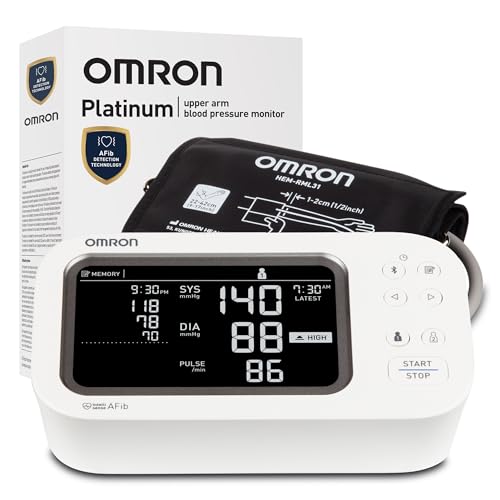
OMRON Platinum BP Monitor

iHealth Track Pro BP Monitor
The Picks, Examined More Closely
The OMRON Bronze fits a routine where readings become part of a larger tracking habit. Its Bluetooth connection to the OMRON Connect app, plus compatibility with Apple Health and Google Fit, gives you more ways to organize measurements than the Braun ExactFit 1 provides.
You still get practical everyday features without digging through menus. The monitor stores 14 readings, identifies irregular heartbeats, and provides a hypertension indicator, while its D-ring cuff fits upper arms from 9 to 17 inches. The included case, batteries, and setup guide make it a neat fit for a bedside table or overnight bag.
Why It Works Well
- App connectivity supports longer-term trend review and report sharing.
- Fourteen stored readings provide a recent history without relying entirely on your phone.
- The hypertension indicator gives an at-a-glance signal when a result falls outside its range.
- A 9-to-17-inch cuff covers a broad range of adult arm sizes.
Things To Consider
- Bluetooth setup adds a step compared with the Braun ExactFit 1’s one-button routine.
- Confirm that your arm circumference falls within the cuff’s stated range before use.
Key Specs
Made For
You benefit most from this model when you want phone-based trend tracking alongside a dependable standalone display.
Another Choice May Suit
The Braun ExactFit 1 suits people who prefer a simpler setup with one-button operation and no app connection.
A morning routine should not feel like operating a small computer. The Braun ExactFit 1 keeps the process grounded with one-button operation, a large display, and an automatic inflation sequence. That simplicity makes it a comfortable choice for someone taking their first measurements or simply wanting fewer steps.
Its clinically validated measurement approach and irregular-heartbeat notification add useful context without crowding the interface. Compared with the OMRON Bronze, this is the simpler appliance: it saves the latest result instead of building a larger history, and it has no listed app connection.
Positive Takeaways
- One-button operation makes daily checks quicker to begin.
- The large display keeps systolic, diastolic, and pulse information easy to locate.
- Irregular-heartbeat detection provides an additional signal during measurement.
Worth Noting
- The cuff fits 8.6-to-16.5-inch arms, so check the fit if your upper arm falls outside that range.
Quick Facts
The Right Fit
This monitor suits adults who value a clear display and straightforward operation over connected trend reports.
A Better Fit Elsewhere
The OMRON Bronze is the better fit for you when phone-based history and report sharing are central to your routine.
HealthTree stands out for households that share one monitor. Its dual-user mode assigns 90 readings to each of two profiles, with date and time information for sorting a personal history. That structure offers more shared storage than the Braun ExactFit 1, which retains only the latest measurement.
The backlit screen and large characters are useful during early mornings or in a dim bedroom. Automatic inflation starts with one button, while the adjustable 8.7-to-16.5-inch cuff wraps comfortably around many adult arms.
Where It Excels
- Two separate profiles keep your readings separate from another household member’s.
- A combined 180-reading memory gives each user meaningful storage.
- Backlighting and large characters improve visibility in low light.
- One-touch operation keeps the sequence familiar from the first check onward.
- Date and time stamps help you organize readings into a chronological history.
Small Caveats
- The cuff’s 16.5-inch upper limit may not suit larger upper arms.
- No phone or computer connection is listed, so digital organization happens on the device.
Best Suited To
You benefit most when two adults want separate profiles and a readable display without app-based setup.
Consider Something Else When
The iHealth Track Pro offers a more colorful, color-coded display for people who prefer quicker visual interpretation.
The Double love monitor is built around a simple premise: a person should not need to study a small screen to complete a check. Its 4.5-inch display, voice broadcast, and adjustable cuff sizes make it especially approachable for older adults or anyone who has trouble reading fine print.
Two users can store up to 240 records in total, and the included cuffs cover both standard and larger arms. Unlike the single-cuff HealthTree, this package gives you more sizing flexibility, plus voice guidance that can be switched off when quiet operation is preferable.
Notable Gains
- Voice announcements read instructions and results for easier hands-free use.
- Two cuff ranges accommodate upper arms from 8.7 to 16.5 inches and 15 to 21.7 inches.
- Up to 120 records per user provide a broad shared history.
- The large blue display is easier to read at a glance than a compact screen.
Practical Considerations
- Voice output may be undesirable in shared rooms, though it can be turned off.
- The larger cuff adds another component to store and keep organized.
- Its broad feature set may be unnecessary for users wanting only a basic result.
Technical Highlights
Built With In Mind
This model suits adults who benefit from spoken results, a large screen, and a choice between standard and larger cuffs.
Where Another Pick Suits Better
The Braun ExactFit 1 is simpler for you when voice guidance and multiple cuff sizes are not needed.
The Complete 2-in-1 expands the familiar upper-arm monitor into a combined blood pressure and EKG device. An EKG records the heart’s electrical activity, so this model serves a different purpose from the straightforward pressure-only units in the list. It can provide a more complete set of measurements for a routine shared with your doctor.
Storage is another step above the OMRON Bronze, with room for 90 readings instead of 14. The combination appeals to you when two measurement types matter more than a minimalist interface or a connected health platform.
What Pays Off
- Combining blood pressure and EKG measurements reduces the need for separate routines.
- Ninety stored readings create a more substantial history for review.
Points To Note
- The EKG function adds a measurement type to learn and may exceed a basic routine.
- Check the upper-arm cuff size against your arm before ordering.
Who Will Love This
You benefit most from this model when combining blood pressure and EKG readings is a central part of your home routine.
Reach For A Different Pick When
The Braun ExactFit 1 better fits you when a simple pressure display and one-button operation are enough.
AFib detection gives the OMRON Platinum a sharper focus than the Bronze’s general irregular-heartbeat notification. It looks for an atrial fibrillation pattern during a routine blood pressure measurement, adding a distinct signal without changing the familiar upper-arm format.
Dual-user support stores 100 readings for each of two people, which exceeds the HealthTree’s 90-per-user arrangement. For couples who want separate histories, that difference adds meaningful room, although you still need to confirm cuff compatibility for both arms.
Benefits That Matter
- AFib detection provides a specific rhythm-related signal during each measurement.
- Each user receives 100 readings for an extensive private history.
- Dual-user profiles keep household trends organized separately.
- The upper-arm format supports a familiar at-home measurement routine.
Trade Offs
- Check the listed cuff sizing before ordering for either user.
- An AFib alert should be discussed with your doctor rather than treated as a result on its own.
- Large per-user memory can be unnecessary for a person who checks only occasionally.
Core Details
Whose Shelf It Belongs On
This model suits two adults who want separate histories and an AFib-focused feature in an upper-arm monitor.
Not Your Match When
The HealthTree monitor offers a better fit for you if a backlit display and a slightly smaller per-user memory capacity suit your routine.
The iHealth Track Pro puts visual clarity at the center of the routine. Its wide-angle LED display can be viewed from different positions, while red, yellow, and green indicators place the result into an easily recognized color group. That makes the screen particularly useful in a low-light bedroom or when you want to check a number quickly.
Operation stays simple with a single start button, comparable to the Braun ExactFit 1. You may find the color-coded approach more useful than a wall of numbers, especially during a hurried morning check.
Everyday Advantages
- Color indicators make the result easier to interpret at a glance.
- The wide-angle display remains readable from different viewing positions.
- One-button operation keeps the measurement process compact.
Where It May Fall Short
- Confirm the cuff range against your upper arm before making this your daily monitor.
Feature Snapshot
Who Should Grab It
You benefit most from this model when visual cues and a readable display matter more than extended memory features.
Skip It When
The HealthTree monitor is the better fit for two people who need separate stored histories and a backlit numeric display.
What Matters Before You Choose a Monitor
Cuff Fit Comes First
A cuff that is too small or too loose can affect the usefulness of your readings, so measure your upper arm before choosing. The Braun ExactFit 1 covers 8.6 to 16.5 inches, while the OMRON Bronze fits 9 to 17 inches. The Double love package offers both standard and larger cuffs, giving you more sizing flexibility for a household with different arm sizes.
Think About How You Will Read Results
A large display helps during a quick morning check, but readability goes beyond size. The HealthTree adds backlighting for dim rooms, the iHealth Track Pro uses color indicators, and the Double love model can announce results aloud. Select the display style that matches your eyesight and typical setting.
Decide How Much History Matters
Memory is useful when you want to compare morning and evening measurements across several days. The OMRON Bronze stores 14 results, the HealthTree provides 90 for each of two people, and the OMRON Platinum stores 100 per user. The Braun ExactFit 1 retains only the latest result, which suits a simple point-in-time routine.
Consider Rhythm Features and Connectivity
Irregular-heartbeat detection appears across several models, while the OMRON Platinum focuses on AFib and the Complete adds EKG measurement. The Bronze is the only listed model with Bluetooth app connectivity and compatibility with Apple Health and Google Fit. These features matter when you plan to review trends digitally or share reports with your doctor.
Making Sense of Added Monitor Features
Common Shopping Slip Ups
The most common mistake is choosing by feature count before checking cuff fit. Another is overlooking storage, which can leave you with little history to compare. Confirm arm range, power method, display visibility, and connection requirements before ordering.
What Separates Premium From Basic
Basic monitors center on pressure readings, a display, and irregular-heartbeat detection. Added storage, app connectivity, voice guidance, dual profiles, AFib detection, and EKG measurement serve different routines. Pay for a feature you will regularly use, not simply the longest specification list.
Frequently Asked Questions
Which type of blood pressure monitor is most practical for home use?
An upper-arm monitor is practical for most home routines because it wraps around the upper arm and supports a familiar daily process. The Braun ExactFit 1 is especially simple, while the OMRON Complete adds EKG measurement.
How do I know which cuff size I need?
Measure your upper arm and compare it with the manufacturer’s stated cuff range. The Braun ExactFit 1 fits 8.6 to 16.5 inches, the OMRON Bronze fits 9 to 17 inches, and Double love includes two ranges.
Do I need a monitor with memory storage?
Memory helps when you want to compare readings across several days or track separate users. The Braun ExactFit 1 stores the latest result, while the OMRON Platinum keeps 100 readings for each of two profiles.
Is an EKG monitor different from a standard blood pressure monitor?
A standard upper-arm model measures blood pressure and may flag an irregular heartbeat. The OMRON Complete also records an EKG, which measures the heart’s electrical activity.
Which monitor works best with a phone?
The OMRON Bronze connects through Bluetooth to the OMRON Connect app and works with Apple Health and Google Fit. The other listed models focus on on-device readings, memory, voice guidance, or additional measurements.
Final Verdict
Your best home blood pressure monitor depends on the routine you will actually maintain. Choose the Braun for simplicity, HealthTree for shared profiles, Double love for accessible guidance, OMRON for connected or specialized measurements, and iHealth for color-coded visibility. Start with cuff fit and the features that support your daily habits.
