

Electric toothbrushes can make brushing more consistent, but the right model depends on the details you use every day. A pressure sensor matters during a rushed morning, while a compact case and long battery life can be more useful during business trips or family vacations. You’ll also want enough replacement heads to avoid interruptions. The options below cover everything from app-guided routines to straightforward rechargeable models, helping you select a toothbrush that fits your habits rather than simply adding more features to your bathroom counter.
A Side- By-Side Look
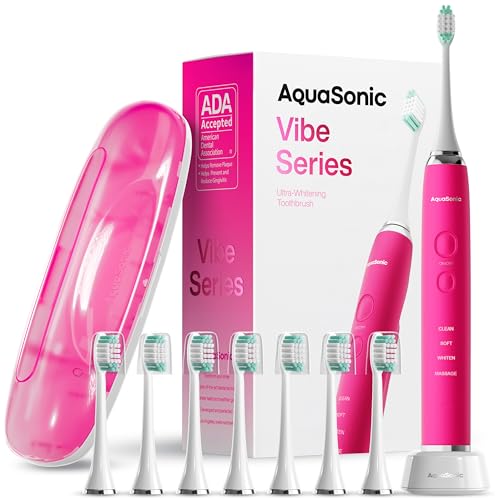
Aquasonic Vibe Series Electric Toothbrush, Electric Pink

Philips Sonicare 7300 Electric Toothbrush

Philips Sonicare 5950 Electric Toothbrush

Phillips Sonicare ProtectiveClean Electric Toothbrush, White/Grey
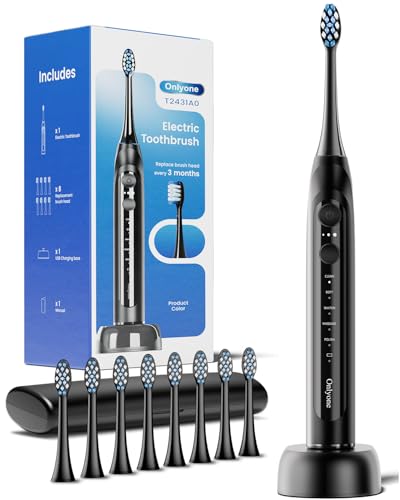
Onlyone Rechargeable Electric Toothbrush, 8 Heads, Travel Case
Aquasonic Black Series Electric Toothbrush, 8 Heads, Travel Case

Aquasonic Vibe Neutrals Electric Toothbrush, Latte

Philips Sonicare DiamondClean 9500
Taking A Closer Look At The Options
The Aquasonic Vibe Series balances replacement supplies, charging convenience, and brushing controls in a slim pink handle. You get a motor rated at 40,000 vibrations per minute, four modes, a smart timer, wireless charging, and an IPX7 water-resistance classification. For a shared bathroom or frequent traveler, the eight-head bundle and hard case reduce the chance of leaving essential accessories behind.
The American Dental Association’s Council on Scientific Affairs accepted this model, and its modes include cleaning, whitening and polishing, and gum-focused brushing. The battery can last up to four weeks at two two-minute sessions daily, although your actual interval may vary with charging and use.
Strengths Worth Knowing
- Eight DuPont brush heads cover roughly two years at the stated replacement interval.
- Four modes suit different routines, including a polishing option.
- The hard travel case holds the handle and two heads.
- Wireless charging avoids connecting a cable to the toothbrush.
- Smart timing prompts help structure a two-minute session.
Points To Note
- Its 40,000-vibration motor differs from the 62,000 bristle movements listed for the Philips Sonicare 7300, so those figures are not directly interchangeable.
- The compact travel case is useful, though eight replacement heads still require separate storage.
Quick Facts
Built With In Mind
You benefit most from this model when replacement heads, multiple modes, and travel storage matter more than app-based coaching.
Consider Something Else When
The Philips Sonicare 7300 suits you better when visual pressure alerts and personalized app guidance drive your daily routine.
Your brushing technique receives more attention with the Philips Sonicare 7300 because a light ring warns you when you press too hard. That visual feedback is easy to notice during a hurried morning. The companion app adds coaching and replacement reminders, making this a practical fit for people who benefit from prompts rather than relying on memory alone.
Power comes from 62,000 bristle movements per minute, while Sonicare Fluid Action moves water between teeth and along the gumline. Four modes and three intensity levels provide room to adjust, and the A3 Premium All-in-One head uses angled, triangular-tip bristles for reaching around tooth edges.
Practical Advantages
- The pressure ring turns excess force into an immediate visual prompt.
- Clean, Sensitive, Gum Health, and White modes suit varied routines.
- BrushPacer divides a session into 20-second sections.
- The app provides coaching and head-replacement reminders.
- Battery life reaches up to 21 days on a full charge.
Small Caveats
- The power adapter is not included, so confirm that you have a compatible one for the charging stand.
- Three brush heads are fewer than the eight supplied with the Aquasonic Vibe Series, making long-term replacement planning necessary.
Made For
You benefit most from the 7300 when pressure awareness, app-guided pacing, and multiple intensity choices help you maintain a consistent routine.
Another Choice May Suit
The Aquasonic Vibe Series fits you better when a larger replacement-head supply and included travel case matter more than app coaching.
The Philips Sonicare 5950 makes pressure awareness tactile rather than visual. Its pressure sensor sends haptic feedback, meaning a gentle vibration reaches your hand when you press too firmly. That approach can be less distracting than looking down at a light ring, particularly for people who keep the toothbrush handle at eye level.
Sonicare Fluid Action directs fluid between teeth and toward the gumline, helping the powered brushing action reach areas that may be missed with a manual brush. The set includes two brush heads and a rechargeable handle. Compared with the Philips Sonicare 7300, the core feedback approach is similar, but the 5950 keeps the setup more compact.
Where It Helps
- Haptic feedback signals excess pressure without requiring visual attention.
- Fluid Action adds water movement around teeth and the gumline.
- Two included heads keep the initial package compact.
Worth Noting
- You receive two replacement heads rather than the larger Aquasonic bundles.
- Haptic pressure alerts may be less noticeable to you than the 7300’s illuminated ring, depending on your grip and attention.
At A Glance
Right Fit For
You benefit most from the 5950 when moving from a manual toothbrush and preferring a subtle pressure cue over app-led instruction.
Look Elsewhere When
The Philips Sonicare 7300 fits you better when a visual pressure alert, longer battery claim, and app-supported coaching take priority.
The ProtectiveClean setup is easy to understand from the start, which makes it a sensible option for anyone tired of complicated brushing controls. You receive a handle, one ProResults plaque-control head, and a charger. Three intensity settings let you adjust the feel without navigating through a larger menu of modes.
The listing emphasizes plaque removal and gum-line cleaning, with a four-day battery life for regular use. You may prefer this restrained approach to app coaching, especially in a shared bathroom where the focus is simply completing a consistent two-minute routine. The white and grey finish also keeps the visual footprint understated.
Everyday Advantages
- Three intensity levels make it straightforward to adjust the brushing feel.
- The included charger avoids sourcing a separate charging accessory.
- A four-day battery suits short trips and regular home use.
- The ProResults head focuses on plaque control along the gumline.
Potential Drawbacks
- The package includes only one brush head, so you may want to keep spare heads available.
- Its four-day battery claim is shorter than the 21-day figure listed for the Philips Sonicare 7300.
Who Will Love This
You benefit most from the ProtectiveClean when you want a rechargeable toothbrush, a few intensity choices, and a simple setup without app-dependent routines.
A Better Fit Elsewhere
The Philips Sonicare 5950 suits you better when tactile pressure feedback and Fluid Action are more important than a generous included-head supply.
The Onlyone model gives you several ways to adjust a daily routine without making the handle dependent on a phone. Five modes cover clean, sensitive, whitening, and massage-style brushing, while a two-minute timer defines the full session. At 30-second intervals, the timer also asks you to change mouth sections, known as quadrants, which helps distribute your attention.
Eight replacement heads, a travel case, a charging base, and wireless charging make this a generous package for a household. The features may require a short adjustment period, particularly if several modes sound similar at first. Starting with the clean or sensitive setting gives you a more useful basis for comparison.
The Upside
- Five modes provide room to adjust the brushing experience.
- The timer divides your session into 30-second mouth sections.
- Eight heads keep replacements available.
- The case and wireless charging support travel.
Possible Compromises
- Five modes can feel excessive until you determine which settings suit you.
- The 30-second prompts assume consistent timing and may feel interrupted during short sessions.
Feature Snapshot
Made For
You benefit most from the Onlyone when spare heads, multiple modes, and a complete travel kit matter most.
Reach For A Different Pick When
The Philips Sonicare 7300 suits you better when visual pressure alerts and app-supported coaching are central to your routine.
The Aquasonic Black Series brings a familiar feature set to people who prefer a traditional black handle. Its 40,000-vibration motor, four modes, smart timing, and wireless charging provide a broad routine without app dependence. The included hard case and eight replacement heads make the package particularly convenient for a frequently changing schedule.
You can choose a cleaning mode or one focused on polishing and gum care, and the American Dental Association’s Council on Scientific Affairs accepted the model. Battery life reaches up to four weeks under the stated two-session-per-day schedule, so packing it for a long trip may be uncomplicated.
Notable Upsides
- Eight heads provide a useful replacement reserve.
- Four modes cover routine, polishing, and gum-focused options.
- The hard case offers protection during transit.
- Wireless charging keeps the handle on its base.
Small Limitations
- The feature set does not include the app coaching offered by the Philips Sonicare 7300.
- Its stated four-week battery interval depends on consistent two-minute sessions.
Key Attributes
For Frequent Travelers
You benefit most from the Black Series when a complete replacement supply, hard case, and long stated battery interval simplify frequent travel.
Where A Sibling Pick Shines
The Aquasonic Vibe Series fits you better when a pink finish better matches your bathroom while retaining a similar travel-focused feature set.
The Aquasonic Vibe Neutrals collection makes the toothbrush itself part of the bathroom’s visual scheme. Its latte finish is softer than stark black or bright pink, making it a natural choice for neutral cabinetry, beige counters, or neatly coordinated accessories. You still receive the practical Vibe Series foundation rather than a novelty handle with limited functions.
A 40,000-vibration motor, four brushing modes, smart vibration timing, a lithium-ion battery, and wireless charging form the core package. The manufacturer also lists eight DuPont brush heads and a custom travel case, so the design choice does not come at the expense of routine supplies.
What Stands Out
- The latte finish coordinates easily with neutral bathroom décor.
- Four modes provide distinct cleaning and polishing choices.
- Eight brush heads reduce replacement interruptions.
- The travel case supports trips and shared bathrooms.
- Wireless charging keeps the daily setup uncluttered.
Details To Watch
- The color changes the appearance, not the listed motor speed or core functions.
- The 40,000-vibration figure remains below the 62,000 bristle movements listed for the Philips Sonicare 9500, and the measurements describe different movements.
Thoughtful Design
You benefit most from this model when a restrained color and coordinated accessories matter as much as a broad feature bundle.
Swap It Out When
The Aquasonic Black Series suits you better when you prefer a traditional dark handle and want the same broad accessory-focused setup.
The Philips Sonicare DiamondClean 9500 places more emphasis on the shape of the brush head than basic vibration counts alone can convey. Its A3 Premium All-in-One head uses multi-angle bristles to reach around teeth and along the gumline. For you, that means a more targeted approach to the places where plaque commonly collects.
The handle delivers 62,000 bristle movements per minute, and Sonicare Fluid Action moves fluid between teeth. The manufacturer reports strong plaque-removal, gum-care, and surface-stain-removal results for the included head. Three brush heads and a clean white finish complete a focused package for a consistent daily routine.
What It Does Well
- The angled A3 bristles reach around multiple tooth surfaces.
- Fluid Action supplements the brush head’s bristle movement.
- 62,000 bristle movements provide a high-frequency cleaning action.
- Three replacement heads are included for the initial routine.
Less-Strong Areas
- Three heads are fewer than the eight supplied with the Aquasonic Vibe Series.
- Its white finish may show visible wear more readily than a darker handle, depending on your storage habits.
Technical Highlights
Best Suited To
You benefit most from the DiamondClean 9500 when detailed head design and fluid-assisted brushing are your main priorities.
Skip It When
The Onlyone Electric Toothbrush fits you better when a larger replacement-head supply and travel case carry more weight than the brush-head design.
What Matters Before You Make Your Choice
Pressure feedback for your brushing style
A pressure sensor measures the force you apply and signals you when it becomes excessive. The Philips Sonicare 7300 uses a light ring, while the 5950 provides a tactile vibration. You may prefer the visible alert during a distracted morning, or the haptic cue when keeping your eyes on the mirror feels unnecessary.
Battery life and travel storage
Battery claims depend on the brushing duration and frequency described by each manufacturer. The 7300 lists up to 21 days, while the Aquasonic models list up to four weeks. Travel cases add useful protection, but a wall charger or compatible charging stand still needs to fit your packing routine.
Modes, timers, and replacement supplies
Cleaning modes change the brushing experience, while timers divide sessions into shorter sections. Eight included heads cover a substantial replacement period, whereas three-head packages look smaller by comparison. Count the people using the toothbrush, then compare that number with how often you want to reorder supplies.
Practical Details That Shape Your Decision
Mistakes Worth Dodging
Shoppers often focus on vibration speed and overlook the brush head, charging setup, and replacement schedule. Compare compatible heads and confirm whether a charger or travel case is included. A model with several modes will not suit everyone, especially when one reliable setting already matches your routine.
What Separates Premium From Basic
Higher-tier models often add pressure awareness, app guidance, or more precisely shaped brush heads. The Philips Sonicare 7300 and DiamondClean 9500 emphasize these refinements, while the Aquasonic models bundle replacement heads and travel accessories. The upgrade makes sense when the added feedback changes how you brush, not merely when the display looks more advanced.
Frequently Asked Questions
Which electric toothbrush is easiest for daily use?
The Philips Sonicare 7300 is well suited to a guided routine because it combines pressure alerts, app coaching, and timed prompts. You can still keep the setup simple by using the handle independently.
Are pressure sensors useful in an electric toothbrush?
A pressure sensor helps you notice when you are applying more force than necessary. The 7300 shows a light ring, while the 5950 uses vibration, giving you two distinct ways to follow the signal.
How often should replacement brush heads be changed?
The Aquasonic Vibe Series states that each included head lasts about three months. Replacing heads at regular intervals helps maintain the intended cleaning performance, so check the model’s guidance before ordering replacements.
Do you need an app for an electric toothbrush?
You do not need an app for basic powered brushing, but app guidance can add pacing, coaching, and replacement reminders. The Philips Sonicare 7300 suits people who find those prompts useful.
Can you travel with a rechargeable electric toothbrush?
You can travel with a rechargeable model, and several options list extended battery intervals. Keep the handle dry during the journey, place it in its protective case, and pack any required charging accessory.
Final Verdict
Your best match depends on the routine you actually repeat: app coaching and visual pressure alerts for the Philips Sonicare 7300, tactile feedback for the 5950, or replacement heads and travel accessories for the Aquasonic models. Match the features to your bathroom, schedule, and tolerance for controls, then choose the simpler option that you will enjoy using every day.
