


Are you tired of inconsistent coffee at home? One day your brew tastes perfect, the next it is weak or too strong. The secret to unlocking consistently delicious coffee is understanding the Coffee to Water Ratio. A dedicated calculator simplifies this crucial step. It ensures optimal flavor extraction every time. This blog post empowers you to brew your perfect cup with precision and ease.
Coffee to Water Ratio Calculator
Please select a coffee type to calculate the ratio.
Understanding Coffee to Water Ratio
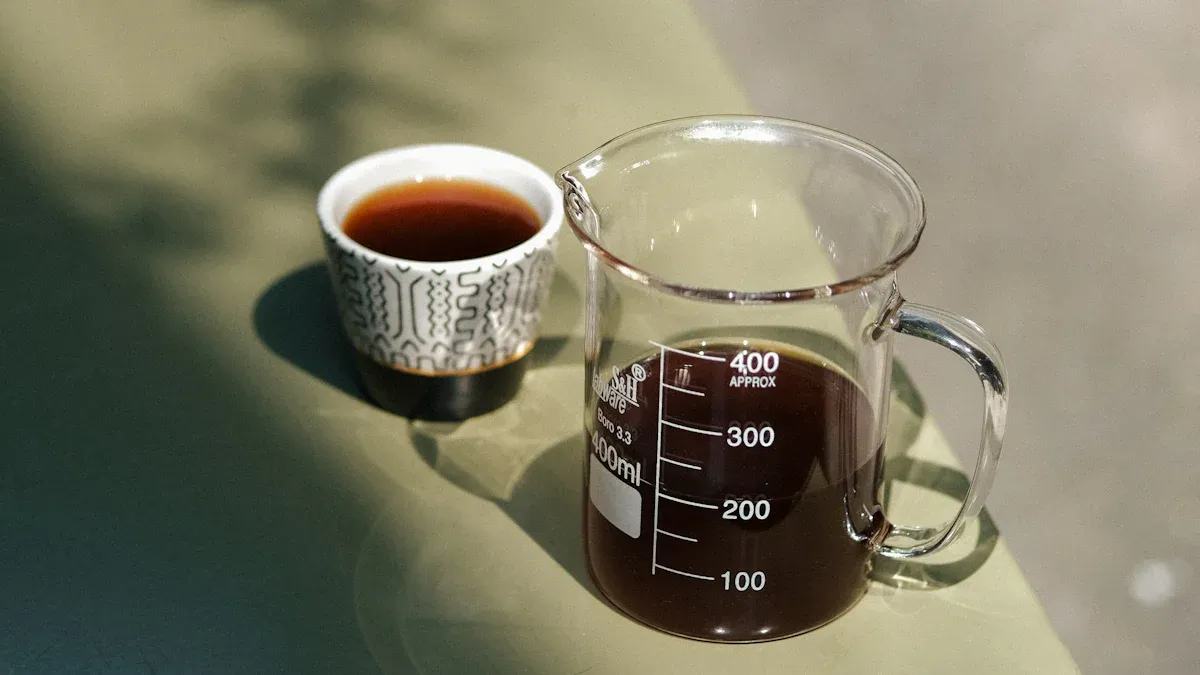
You want to brew great coffee. The Coffee to Water Ratio is the most important factor. It tells you how much coffee grounds you need for a certain amount of water. This ratio is fundamental for brewing quality.
Defining the Golden Ratio
Many people talk about the “Golden Ratio” in coffee brewing. For the coffee industry, this means specific numbers from the Brew Control Chart. This chart looks at how strong your coffee is (TDS) and how much flavor you pull out (extraction percentage). The standard says your coffee should be between 1.15-1.35 TDS strong. It also says you should extract 18-22% of the coffee bean’s flavor.
For you, the average coffee drinker, the “Golden Ratio” often means 55 to 60 grams of coffee for every liter of water. The Specialty Coffee Association suggests 55 grams per liter. You can adjust this by about 10 percent. Professor Earnest Lockhart did research in the 1950s. His work helped create the Brew Control Chart and its recommendations. The Midwest Research Institute first set the 18-22% extraction guideline in 1957. The Coffee Brewing Institute (CBI) funded this research. They helped create the Brew Control Chart.
The “Golden Ratio” also refers to a 1:1.618 ratio of coffee to water by weight. This specific ratio helps you get a perfect balance of flavors. It optimizes how much oil, acid, and sugar you pull from the coffee grounds. This ratio keeps your coffee from being too weak or too strong. It helps you make a perfectly balanced cup. Other things also affect your coffee’s taste. These include:
The quality and freshness of your beans
How dark your beans are roasted
The size of your coffee grind
The temperature of your water
The brewing method you use
Impact on Coffee Taste
The Coffee to Water Ratio directly changes how strong your coffee tastes and its flavor. A higher ratio means you use more coffee. This makes a stronger coffee with more intense flavors. But if you extract too much, it can taste bitter. A lower ratio means you use less coffee. This makes a lighter coffee. It can taste brighter or more acidic. If you do not extract enough, it can taste sour. Adjusting this ratio changes the balance between coffee flavors and water. This affects the final strength and flavor. For example, adding a little more water can help if your coffee is bitter. Using more coffee can fix sour or weak coffee.
Extraction yield is a percentage. It shows how much of the coffee bean ends up in your cup. About 30% of a roasted coffee bean can dissolve in water. You usually aim for an extraction between 18% and 22%. This balance is key. It helps you get complex flavors. It also stops you from over-extracting bitter notes. It prevents under-extracting, which makes coffee weak and dull.
Different brewing methods need specific ratios. This is because they have different brew times, grind sizes, and pressures:
Pour-Over: 1:15 to 1:18
French Press: 1:12 to 1:15
Drip: 1:15 to 1:17
Espresso: 1:2 to 1:3
Cold Brew Concentrate: 1:4 to 1:5 (before you add more water)
Immersion methods, like French press, need a lower ratio for enough strength. Pressure brewing, like espresso, uses much less water for a strong drink. Drip and pour-over methods balance how fast water flows and how much flavor it pulls out.
You can tell if your coffee is under-extracted or over-extracted by its taste:
Extraction Type | Key Sensory Attributes |
|---|---|
Under-extracted | Overwhelming sourness, no sweetness, one acidic note, no other flavors |
Over-extracted | Intense bitterness, dryness (your tongue feels like moisture is gone) |
Consistency for Deliciousness
The coffee to water ratio affects both how much flavor you extract and how strong your coffee is. A higher ratio usually makes a bolder flavor. A lower ratio can make a more diluted taste. Extraction yield is the percentage of dissolved material. It measures how well you brew. An ideal extraction yield is usually 18% to 22%. This can change based on your brewing method. Concentration, measured by Total Dissolved Solids (TDS), shows how much dissolved material is in your coffee. A higher TDS means a stronger extraction. Changing your brewing ratio, like using a 1:15 ratio (1 gram of coffee to 15 grams of water), directly impacts the extraction yield. This lets you control the final flavor.
Different brewing methods have their own ideal extraction yield ranges. These ranges greatly affect taste. For espresso, the ideal yield is 18% to 22%. Below 18% makes sour, under-extracted coffee. Above 22% can make bitter, over-extracted coffee. Pour-over methods usually suggest 18% to 24% for a balanced cup. Lower yields lack richness. Higher yields can make flavors unclear. French press is an immersion method. It has a wider ideal range of 20% to 30%. Yields below 20% can be watery. Above 30% can make a gritty, bitter brew. Knowing these ranges for each method helps you get the best flavors.
Common Coffee Brewing Ratios
You now understand the importance of the Coffee to Water Ratio. Let’s look at common guidelines. These ratios help you achieve a balanced cup. The Specialty Coffee Association (SCA) suggests a ‘Golden Cup Standard’ of 1:18. This is a mild ratio. It works well for pour-over, Chemex, and drip machines. Some sources also mention a range of 1:17 to 1:18 for this standard. Counter Culture Coffee often recommends a 1:17 ratio. This is a good starting point for many brewers.
Standard Ratio Guidelines
Here are some common ratios you will see:
1:18: This ratio makes a lighter, more delicate coffee. It highlights subtle flavors.
1:17: Many consider this a balanced ratio. It offers good strength without being too intense.
1:16: This ratio gives you a slightly stronger cup. It brings out more body and richness.
1:15: You get a robust and bolder coffee with this ratio. It is great if you like a strong brew.
A higher number after the colon means more water per gram of coffee. This results in a milder brew. A lower number means less water, giving you a stronger, more concentrated coffee.
Adjusting for Brew Method
Your brewing method also changes the ideal Coffee to Water Ratio. Different methods extract coffee differently.
Consider these common methods and their recommended ratios:
Brewing Method | Recommended Coffee-to-Water Ratio |
|---|---|
French Press | 1:12 to 1:16 |
Espresso | 1:2 |
Pour Over | 1:14 to 1:16 |
Drip Coffee | 1:16 to 1:18 |
Cold Brew | 1:5 to 1:8 |
For example, full immersion methods like French press need a tighter ratio. This means you use more coffee relative to water. A ratio closer to 1:15 works well. Water and coffee stay in contact longer in these methods. This allows more flavor extraction. You need less coffee to balance the taste. Pour-over and drip methods often use ratios like 1:16 to 1:18. These methods have water flowing through the grounds. This requires a slightly different balance for optimal extraction.
Manual Coffee Ratio Calculation
You can calculate your coffee ratio by hand. This helps you understand the process better. It also ensures you get the exact amount of coffee and water you need.
Basic Formula and Units
The basic mathematical formula for your coffee ratio is simple. You express it as 1 gram of coffee to ‘x’ grams of water. The ‘Golden Ratio’ typically falls between 1:15 and 1:18. You use grams for both coffee and water because 1 milliliter of water is about 1 gram of water. Coffee Bros. states that all ratios use “1 gram of coffee to ‘x’ grams of water.” They define ratios as “the number of coffee grounds in grams to water in grams.”
To calculate, first, determine your desired total liquid weight. For example, if you want 8 ounces of coffee, multiply 8 by 30 grams (since 1 ounce is about 30 grams). This gives you 240 grams of total liquid. Next, choose your target ratio, like 1:15. Divide the total liquid weight by the water portion of your ratio. So, 240 grams divided by 15 equals 16 grams of coffee needed. You should convert everything to common measures like grams and milliliters for precision. A 1:16 ratio means you use 1 gram of coffee for every 16 grams (or ml) of water.
Practical Calculation Examples
Let’s look at some practical examples for different cup sizes and brewing methods. Your personal preferences play a big role in these calculations. If you want a bolder cup, you can use a higher coffee-to-water ratio. For a milder flavor, use a lower ratio. Always test different ratios to find your ideal scenario.
For a 1-cup autodrip with an average strength (a 1:17 ratio), you need about 13.61 grams of coffee for 227 grams of water.
If you brew a 12oz pour-over (340g of water) with a 1:15 ratio, you need about 23 grams of coffee.
Specific pour-over methods also have nuances. For Chemex, a 1:15 ratio is common. Hario V60 ratios closer to 1:16 seem ideal.
You can apply these calculations to various brewing methods like drip coffee, French press, espresso, pour-over, and cold brew. You can calculate water amounts in ounces, grams, and milliliters for different cup sizes. Then you calculate total ground coffee based on chosen strength ratios like 1:18, 1:16, 1:15, or 1:13.
Introducing the Coffee Ratio Calculator
You have learned about the importance of ratios. Now, let’s explore a tool that makes brewing easier: the coffee ratio calculator. These online tools help you determine the perfect amounts of coffee and water. They take the guesswork out of your morning routine. You can find your ideal brew with precision.
How the Calculator Works
A coffee ratio calculator simplifies your brewing process. It acts as your personal barista assistant. These tools help you figure out exactly how much coffee and water you need. You just input a few details. The calculator then provides precise measurements.
Many calculators offer core functionalities. They calculate the amount of coffee you need based on your desired water amount. You can choose between metric units like grams and milliliters. You can also use imperial units like ounces and cups. These tools often provide various coffee-to-water ratios. For example, you might see 1:15, 1:16, 1:17, or 1:18. Each ratio comes with an explanation of its resulting strength. You will know if your coffee will be strong, medium-strong, medium, or mild.
The calculator helps you determine the ideal coffee-to-water ratio for your taste. You can adjust the taste and strength by simply changing the ratio. It also calculates the total volume of brewed coffee. It even accounts for the water absorbed by the coffee grounds. You can choose from many units for water, such as milliliters, liters, gallons, quarts, cups, and ounces. For ground coffee, you can select grams, ounces, tablespoons, cups, pounds, or kilos. These calculators help you decide how much coffee per cup you need. They base this on your chosen brewing method. You can also decide on the final volume of coffee you want to make.
Key Inputs and Outputs
To use a coffee ratio calculator, you provide some key information. The calculator then gives you the exact measurements you need.
You will typically input your brewing method. This could be French press, cold brew, pour over, autodrip, Aeropress, Moka pot, Siphon, Chemex, or various espresso types. You also tell the calculator your desired coffee strength. Options often include mild, average, strong, or robust. If you have a specific preference, you can enter a custom ratio. You also specify the amount of coffee you want to make. This could be a certain number of cups, mugs, fluid ounces, or milliliters. Sometimes, you input the amount of ground coffee you plan to brew, in grams, ounces, tablespoons, teaspoons, or milliliters. For example, you might select “drip coffee” as your method and “one cup” as your desired brew size.
Once you provide these inputs, the calculator gives you clear outputs. It tells you the grams of water, milliliters of water, or ounces of water you need. It also tells you the total ground coffee required, usually in grams. This means you get the exact grams of coffee needed for your perfect brew. A common default ratio provided by many calculators is 1:16. Some calculators even draw inspiration from specific coffee experts, like James Hoffmann. They provide recommended ratios based on expert advice.
Benefits of Using a Coffee Ratio Calculator
Using a coffee ratio calculator changes your brewing experience. It offers many advantages. You will make better coffee with less effort.
Achieve Consistent Flavor
You want your coffee to taste great every time. A calculator helps you do this. Measuring coffee with a scale ensures you use the same amount of coffee each time. This is important because coffee weight changes based on how it is roasted. This consistent input leads to a consistent flavor profile. The calculator removes guesswork. You get consistently good coffee. It helps you find the perfect ratio for any brewing method. The right ratio ensures balanced extraction. This brings out desired flavors. It stops your coffee from tasting weak, sour, bitter, or harsh.
Eliminate Guesswork and Waste
You no longer need to guess how much coffee or water to use. The calculator provides precise measurements. This removes the need for estimation. It accounts for different brewing methods. Each method has specific ratio needs due to different extraction times. The calculator helps you understand how different ratios change taste. This lets you fine-tune your brew. You can discover your personal preferences. It ensures consistency in brewing. This is how professional baristas achieve great results.
Experiment with Ratios Easily
You can easily try new coffee strengths and flavors. Calculators let you select specific ratios. For example, you can choose 1:15, 1:16, or 1:17. You then see the exact coffee and water measurements. This helps you experiment with different strengths. Adjusting the ratio directly changes flavor. A 1:15 ratio makes a stronger, more intense coffee. A 1:17 ratio gives you a lighter, cleaner cup. If your coffee tastes thin, try a 1:15 ratio. If it is too heavy or bitter, move towards 1:17. You can explore many ratios:
Pour-over: Mild 1:18, Average 1:16, Robust 1:13
French Press: Mild 1:18, Average 1:15, Robust 1:13
Cold Brew: 1:9 to 1:7 (usual), 1:5 (strong)
Empower All Skill Levels
The calculator helps everyone make better coffee. Beginners can move past vague “scoops.” Professional brewing uses precise gram-based ratios, like 1:16 or 1:17. This precision helps you understand and control your results. The calculator’s guides empower every home brewer. They offer clear instructions and professional tips. You can solve common coffee problems like sour or bitter results. You will have fewer failed brews and waste less coffee. Experienced brewers also benefit. They can fine-tune ratios for strength, body, and sweetness. They can select different brew methods and instantly see recommended measurements.
You now understand the power of a coffee to water ratio calculator. This tool transforms your home brewing. It gives you consistent flavor, precise measurements, and enhanced taste. Embrace this simple tool. You will elevate your coffee experience. Discover the joy of brewing a perfectly balanced cup, tailored exactly to your personal taste. ☕
FAQ
What is the “Golden Ratio” for coffee?
The “Golden Ratio” often means 55 to 60 grams of coffee for every liter of water. You achieve a balanced flavor with this. This ratio optimizes the extraction of oils, acids, and sugars. You get a perfectly balanced cup.
Why should I use a coffee ratio calculator?
A calculator removes guesswork. It gives you precise measurements for coffee and water. You achieve consistent flavor every time. It helps you avoid waste. You can also easily experiment with different strengths.
How does the ratio affect coffee taste?
A higher ratio (more coffee) makes a stronger, more intense brew. A lower ratio (less coffee) results in a lighter, milder cup. You control the balance of flavors. This prevents your coffee from tasting weak, sour, or bitter.
Can I use different ratios for different brewing methods?
Yes, you should. Different methods need specific ratios. For example, French press often uses 1:12 to 1:16. Pour-over methods typically use 1:14 to 1:16. The calculator helps you find the right ratio for your chosen method.