

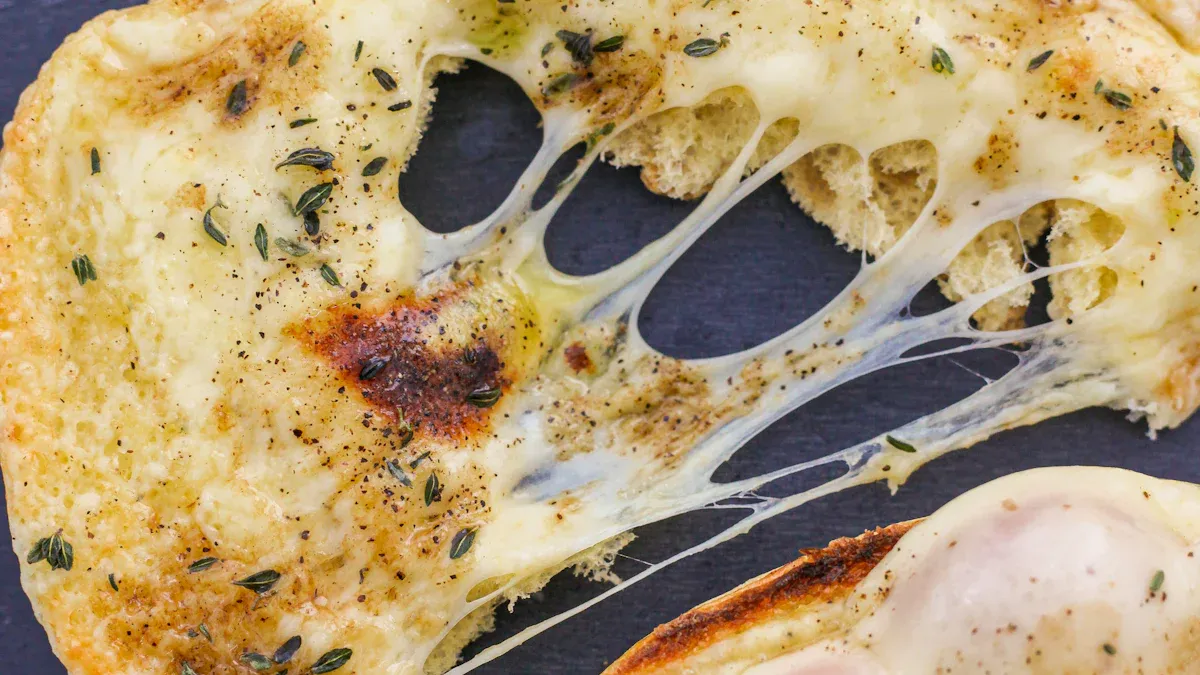
Wensleydale cheese is a crumbly, milky, and slightly acidic cheese. It originates from Wensleydale, North Yorkshire, England. This distinctive Wensleydale cheese offers a unique texture and flavor profile. Wensleydale also shows great versatility. Readers will explore its taste, nutrition, and various culinary applications of this beloved Wensleydale.
Key Takeaways
Wensleydale cheese comes from North Yorkshire, England. French monks first made it with sheep’s milk. Later, people used cow’s milk.
This cheese has a mild, clean taste. It is slightly sweet and tangy. It often tastes nutty with a hint of honey.
Wensleydale cheese is good for you. It has lots of protein and calcium. It also has less salt than many other cheeses.
You can eat Wensleydale cheese in many ways. It tastes great with fruitcake or apples. You can also put it in salads or melt it in dishes.
There are different kinds of Wensleydale cheese. Some have fruit like cranberries.
What Is Wensleydale Cheese
Origins and History
Wensleydale cheese boasts a rich history. French Cistercian monks first made this cheese. They came from the Roquefort region and settled in Wensleydale, North Yorkshire, England. These monks initially built a monastery at Fors. Later, they relocated to Jervaulx in Lower Wensleydale. They brought a recipe for making cheese using sheep’s milk. During the 14th century, cows’ milk began to replace sheep’s milk. This change altered the cheese’s character. After the monastery’s dissolution in 1540, local farmers continued the cheese-making tradition. They preserved the craft for 300 years. This continued until World War II.
The 19th and 20th centuries saw a significant shift in the cheese industry. This period, known as the ‘cheddarfication,’ impacted Wensleydale. It caused the cheese to become sharper and harder. It became more like Cheddar, despite its origins as a soft, blue ewe’s milk cheese. More recently, animated characters Wallace and Gromit boosted sales of Wensleydale. They frequently showed enthusiasm for the Yorkshire specialty in their films.
Production Process
Wensleydale cheese production follows several careful steps. It begins with fresh milk. Modern Wensleydale cheese primarily uses cow’s milk. Historically, cheesemakers used sheep’s milk.
Milk Pasteurisation & Vat filling: Fresh milk is heated to 72°C for 15 seconds. Then, it is cooled and pumped into vats.
Starter addition: Cheesemakers add a special blend of bacteria, called starter cultures, to the milk. These cultures convert lactose into lactic acid, which ‘sours’ the milk.
Rennet Addition: Rennet is stirred into the milk. This allows the milk to set and form a semi-solid junket.
Cutting, Stirring and Scalding: Workers cut the coagulum into small pieces. This releases curds and whey. Steam heats the curds and whey, expelling moisture.
Pitching: Stirring stops. The curd settles. Workers cut the curd into large blocks and move them to the sides of the vat to drain whey.
Salting: Salt is added to the curd. This reduces starter activity, expels excess whey, preserves the cheese, and enhances its flavor.
Milling: The salted curd mellows for 5-10 minutes. Then, a cheese ‘mill’ shreds it into small pieces.
Mould filling: Workers pack milled curds by hand into stainless steel molds. They weigh them and load them onto boards for pressing.
Pressing: The cheese is lightly pressed. This shapes it and expels any remaining whey.
Bandaging and Packing: Traditional cheeses are bandaged in muslin. They dry for 4-5 days, turned daily. Once dry, they are bagged, labeled, and stored or sent to a maturing room.
Storing and Grading: Traditional cheeses are stored in a cool, dark place for 4-6 months. A grader regularly checks them.
The primary ingredients for Wensleydale cheese include whole milk, direct set Mesophilic culture, rennet, and non-ionized salt. Calcium Chloride is also used if cheesemakers use homogenized milk.
Key Characteristics
Wensleydale cheese has distinct characteristics. It is a creamy-white, flaky cheese. It feels firm but not dry or hard. Its surface is crumbly, while the overall texture is creamy. It has a fine curd, minimal texturing, and a high moisture content. Authentic Wensleydale always produces some crumbs when cut.
Aspect | Description |
|---|---|
Origin | Hawes in Wensleydale, North Yorkshire, England |
Texture | Crumbly yet moist, not as firm as cheddar |
Flavor | Mild, slightly sweet and tangy, with hints of wild honey |
Color | Generally white or pale yellow |
Milk | Traditionally sheep’s milk, modern versions often cow’s milk |
Aging | Typically 1-3 months |
Varieties | Plain, blue-veined, or with added ingredients like cranberries or ginger |
The flavor profile of Wensleydale is mild and clean. It has a subtle sweetness and slight tanginess. Young cheese offers fresh, lactic notes with a hint of honeyed sweetness. This sweetness intensifies with age without becoming overly sharp. Yorkshire Wensleydale cheese is known for its distinct crumbly texture and creamy taste. It also features subtle hints of honey-like sweetness and a buttery flavor with a subtle tanginess. This sets it apart from other varieties of cheese.
Wensleydale Cheese Taste Profile
Crumbly Texture
The crumbly texture of Wensleydale cheese is a hallmark. A unique structure and a carefully maintained, traditional recipe create this characteristic. Expert cheesemakers have honed extensive knowledge, specialized skills, and meticulous craftsmanship over generations. This distinctive quality is a culmination of their efforts. The recipe, a closely guarded secret, is essential for achieving the product’s award-winning crumble. This texture feels firm but not dry or hard. It always produces some crumbs when cut.
Flavor Notes
Wensleydale offers a mild and clean taste. It has a subtle sweetness and slight tanginess. White Wensleydale is slightly sweet but also tart. People describe it as having a nutty, buttermilk flavour. A honey aftertaste and a gentle aroma of cut grass complement this. The product has a clean tang behind its mild taste.
Different types of Wensleydale present varied notes:
General Wensleydale: Tangy, sharp, slightly sweet.
Real Yorkshire Wensleydale: Mild taste with a slightly acidic quality and hints of honey.
Mature Wensleydale: Stronger taste than Real Yorkshire Wensleydale.
Extra Mature Wensleydale: Strongest taste among all Wensleydale varieties.
Blue Wensleydale: Strong taste, less salty than Blue Stilton.
Oak Smoked Wensleydale: A very special taste due to oak smoking.
Young Wensleydale offers fresh, lactic notes with a hint of honeyed sweetness. This sweetness intensifies with age. It does not become overly sharp.
Age and Flavor
Aging significantly influences the taste development of Wensleydale. Following pressing, the product is salted and then aged for a minimum of three weeks. Some varieties mature for several months. A cool and humid aging environment, around 10-12°C, is crucial for full taste development. British Wensleydale, typically aged for three weeks to three months, exhibits a range of textures and tastes. Younger versions are moist and crumbly. Aged versions become firmer and more complex.
The aging process, or affinage, is a controlled maturation. Natural enzymes and cultures develop unique textures, aromas, and tastes. This process allows the product to become more complex and expressive over time. The stages of maturation reveal different taste profiles:
Three Months: Products are youthful, tender, soft, creamy, and mild. They have a fresh and lactic aroma.
Six Months: More structure forms. They have firmer textures and juvenile complexity in taste. Mature Wensleydale is typically aged for about six months.
Twelve Months: Products are balanced and fully formed. They offer depth, earthy notes, and a rounded mouthfeel.
Eighteen to Twenty-Four Months: These are considered the pinnacle. These products are robust, often crystalline, and deeply savory. Extra Mature Wensleydale matures for over nine months.
After the whey drains and curds press, Wensleydale wheels mature to develop their unique tastes and textures. This aging period can range from a few weeks to several months. It directly influences the product’s final characteristics. Traditional methods like bandaging also influence taste development. Cheesemakers wrapped the product in cloth and coated it with fat. This reduced moisture loss during aging. It created a semipermeable layer. This process results in a slightly drier, crumbly body with distinctive, sharp, and earthy tastes. Controlled aging conditions, including temperature, humidity, and airflow, are crucial for achieving the desired body and taste in bandaged products. Factory-made Blue Wensleydale ages for approximately 2 months. Historically, farmhouse versions of Blue Wensleydale aged for up to 6 months. Blended Wensleydale, often made with young product, ages for around three months.
Production Impact on Flavor
Variations in the production process significantly affect the final taste profile of Wensleydale. The aging process is one key factor. The product typically ages for three to four months. This develops a characteristic crumbly texture and a slightly sweet, tangy taste. Longer aging, up to six months for varieties like Special Reserve Yorkshire Wensleydale, results in a harder texture and a deeper, more mature taste.
Smoking also impacts the taste. Oak Smoked Yorkshire Wensleydale is naturally smoked over oak chips for 18 hours after formation. It acquires a subtle smoked taste. Flavor additions are another common variation. Popular versions of the product are augmented with natural tastes such as cranberries, mango and ginger, or apricots. These directly influence their taste profiles.
Salt plays a vital role in stabilizing and balancing the tastes of the product. It controls bacterial and mold activity. This acts as a crucial preserving factor in the cheesemaking process. Adjusting salt levels can significantly impact the overall taste balance of the final product.
In the 1950s, strict guidelines from the Milk Marketing Board focused on standardized yields. They did not focus on taste or tradition. This led to less full-tasting products. However, the Wensleydale Creamery continues to produce this type of product using traditional methods. Fresh milk from cattle grazing in the limestone meadows of the Yorkshire Dales, consuming wild herbs, imparts a distinctive and extraordinary taste to the product. The region’s environmentally sensitive designation restricts artificial chemicals. This ensures a natural composition that contributes to the product’s unique taste.
Nutritional Information of Wensleydale
Wensleydale offers valuable nutrition. Understanding its nutrition helps consumers make informed dietary choices. This section details the nutrition facts for Wensleydale.
Calories and Fat
Wensleydale provides a good source of energy. A 100g serving contains significant calories.
Serving Size | Energy (calories) |
|---|---|
10g | 38 |
40g | 152 |
The fat content is also notable.
Nutrient | Per 100g |
|---|---|
Total Fat | 32.14g |
Saturated Fat | 21.43g |
These figures contribute to the overall nutrition profile of Wensleydale.
Protein and Calcium
Wensleydale is a good source of protein. It contains nearly 7 grams of protein per ounce. This equals approximately 24 grams per 100 grams. The cheese also provides a high amount of calcium. Wensleydale contains approximately 714.28 mg of calcium per 100g. A 28g serving provides 200 mg of calcium. This makes Wensleydale a beneficial food for bone health. This nutrition is important for many body functions.
Vitamins and Minerals
Wensleydale contains several important vitamins and minerals. It includes Vitamin D.
Vitamin |
|---|
Vitamin D |
Other minerals are also present.
Nutrient | Value |
|---|---|
Calcium | 195mg |
Sodium | 160mg |
Vitamin A | 150μg |
These elements add to the comprehensive nutrition of Wensleydale.
Dietary Aspects
Wensleydale offers a rich nutrition profile. It provides a good source of protein. It also contains significant amounts of various vitamins and minerals. A 28g serving contributes:
Vitamins: 11% DV of Vitamin A, 10% DV of Riboflavin (B2), 4% DV of Biotin, and 2% DV of Pantothenic acid (B5).
Minerals: 12% DV of Calcium, 9% DV of Phosphorus, 9% DV of Iodine, and 9% DV of Zinc.
Wensleydale Creamery Wensleydale Cheese contains 0.1g of total carbohydrates per 100g serving. This makes it a low-carb option. Wensleydale also has a lower sodium content compared to many other popular cheeses.
Cheese Type | Sodium Content (mg per 100g) |
|---|---|
Wensleydale | 440 |
Cheddar | 653 |
Camembert | 842 |
Parmesan | 1180 |
This chart visually represents the sodium difference. Wensleydale has approximately 30% to 65% less sodium than Cheddar, Camembert, and Parmesan. This makes Wensleydale a good choice for those monitoring sodium intake. Its overall nutrition makes it a healthy addition to many diets.
Uses and Pairings for Wensleydale Cheese

Wensleydale offers diverse culinary applications. Its unique taste and texture make it a versatile ingredient. People enjoy it in many dishes and with various accompaniments.
Classic Uses
Wensleydale holds a special place in British cuisine. George Orwell once cited Wensleydale as an example of British culinary supremacy. This highlights its esteemed status. Traditionally, people enjoy Wensleydale with fruitcake in its native Yorkshire. This pairing creates a delightful balance of sweet and savory.
Recipe Ideas
Many recipes feature Wensleydale. One specific recipe is ‘Sugared Wensleydale Cheese with Biscuits’. This shows its adaptability. Other popular ideas include:
Brad’s Foie Gras Hors d’oeuvres (featuring Wensleydale with blueberries)
Wensleydale Pastry Bites
My Avocado & Apricot Cheese Spread (using Wensleydale with apricot)
Skillet Cauliflower Cheese With Caramelised Red Onions (containing crumbled Wensleydale)
Fruit and cheese sticks (with Cranberry Wensleydale)
Courgette, Red Onion and Pea Cheese Pasta (incorporating grated Wensleydale)
Yorkshire Wensleydale Cheese, Sun Dried Tomato & Red Onion Quiche
People also enjoy Yorkshire Wensleydale & Cranberries stuffed in bacon-wrapped chicken breasts. They serve this with an apple and walnut salad. Another option is Yorkshire Wensleydale & Cranberries and Apple Cake. Wensleydale Blue, Mushroom and Spinach Savoury Pancakes also make a delicious meal.
Food Pairings
Wensleydale pairs well with many foods. People often enjoy it on a classic cheese board. Its crumbly texture and mild flavor complement other cheeses. They also crumble Wensleydale over salads. This adds a creamy, tangy element. Cooks melt Wensleydale into savory dishes. This enhances their richness. The cheese’s slight sweetness makes it a good match for fruits like apples and pears.
Beverage Pairings
Wensleydale pairs nicely with certain beverages. Its mild, milky flavor complements lighter drinks. A crisp white wine, such as a Sauvignon Blanc, works well. Some people prefer a light-bodied ale or cider. These drinks enhance the cheese’s subtle notes without overpowering them.
Types of Wensleydale Cheese
Wensleydale comes in many varieties. These varieties offer different tastes and textures. Production methods also create distinct types. Consumers can find lemony, grainy factory cheese. They can also find softer, multidimensional farmhouse cheese. These differences highlight the versatility of Wensleydale.
Traditional Wensleydale
Traditional Wensleydale often refers to farmhouse Wensleydale. Artisans make this cheese using time-honored methods. Farmhouse Wensleydale typically has a richer, more complex flavor. Its texture is often softer and more crumbly than mass-produced versions. This type of Wensleydale reflects the specific conditions of its origin. It often uses milk from local herds.
Commercial Wensleydale
Commercial Wensleydale is widely available. Factories produce this cheese on a larger scale. This production often leads to a more consistent product. Commercial varieties might have a slightly firmer texture. Their flavor can be milder and less nuanced than farmhouse Wensleydale. These varieties are popular for everyday use.
Flavored Wensleydale
Flavored Wensleydale varieties are very popular. Producers add various ingredients to the cheese. Cranberries are a common addition. They give the cheese a sweet and fruity flavor. Other popular additions include apricots, ginger, or even blueberries. These flavored varieties offer a delightful twist on the classic Wensleydale. They are excellent for snacking or dessert.
Blue Wensleydale
Blue Wensleydale is a distinct variety. Cheesemakers introduce blue mold cultures during production. This creates blue veins throughout the cheese. Blue Wensleydale has a stronger taste than its plain counterparts. It offers a tangy, savory flavor. This variety is less salty than other blue cheeses like Blue Stilton. Blue Wensleydale provides a unique experience for cheese lovers.
This article explored Wensleydale’s unique taste, its nutritional value, and its versatility as a cheese. It stands as a traditional British cheese with a rich history. Readers should explore different forms of Wensleydale. They can incorporate it into their cooking and snacking. Discover your favorite Wensleydale experience.
FAQ
What is the origin of Wensleydale cheese?
French Cistercian monks first made Wensleydale cheese. They settled in North Yorkshire, England. They used sheep’s milk. Later, cheesemakers switched to cow’s milk. Local farmers continued the tradition after the monasteries closed.
What does Wensleydale cheese taste like?
Wensleydale cheese has a mild, clean taste. It offers subtle sweetness and slight tanginess. People describe it as nutty with a buttermilk flavor. It often has a honey aftertaste and a gentle aroma of cut grass.
What are the nutritional benefits of Wensleydale cheese?
Wensleydale cheese provides good protein. It contains significant calcium, beneficial for bone health. It also offers vitamins like A and D. The cheese has lower sodium than many other popular cheeses.
What foods pair well with Wensleydale cheese?
People enjoy Wensleydale cheese with fruitcake. It pairs well with apples and pears. You can crumble it over salads. It also melts into savory dishes. Crisp white wine or light ale complements its flavor.
What are the different types of Wensleydale cheese?
Wensleydale cheese comes in traditional farmhouse versions. Commercial varieties are also available. Flavored types include cranberry or ginger. Blue Wensleydale has blue veins and a stronger, tangy taste.