


The nutrition facts label is a standardized tool. It helps you understand food content. This label is crucial for informed food choices in 2025. Nearly 80% of US adults use these labels for buying decisions. This guide helps you navigate the label effectively. You will quickly identify key nutrition information for healthy eating. These labels empower you to make informed dietary choices. This leads to positive long-term health outcomes. They provide crucial information about nutrition.
Key Takeaways
The Nutrition Facts Label helps you understand what is in your food. It helps you make smart food choices.
New labels in 2025 will have a simple ‘Nutrition Info box’ on the front. This box will show if a food is ‘Low,’ ‘Med,’ or ‘High’ in saturated fat, sodium, and added sugars.
Always check the serving size first. All other numbers on the label are for one serving. If you eat more, you get more calories and nutrients.
The Percent Daily Value (%DV) tells you if a food has a lot or a little of a nutrient. Aim for foods with high %DV for good nutrients like fiber. Choose foods with low %DV for things like added sugars and sodium.
Use the label to compare foods and pick healthier options. Look for less added sugar, sodium, and unhealthy fats. Choose foods with more vitamins and minerals.
What is the Nutrition Facts Label in 2025?
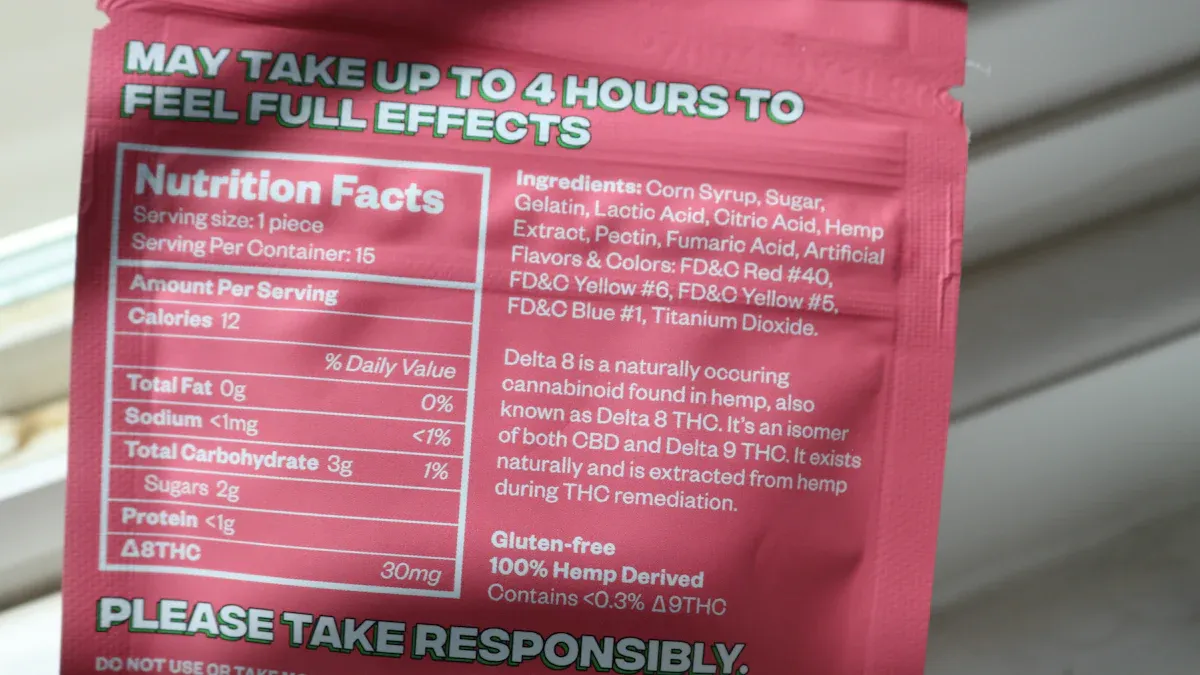
Purpose of Nutrition Labels
The Nutrition Facts Label is a standardized panel you find on packaged foods. It gives you quick, important information about what you eat. The U.S. Food and Drug Administration (FDA) regulates these labels. They help you make informed food decisions. Food and beverage makers and stores actively help you choose wisely at the grocery store. The ‘Facts up Front’ program is a good example. This voluntary program has helped for over ten years. It puts short, easy-to-read nutrition information on the front of packages. This information comes from the full Nutrition Facts Panel, usually on the back. This makes crucial nutrition facts easier to find. It helps you understand nutrition better and reach your dietary goals.
The Nutrition Labeling and Education Act (NLEA) became law in 1990. This important law made sure food labels gave you full information. It helped you make smart food choices. It also encouraged food makers to create healthier products. Before NLEA, most packaged foods did not have mandatory nutrition information. Only items making special claims or fortified with vitamins had it. The NLEA then required a detailed, standard Nutrition Facts Label on all food packaging. This label shows serving size, calories, fat content, carbohydrates, fiber, sugars, protein, cholesterol, sodium, and some vitamins and minerals. This standard label officially started in May 1994.
Key Updates for 2025
You will see some important changes to the Nutrition Facts Label by 2025. These updates aim to make nutrition information even clearer. A proposed rule for a ‘Front-of-Package Nutrition Info box’ is under review. This box would appear prominently on most packaged foods. This new system simplifies your choices. It categorizes saturated fat, sodium, and added sugars as ‘Low,’ ‘Med,’ or ‘High.’ This gives you a simple snapshot of a product’s health profile. It helps you make healthier choices quickly. You will not need to search for details on the back of the package.
These 2025 updates, including the mandatory front-of-package (FOP) label, make nutrition information more accessible. They give you an immediate look at a product’s health. This helps you compare products fast and choose healthier options. Calorie counts and font sizes on the back-of-package label will also be larger and bolder. This improves readability. The main goal is to improve health understanding. It also aims to help with diet-related chronic diseases and improve health fairness.
The FDA’s proposed rule, announced in January 2025, requires this ‘Nutrition Info box.’ This rule means changes to existing food labeling rules. These changes affect the information panel, nutrient content claims, and how statements appear. They also affect claims for sodium, fat, and cholesterol. The definition of ‘healthy’ claims on food labels is also changing. This means manufacturers must update their labels. They might also need to change their products. Labels will need new artwork, layout, and marketing claims to meet these new rules.
The FDA will focus enforcement on added sugars, serving size accuracy, and front-of-package nutrient claims. They also encourage plant-based milk alternatives to voluntarily show nutrient differences compared to dairy milk. Some products, like spices or plain instant coffee, have ‘no nutritional significance.’ They may not need a full Nutrition Facts panel. However, if any nutrients are present, they must be shown. Structured product labeling guidelines are also important. They help organize information better and make it easier to access. A 2025 study by Y. Liu et al. found that front-of-package labels can guide you to healthier choices. However, a simple ‘healthy’ badge might not always work. The study showed people would pay more for an unlabeled yogurt than for one called ‘healthy.’ This suggests you might worry ‘healthy’ products taste worse. Adding text like ‘meets FDA’s criteria: low in sat fat, sugar and sodium’ removed this pricing issue. This shows clear information is key for you to understand.
How to Read a Nutrition Facts Label: Key Sections
You want to make informed food choices. Understanding the main parts of the nutrition facts label is essential. This section guides you through the most important features. You will learn what each piece of information means for your health.
Serving Size and Servings Per Container
Look at the top of the label. You will find the “serving size” and “servings per container.” The “serving size” tells you the standard amount of food for one serving. This amount is often measured in cups, grams, or pieces. The “servings per container” tells you how many of those servings are in the entire package.
These numbers are very important. All other nutrition information on the label refers to one serving. If you eat two servings, you double all the numbers. If you eat half a serving, you halve them. Always check the serving size first. This helps you accurately calculate your intake.
The FDA sets guidelines for determining a serving size.
First, they categorize the food. Is it a liquid or a powder? Is it a main dish or a side dish? They also consider if it’s a single unit, a bulk item, or a product you divide.
Next, they use the RACC (Reference Amounts Customarily Consumed). This is a detailed list of typical amounts people eat for various food types. The RACC acts as a benchmark.
Finally, they adjust the serving size for practicality. It must be easy for you to understand. For example, a whole cookie might be listed as one serving, even if it slightly differs from the RACC. This makes it simpler for you to measure what you eat.
Calories: Your Energy Snapshot
Below the serving information, you will see “Calories.” Calories measure the energy you get from food. They come from carbohydrates, proteins, and fats. This number tells you how much energy one serving provides.
Monitoring calories helps you understand a food’s contribution to your daily energy intake. Your individual caloric needs differ. Factors like your age, activity level, height, and weight all play a role. Eating more calories than your body uses can lead to weight gain. Eating fewer calories than you burn can lead to weight loss. The nutrition labels help you balance your energy intake. They show the numerical calorie content. Some labels also show energy as a proportion of daily guidelines. This helps you manage your overall nutrition.
Understanding Percent Daily Value (%DV)
The “percent daily value” (%DV) is a key feature on the label. This daily value shows you how much a nutrient in one serving contributes to a total daily diet. The FDA bases this on a 2,000-calorie daily intake. This 2,000-calorie diet is a general guide. Your actual needs might be higher or lower.
You use the percent daily value to quickly assess a food’s nutrient content.
A %DV of 5% or less means the food is low in that nutrient.
A %DV of 20% or more means the food is high in that nutrient.
For nutrients you want more of, like fiber or certain vitamins, aim for foods with a higher percent daily value. For nutrients you want to limit, like saturated fat, sodium, or added sugars, choose foods with a lower percent daily value. This helps you make healthier choices. You should consider the %DV along with the actual nutrient amounts. This helps you understand how to read a nutrition facts label effectively. These labels are powerful tools for your health.
Decoding Nutrients: Fats, Carbs, and Protein
You look at the nutrition label to understand what you eat. This section helps you decode the main nutrients: fats, carbohydrates, and protein. Understanding these macronutrients is key for good nutrition.
Fats: Saturated, Trans, and Unsaturated
Fats provide energy. You see different types of fats on your nutrition label. Saturated fats can cause health problems. They build up cholesterol in your arteries. This raises LDL, or “bad,” cholesterol. This increases your risk for heart disease and stroke. Many foods high in saturated fat also have many calories. This can lead to weight gain. Maintaining a healthy weight helps reduce risks for diabetes and heart disease. If you have diabetes, choose foods lower in saturated and trans fats. These fats raise LDL cholesterol, increasing heart attack and stroke risk. Limit your daily intake of saturated fat, trans fat, and cholesterol to protect your heart.
Trans fats are also harmful. Food makers must list trans fat content on labels since 2006. A product can say “trans free” if it has less than 0.5g of trans fat per serving. Always check the ingredient list for hydrogenated oils. “Trans free” does not mean zero trans fat. Look for “0 g trans fat” on the label. Avoid hydrogenated oils in the ingredients list. Unsaturated fats, like monounsaturated and polyunsaturated fats, are healthier choices.
Carbohydrates: Total, Fiber, and Sugars
Carbohydrates give your body energy. The nutrition label breaks them down. “Total Carbohydrates” includes sugars, starches, and fiber. Fiber is important for digestion. It helps you feel full. Sugars provide quick energy. The label shows total sugars and added sugars. You want to limit added sugars.
Protein: Building Blocks for Your Body
Protein is essential for your body. It helps build and repair muscles and tissues. Protein also helps make enzymes and hormones. You need enough protein for overall health. The label tells you how much protein is in one serving.
Essential Micronutrients and Added Sugars
You now understand macronutrients. Next, you need to focus on essential micronutrients and added sugars. These components significantly impact your overall health and nutrition.
Identifying Added Sugars
Added sugars are a key focus on the new labels. You find them in many processed foods. They contribute calories but offer little nutritional value. The FDA defines added sugars as:
sugars that are “added during the processing of foods, or are packaged as such, and include sugars (free, mono- and disaccharides), syrups, naturally occurring sugars that are isolated from a whole food and concentrated so that sugar is the primary component (e.g., fruit juice concentrates), and other caloric sweeteners.
The FDA also recognizes that:
there are currently no artificial methods to distinguish between added and naturally occurring sugars.” There are also no analytical methods that can determine the amount of added sugar in specific foods containing added sugars alone or in combination with naturally occurring sugars, where the added sugars are subject to fermentation.
High consumption of added sugars links to several health issues.
Obesity
Cardiovascular disease (CVD) risk factors, including dyslipidemia, elevated blood pressure
Diabetes
Non-alcoholic fatty liver disease
Cognitive decline
Cancer
Dr. Frank Hu, a professor of nutrition at Harvard, states that more added sugar increases heart disease risk. High sugar amounts can overload your liver. It metabolizes sugar like alcohol. This converts dietary carbohydrates to fat. This can lead to fatty liver disease. Fatty liver disease contributes to diabetes and increases heart disease risk. Excessive added sugar also raises blood pressure and increases chronic inflammation. Both are pathways to heart disease.
Sodium: Managing Intake
Sodium is another nutrient you must monitor. Too much sodium can harm your health. Health organizations recommend limiting your daily sodium intake.
Organization | Sodium Recommendation (g/day) | Salt Recommendation (g/day) |
|---|---|---|
WHO 2013 | <2 | 5 |
WCRF/AICR 2016 (Public Health Goals) | 2 | 5 |
WCRF/AICR 2016 (Personal Recommendations) | 2.4 | 6 |
FSAI 2016 (Target for Irish Population) | 2.4 | 6 |
FSAI 2016 (RDA for Individuals) | 1.6 | 4 |
AHA/ACC 2013 (for blood pressure lowering) | No more than 2.4; further reduction to 1.5 for greater BP reduction | N/A |
IOM 2013 (Tolerable Upper Intake Level) | 2.3 | 5.8 |
IOM 2013 (Adequate Intake for young adults) | 1.5 | 3.8 |
IOM 2013 (Adequate Intake for older adults 50-70) | 1.3 | N/A |
IOM 2013 (Adequate Intake for older adults 71+) | 1.2 | N/A |
EU countries 2018 | N/A | 5 or 6 |
DGE 2016 | 1.5 | Up to 6 |
NNR 2012 | 2.4 | 6 |
BfR 2011 | N/A | 3.5 to 6 |
SACN 2003 | 2.4 | 6 |
DGAC 2015 | <2.3 | N/A |
AHA/ACC 2013 (for blood pressure lowering) | No more than 2.4; further reduction to 1.5 for greater BP reduction | N/A |
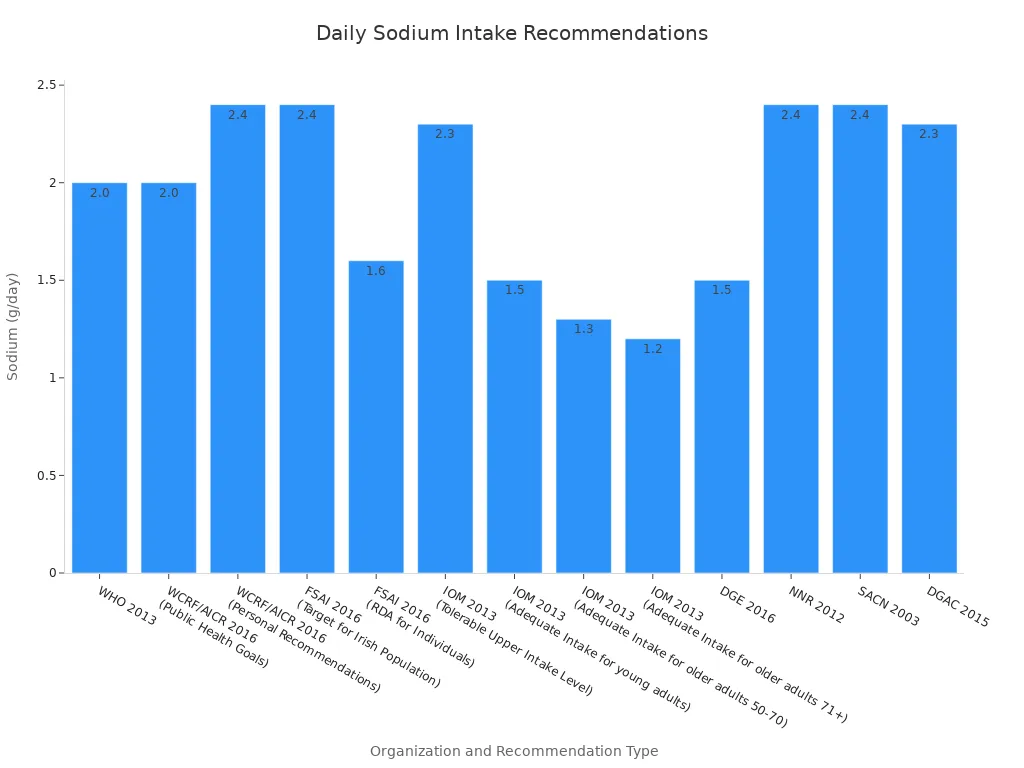
Many health organizations suggest a low sodium intake. Aim for less than 2.3 grams per day. This equals about one teaspoon of salt.
Excessive sodium in your blood, called hypernatremia, can occur. This happens from not drinking enough fluids or severe dehydration. It causes water to shift from your cells into your blood. This dilutes the sodium. It can lead to fluid buildup in your brain. This may result in seizures, coma, or even death. Fluid in your lungs can cause breathing problems. Other symptoms include nausea, vomiting, weakness, and intense thirst.
When your kidneys struggle with too much sodium, your body holds water. This dilutes the sodium. It increases fluid around cells and blood volume. This makes your heart work harder. It puts more pressure on your blood vessels. Over time, this can stiffen them. This process can lead to high blood pressure, heart attack, stroke, and heart failure. High salt intake can also directly harm your heart, aorta, and kidneys. It can even negatively impact your bones.
Key Vitamins and Minerals (Vitamin D, Potassium)
The nutrition label also highlights important vitamins and minerals. Vitamin D and potassium are two key micronutrients. They play vital roles in your health.
You get Vitamin D from:
Fatty fish (salmon, tuna, mackerel)
Fortified foods: milk, many ready-to-eat cereals, some brands of yogurt and orange juice, some margarines
Small amounts in beef liver and egg yolks
Naturally small amounts in cheese
Potassium sources include many common foods and drinks. Adequate potassium intake helps reduce blood pressure in adults. This lowers your risk of stroke and coronary heart disease. It also protects against age-related bone loss and helps reduce kidney stones.
Vitamin D helps your body absorb calcium. It boosts bone mineral density. Potassium also enhances bone mineral density. Together with magnesium, potassium prevents your blood from becoming too acidic. This stops calcium from leaching out of your bones and teeth. Vitamin D also helps prevent certain cancers. It aids in weight management and speeds up healing and recovery. It may even help lower blood pressure.
Using Nutrition Labels for Healthier Choices

You want to make better food decisions. Apply the knowledge you gain from reading the nutrition labels. This section gives you actionable advice.
Comparing Products Effectively
You can compare products effectively. Do not rely on a single score. Instead, compare nutrient values one by one. This helps you find small differences. You can use statistical tests to find significant differences between brands. Algorithms and scoring systems also help.
The Health Star Rating (HSR) or traffic-light icons show key nutrients. These systems give you easy-to-understand nutrition profiles. They help you find healthier alternatives. Mobile apps like FoodSwitch scan barcodes. They use science-based algorithms. These apps show overall nutritional quality. They also suggest healthier product switches. They consider energy, saturated fat, sugar, salt, protein, fiber, and fruit/vegetable content. This helps you make informed food choices.
Tailoring Choices to Dietary Needs
Your dietary needs are unique. Use nutrition labels to meet them. If you manage blood sugar, check carbohydrate and sugar content. If you watch your heart health, focus on saturated and trans fats. Look for lower sodium if you manage blood pressure. This label helps you find foods that fit your specific health goals. This personalized approach to nutrition supports your well-being.
Empowering Your Grocery Shopping
You can make smart food choices at the store. Use these practical tips.
Check the Calories: Look at calorie counts per serving. This helps you meet your daily needs. Choose nutrient-dense foods.
Examine the Nutrients: Focus on fats. Aim for lower saturated and trans fats. Seek lower cholesterol. Understand total carbs, fiber, and sugars. Ensure balanced protein intake. Look for higher %DV of essential vitamins and minerals.
Beware of Added Sugars and Sodium: Find hidden sugars like high fructose corn syrup. Watch for too much sodium. Limiting these benefits your long-term health.
Understand Ingredient Lists: Ingredients are listed by weight. Choose products with whole, recognizable ingredients. Be careful with long lists and artificial additives.
Use Percent Daily Values (%DV) Wisely: Remember, 5% DV or less is low. 20% DV or more is high. Choose foods with higher %DV for fiber, vitamin D, calcium, iron, and protein. Pick foods with lower %DV for saturated fat, sodium, and added sugars.
Compare Products: When similar items are available, compare their nutrition labels. Select the one that best meets your health goals.
Watch for Marketing Tricks: Be careful with claims like “natural” or “low-fat.” Always check the actual nutrition facts label for true information.
Consider Special Dietary Needs: If you need gluten-free or allergen-free foods, check for certifications and warnings on the label.
You now grasp the importance of nutrition labels. Remember the 2025 updates. Reading these labels empowers you. It is a powerful tool for your personal health. You make conscious food choices. Apply this knowledge consistently. This helps you achieve your dietary goals. It supports a healthier lifestyle and better overall nutrition.
Make informed decisions every time you shop!
FAQ
What is the biggest change to the Nutrition Facts Label in 2025?
The biggest change is the new “Front-of-Package Nutrition Info box.” This box will show key nutrients like saturated fat, sodium, and added sugars. It uses simple “Low,” “Med,” or “High” ratings. This helps you quickly see a product’s health profile.
Why is “added sugars” now so important on the label?
Added sugars contribute calories without much nutrition. High amounts link to health issues like obesity and heart disease. The label now clearly shows added sugars. This helps you limit your intake for better health.
How does serving size affect the nutrition information I see?
All nutrition information on the label refers to one serving. If you eat two servings, you consume double the calories and nutrients listed. Always check the serving size first. This helps you accurately calculate your intake.
What does %DV mean for my daily diet?
The %DV, or Percent Daily Value, shows how much a nutrient in one serving contributes to your total daily diet. It uses a 2,000-calorie diet as a guide. A low %DV (5% or less) means a food is low in that nutrient. A high %DV (20% or more) means it is high.