

Do you ever find your baking results inconsistent? Scaling a favorite recipe up or down can often lead to frustration. You might wonder why your dough feels different each time. The Baker’s Percentage Calculator provides a powerful answer to these common problems. This tool brings precision and control directly into your kitchen. It helps you achieve perfect, repeatable results every single time.
Understanding Baker’s Percentage
Core Concept Defined
Baker’s percentage is a fundamental concept in baking. It provides a precise way to measure ingredients. You express each ingredient’s weight as a percentage of the flour’s weight. Flour always represents 100% in this system. This method helps you understand the true ratio of ingredients in your recipe.
Baker’s percentage, also known as baker’s math, is a method for writing formulas. Each ingredient is expressed as a percentage of the flour’s weight. The flour’s weight is consistently 100%. This means you divide each ingredient’s weight by the flour’s weight to get its percentage. For example, if you use 500 grams of flour and 300 grams of water, your water percentage is (300/500) * 100 = 60%.
It is important to understand that baker’s percentage is relative to the flour’s weight, not the total dough weight. When you sum all the baker’s percentages, the total will always be more than 100%. This is because flour itself is 100%.
Consider this example:
Ingredients | Weight | Baker’s Percentage |
|---|---|---|
Flour | 1000g | 100% |
Water | 600g | 60% |
Salt | 20g | 2% |
Yeast | 5g | 0.5% |
Total Baker’s Percentages | N/A | 162.5% |
The total dough weight would be 1625g, but the sum of baker’s percentages is 162.5%. This distinction is key to using the Baker’s Percentage Calculator effectively.
Why it’s Essential
Using baker’s percentage is essential for several reasons. It brings consistency, scalability, and a deeper understanding of ingredient ratios to your baking.
Ensures the right balance of ingredients for baked goods. You achieve consistent results every time.
Facilitates scaling recipes up or down for various production needs. This applies whether you are baking for a large family or a small batch.
Guarantees consistent results every time. You can expect the same texture and flavor.
Greater consistency in recipes due to weight-based measurements. This removes guesswork.
Ease and simplicity of scaling formulas up or down. You can adapt recipes quickly.
Quickness to correct defects in the formula. It is easier to identify if a recipe is too dry, sweet, or salty.
Ability to check if a formula is well-balanced. You can see the ratios clearly.
Precision of measurement. This helps eliminate or fix scale errors.
Consistency in production. Your baked goods will always meet your standards.
Ease in predicting how the final product will look. You can anticipate crumb structure based on hydration.
Baker’s percentages are a simple system. Professionals use it to scale dough recipes with precision. It makes scaling recipes up or down easy. It keeps the dough’s texture and flavor consistent. Whether you make a small or large batch, the formula remains the same. This allows for consistent results across various baked goods. The Baker’s Percentage Calculator helps you achieve this precision. It ensures all ingredients change proportionally. This maintains the correct balance of the original recipe. This method provides more precise measurements. It leads to consistent results whether you increase or decrease the batch size. It allows for efficient adjustment of recipes. The finished baked product will be just as good regardless of scaling.
Using a Baker’s Percentage Calculator
A Baker’s Percentage Calculator simplifies the complex math of baking. It takes your desired ratios and translates them into precise, usable weights. You no longer need to guess or perform tedious calculations by hand. This tool ensures your ingredients are always in perfect balance.
Inputting Recipe Data
You typically start by telling the calculator how much flour you want to use. This is your foundation. For example, you might decide you need 500 grams of flour for your recipe. Then, you input the desired percentages for your other ingredients. The calculator needs to know what kind of flour you are using. It also needs to know the percentages for water, salt, and yeast.
A good Baker’s Percentage Calculator often includes specific fields for various ingredients. You might see input fields for:
Whole Wheat Flour (g)
Dark Rye Flour (g)
AP or Bread Flour (g)
Non-chlorinated Water (g)
Fine Sea Salt (g)
Instant Dry Yeast (g)
Levain: Whole Wheat Flour
Levain: Flour B
Levain: Water
You enter the flour weight first. Then, you input the percentage for each additional ingredient. For instance, you might want 65% water, 2% salt, and 0.5% yeast. The calculator then does the rest.
Interpreting Output Weights
Once you input your data, the Baker’s Percentage Calculator provides exact ingredient weights. It converts your percentages into grams or ounces. This gives you a precise shopping list for your baking.
Here is how a calculator converts percentages into ingredient weights:
It divides the ingredient’s percentage by 100.
Then, it multiplies that result by the weight of the flour.
For example, if water is 60% and flour is 700g, the water weight is (60 / 100) * 700 = 420g.
Alternatively, if you know the total desired quantity of your recipe, the calculator can work backward.
It first determines the weight equivalent of 1%. It does this by dividing the total desired weight by the total percentage of all ingredients.
For instance, if the total weight is 2600g and the total percentage is 163.3%, then 1% equals 2600 / 163.3 = 15.9g.
Each ingredient’s weight is then found by multiplying its percentage by this 1% equivalent.
For example, Flour = 100 * 15.9 = 1590g, Water = 60 * 15.9 = 954g.
Let’s look at a simple bread recipe example. You want to make a loaf of bread.
Start with a simple white bread recipe. For example: 500g flour, 330g water, 5g dry instant yeast (DIY), and 10g salt.
Identify the total amount of flour in the recipe. This is 500g.
Calculate the percentage for each ingredient. You divide its weight by the total flour weight and multiply by 100.
Flour: 500g / 500g = 1.00 = 100%
Water: 330g / 500g = 0.66 = 66%
DIY: 5g / 500g = 0.01 = 1%
Salt: 10g / 500g = 0.02 = 2%
The resulting baker’s percentage formula is: 100% flour, 66% water, 1% DIY, and 2% salt.
Now, imagine you want to make a smaller loaf, say 750g total dough weight, instead of the original recipe’s total.
First, sum all the baker’s percentages: 100% flour + 66% water + 1% DIY + 2% salt = 169%.
Convert this total to a decimal: 1.69.
Divide your desired loaf weight (750g) by the total baker’s percentage in decimal form: 750g / 1.69 = approximately 443.79g. This gives you the new flour weight.
Calculate the weight of every other ingredient. You multiply the new flour weight (443.79g) by their respective baker’s percentages in decimal form.
Water: 443.79g * 0.66 = 292.90g
DIY: 443.79g * 0.01 = 4.44g
Salt: 443.79g * 0.02 = 8.88g
This process shows you how the calculator works. It gives you the exact amounts you need for your desired batch size.
Benefits of Baker’s Percentage
Using baker’s percentage transforms your baking. It gives you control and understanding. You will see many advantages in your kitchen.
Effortless Recipe Scaling
You can easily scale recipes up or down. This system ensures consistency, flavor, and texture you can count on. Pizza pros and bakers use this simple system. They scale dough recipes with precision every single time. It makes scaling recipes easy. It keeps the dough’s texture and flavor consistent. You can make a small batch for yourself or a large one for a party. The results will always be the same.
Precise Recipe Modification
Baker’s percentage makes precise recipe modification simple. Flour is the constant. It is always 100%. Each other ingredient is a percentage of that flour. This lets you determine exact measurements for any recipe size. You can easily adjust ingredients. For example, you might want 20% whole wheat flour in your recipe. You can calculate the exact amount needed. This system helps you experiment with recipes. You can adjust them to meet your desired yield. The ratios between ingredients stay the same, even if amounts change.
Troubleshooting Baking Issues
Baker’s percentage helps you troubleshoot common baking issues. You can quickly identify problems. For example, if your dough is too dry, you might have low hydration. If it is too wet, hydration might be too high. This system helps you adjust ingredients like salt or levain. You can fix issues like bland taste or slow fermentation. You can even adjust for weather changes.
Issue | Possible Cause | How Baker’s Percentage Helps |
|---|---|---|
Dough too dry/tight | Low hydration percentage | Increase water by 2-5% |
Dough too wet/sticky | High hydration or weak flour | Lower hydration or use stronger flour |
Bread tastes bland/salty | Incorrect salt percentage | Adjust salt to 1.8-2.2% |
Slow fermentation | Low levain percentage | Increase levain slightly, especially in cold weather |
Fast fermentation | High levain or warm conditions | Reduce levain or ferment in a cooler space |
Tight crumb | Hydration or mixing technique | Increase hydration or knead more |
Adjusting for weather | Temperature variations | Reduce levain in hot weather; increase in cold weather |
Deepening Your Baking Knowledge
Understanding baker’s percentage deepens your baking knowledge. You learn the true ratios of ingredients. This system helps you compare different recipes. You see how changes in one ingredient affect the whole. The Baker’s Percentage Calculator helps you visualize these relationships. You gain confidence to create your own recipes. This knowledge makes you a better baker.
Finding or Building Your Calculator
You have many ways to get a Baker’s Percentage Calculator. You can find tools online, build one yourself in a spreadsheet, or even do the math by hand. Each method offers different levels of convenience and control.
Online Tools and Apps
Many online tools and mobile apps help you with baker’s percentages. These tools make calculations easy. For example, Baker Buddy helps you input a target dough weight. It then calculates all ingredient amounts for you. It also stores your recipes. Baker’s note is another app. It lets you store recipes, add photos, and automatically adjust ingredient quantities when you scale a recipe.
Other apps like Homebaker are great for bread baking. They calculate percentages, dough weight, and hydration automatically. You can track baking sessions and even share recipes. These apps often support features like:
Automatic baker’s percentage calculations.
Handling multi-stage recipes.
Scaling by desired yield or ingredient.
Syncing across your devices.
Providing a good mobile experience.
Spreadsheet Method
You can also build your own Baker’s Percentage Calculator using a spreadsheet program like Excel or Google Sheets. This gives you full control. You set up columns for ingredients, their weights, and their percentages. You then use simple formulas. For example, you can tell the spreadsheet to calculate the weight of water if you input the flour weight and water percentage. This method is flexible. You can customize it exactly how you like.
Manual Calculation
Sometimes, you might need to calculate baker’s percentages without a tool. You can do this manually. To find an ingredient’s baker’s percentage, you divide its weight by the flour’s weight. Then, you multiply that result by 100%.
Here is an example:
Ingredient | Weight (kg) | Calculation (Ingredient Mass / Flour Mass) | Baker’s Percentage |
|---|---|---|---|
Flour | 10 | 10 kg ÷ 10 kg = 1.000 | 100% |
Water | 3.5 | 3.5 kg ÷ 10 kg = 0.350 | 35% |
Milk | 3.5 | 3.5 kg ÷ 10 kg = 0.350 | 35% |
Fresh Yeast | 0.4 | 0.4 kg ÷ 10 kg = 0.040 | 4% |
Salt | 0.18 | 0.18 kg ÷ 10 kg = 0.018 | 1.8% |
This table shows you how to calculate each ingredient’s percentage. You can use this method to check your recipes or when you do not have access to digital tools.
Effective Calculator Use
You can get the most from your Baker’s Percentage Calculator. You need to understand some key practices. These tips help you achieve consistent and delicious results.
Weight Over Volume
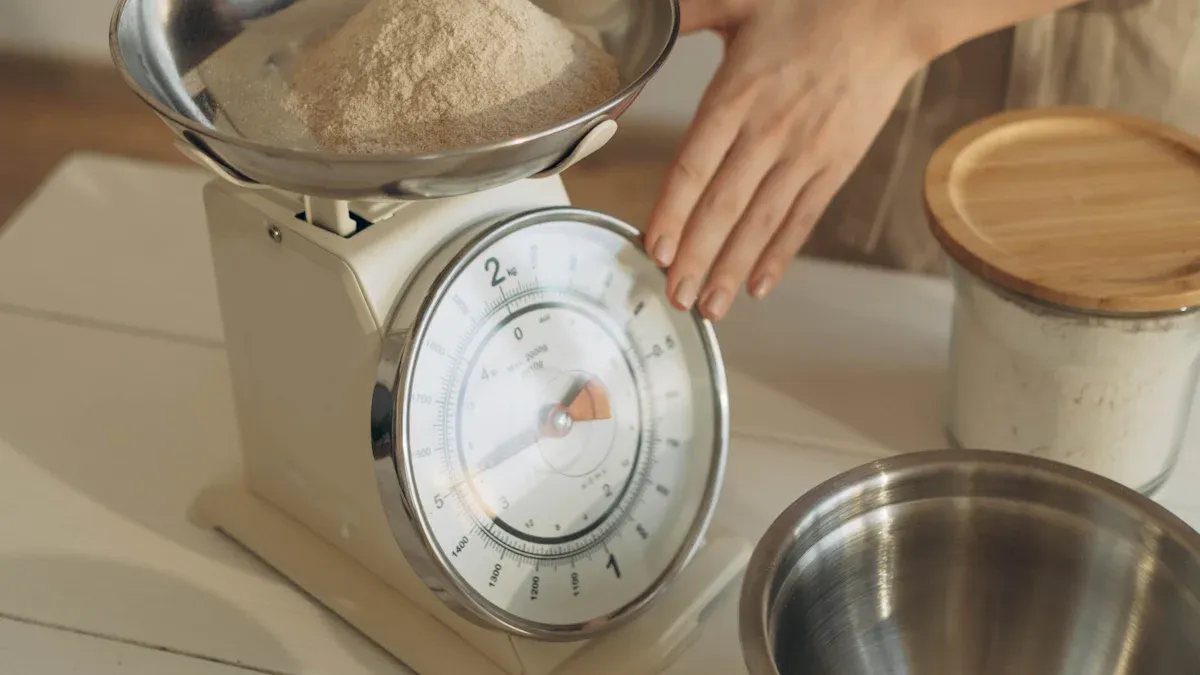
Always measure your ingredients by weight. This is more accurate than using volume. Volume measurements can vary greatly. For example, one cup of all-purpose flour can weigh differently. It might be 135 grams in Alton Brown’s recipes. It could be 140 grams in The Essential New York Times Cookbook. America’s Test Kitchen found it can be as little as 88 grams if you sift it directly into the cup.
Many factors cause these differences. Your scooping technique matters. The type of measuring cup you use also plays a role. How you pack the ingredient changes the amount. Just a few grams can change your baked goods. Too much flour can make a chocolate cake tough and chewy. Most pastry professionals bake by weight. This gives them reproducible and precise results. Measuring by weight, especially with grams, removes guesswork.
Common Percentage Ranges
Understand typical percentage ranges for different baked goods. This helps you know what to expect.
For bread, hydration percentages are important:
Hydration Percentage | Characteristics | Examples |
|---|---|---|
50-60% | Stiff, dry dough; tight crumb, chewy texture | Bagels, some sandwich breads |
60-70% | Manageable dough; balanced crumb, slightly chewy | Basic white and whole wheat loaves |
70-85% | Wet, sticky dough; open, airy crumb, crispy crust | Ciabatta, focaccia |
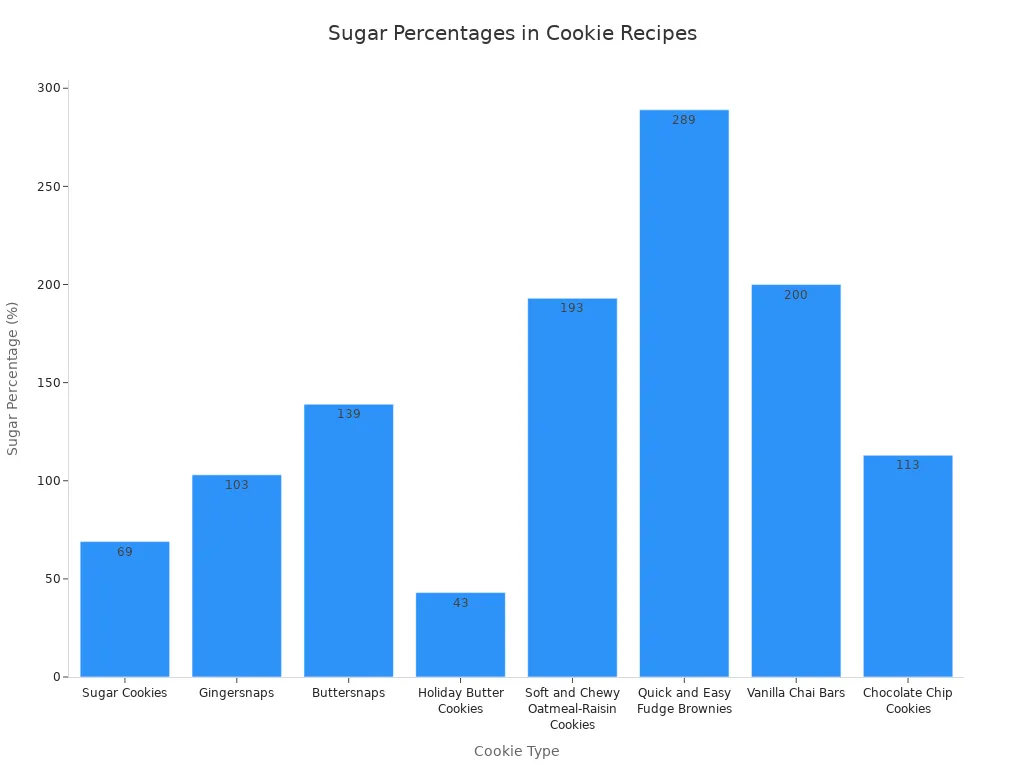
For cookies, sugar percentages vary widely:
Cookie Type | Sugar Percentage |
|---|---|
Sugar Cookies | 69% |
Gingersnaps | 103% |
Buttersnaps | 139% |
Holiday Butter Cookies | 43% |
Soft and Chewy Oatmeal-Raisin Cookies | 193% |
Chocolate Chip Cookies | 113% |
Salt usually falls between 1.5% and 2%. Yeast percentages depend on the type. Fresh yeast is 0.7% to 5%. Active dry yeast is 0.3% to 2.5%. Instant yeast is 0.2% to 2%.
Gradual Recipe Adjustments
Start with small adjustments when you modify recipes. Observe their impact. Change one thing at a time. This helps you understand what each ingredient does. You can then fine-tune your recipes for perfect results.
The Baker’s Percentage Calculator transforms your baking. It empowers bakers at every skill level. This tool brings you consistency, control, and creativity. You can effortlessly scale recipes for any batch size. It ensures consistent results every time. You gain efficiency in recipe formulation. This calculator simplifies experimentation for you. It mitigates common baking challenges. Embrace this tool to elevate your baking. You will experiment with confidence. Experience the joy of precise and successful baking.