

Is honey a Honey Healthy Alternative to sugar? You might wonder if honey truly offers a healthier choice. While honey does offer some unique benefits, remember it is still a form of sugar. Excessive sugar intake can severely impact your health, contributing to issues like fatty liver disease, high blood pressure, and an increased risk of heart disease. You must consume all sugar, including honey, in moderation. Consider honey a nutritious alternative to processed sweeteners, but its overall healthfulness depends on your usage. So, is honey good for you? Let’s explore the facts.
Key Takeaways
Honey has more nutrients than regular sugar, but it is still a sugar. You must eat it in small amounts.
Honey can help your body in many ways. It fights bad things in your body and helps with coughs.
People with diabetes can eat honey. They must eat only a little bit and watch their blood sugar.
Raw honey is better than regular honey. It keeps more good things because it is not heated or filtered.
Do not give honey to babies under one year old. It can make them very sick.
Honey vs. Sugar: Nutritional Comparison

You often wonder about the calorie and carb content of honey versus sugar. Both honey and sugar are high in carbohydrates. They both raise your blood sugar levels. Understanding these differences helps you make informed choices.
Calorie and Carb Content
A single tablespoon of honey contains 64 calories. It also has 17 grams of carbohydrates, which are mostly sugars. In contrast, one tablespoon of white sugar has about 48 to 50 calories. This means honey has more calories per tablespoon than sugar. You must remember this when you consider your total daily intake of sugar. Too much sugar, whether from honey or refined sugar, can affect your health.
Glycemic Index Differences
The glycemic index (GI) tells you how quickly a food raises your blood sugar. You might think honey has a much lower glycemic index than sugar. When you compare the glycemic index of sweeteners, table sugar has a glycemic index of about 60. Most honeys have a marginally lower glycemic index than 60. However, honey’s GI can vary a lot. For example, Yellow Box honey might have a GI of 35. Pure honey can have a GI of 58. Honey with high glucose levels could reach 78. This variation happens because there is no single official testing method for GI ratings. You can see the differences in this chart:
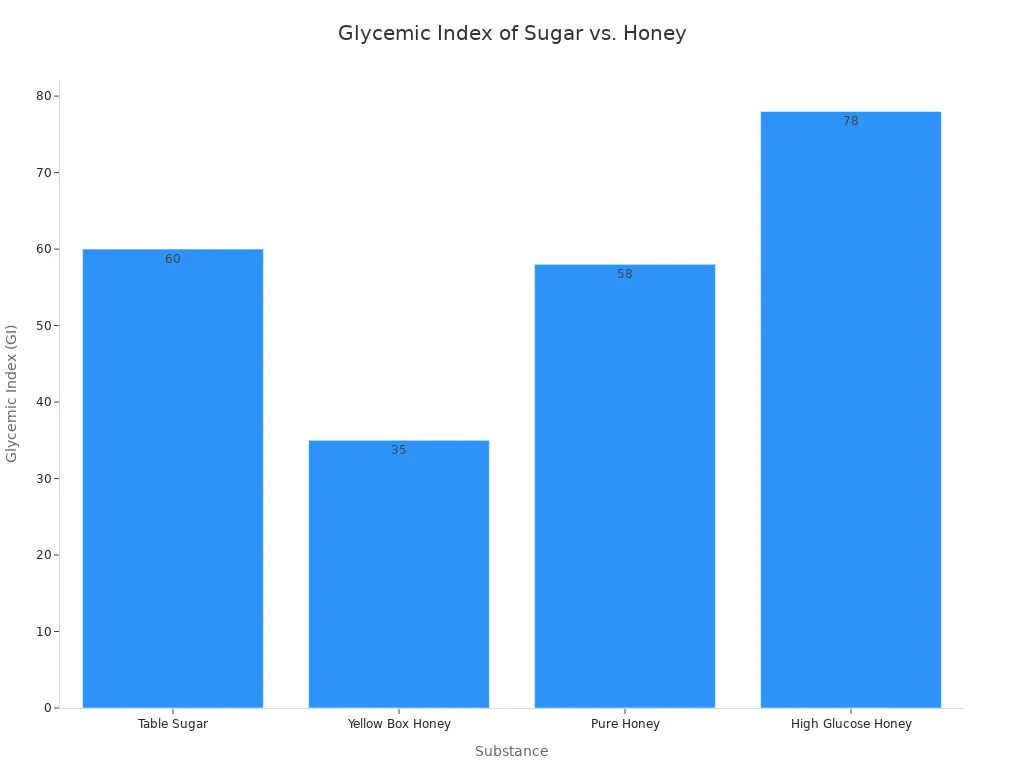
This variability means you cannot assume all honey has a lower glycemic index. This is important for people managing diabetes. You need to consider the specific type of honey.
Micronutrients in Honey
Refined sugar offers no real nutritional value beyond calories. Honey, however, provides some trace amounts of vitamins and minerals. This is a key part of honey nutritional value. You will not find these in processed sugar. Honey contains water-soluble vitamins. These include riboflavin (B2), niacin (B3), folic acid, pantothenic acid (B5), and pyridoxine (B6). You also find small amounts of Vitamin C. For minerals, honey offers iron, manganese, zinc, selenium, copper, calcium, potassium, magnesium, and phosphorus. The amount of these micronutrients changes. Factors like the type of plant the bees visited, where the honey came from, and how it was processed all play a role. Darker honeys usually have more minerals. For instance, honeydew and chestnut honeys are darker. They have higher levels of potassium, calcium, magnesium, and phosphorus. This is more than lighter honeys like heather or eucalyptus honey. So, while the amounts are small, honey does offer more than just sweetness. This contributes to the overall honey nutritional value. People with diabetes might find these trace nutrients appealing, but remember the sugar content. Both honey and sugar impact blood sugar levels, which is a concern for diabetes. Managing your intake of any sugar is crucial for diabetes.
Is Honey Good For You? Health Benefits Explored
You might ask, “is honey good for you?” Beyond its sweet taste, honey offers several health benefits of honey that contribute to your overall health. These benefits come from its unique composition.
Antioxidant and Anti-inflammatory Properties
Honey contains powerful antioxidants. These compounds protect your body from damage. You find specific antioxidants like Pinocembrin, Kaempferol, Quercetrin, Naringenin, Galangin, and Chrysin in honey. It also has phenolic compounds, nitrogen compounds, carotenoids, and ascorbic acid. These substances give honey its anti-inflammatory power. Studies show honey can lower inflammation markers in your body. For example, one study found honey reduced plasma prostaglandin concentrations. Another clinical trial showed honey significantly reduced oral mucositis, a painful inflammation, in cancer patients. This highlights the anti-inflammatory benefits of honey.
Cough and Cold Relief
You can use honey to soothe coughs and colds. It helps reduce cough frequency and improves sleep quality for both children and adults. Look at this comparison:
Treatment | Cough Frequency Reduction (points) |
|---|---|
Honey | 1.89 |
Dextromethorphan | 1.39 |
Placebo | 0.92 |
This table shows honey performs better than a placebo and similar to some over-the-counter medicines. Doctors even recommend honey as an alternative to antibiotics for upper respiratory infections. This is a significant benefit for your health.
Gut Health and Digestion Support
Honey acts as a prebiotic, which means it feeds the good bacteria in your gut. It contains special carbohydrates called oligosaccharides. These stimulate beneficial bacteria like Lactobacillus and Bifidobacteria. At the same time, honey helps reduce harmful bacteria such as Salmonella and E. coli. This action improves your gut health and digestion. These benefits are important for everyone, including those managing conditions like diabetes.
Wound Healing Applications
You can also use honey for wound care. It helps wounds heal faster through several mechanisms. Honey cleans wounds by drawing out fluid and dead tissue. It fights bacteria and reduces inflammation. Honey also promotes new blood vessel growth and supplies essential nutrients to the wound. Doctors have seen honey improve acute wounds, burns, venous ulcers, and even pressure wounds. This shows the remarkable health benefits of honey for healing.
Honey and Diabetes: Blood Sugar Effects
You often wonder about the impact of honey and diabetes. Managing your blood sugar levels is a key concern if you have diabetes. Understanding how honey affects your body helps you make informed dietary choices.
Effects of Honey on Blood Sugar
You know that all forms of sugar raise your blood sugar. However, the effects of honey on blood sugar can differ from refined sugar. In non-diabetic individuals, honey generally leads to a lower glycemic response. It also reduces serum glucose concentrations compared to sucrose or glucose-fructose solutions. Some studies show natural honey causes only a minimal 20% increase in blood glucose. This is significantly less than the 47% and 52% increases observed with simulated honey and D-glucose after 60 minutes. Furthermore, after 180 minutes, the reduction in blood glucose levels following natural honey consumption was 9.75%. This was twice lower than the 20% reduction seen after D-glucose consumption.
In non-diabetic controls, honey showed a significantly lower glycemic index (GI) and peak incremental index (PII) compared to both glucose and sucrose. Honey also produced a significantly higher C-peptide level in these controls. The postprandial glycemic response was also attenuated with honey consumption compared to sucrose in normal subjects. This suggests honey might be better for blood sugar control in some contexts. However, some research, particularly in non-diabetic rats, found no significant difference in glucose levels when comparing honey, a honey-based diet, or sucrose. This highlights the complexity of honey and diabetes.
Can People With Diabetes Eat Honey?
You might ask, “can people with diabetes eat honey?” The answer is yes, but with caution. Honey still contains carbohydrates and affects blood sugar levels. While it may have a lower glycemic index than table sugar, it is not a free food. The glycemic index of sweeteners varies, and even honey can have a high GI depending on its type. You must consider your overall carbohydrate intake. If you have diabetes, you need to monitor your blood sugar closely after consuming honey. This helps you understand your body’s response. So, is honey good for diabetes? It can be, in very small amounts, as part of a carefully managed diet.
Recommended Intake for Diabetics
If you have well-controlled type 2 diabetes, you can include honey in your diet. However, you must limit your intake. So, which honey is best for people with diabetes and how much can you have?
Limit honey intake to 1 to 2 teaspoons per day.
This amount provides potential health benefits without significant blood sugar spikes.
Always consult a doctor or a registered dietitian before making dietary changes. This is especially important for blood sugar control.
Understanding which honey is best for people with diabetes involves looking at its glycemic index. Lighter honeys often have a slightly higher glucose content, which can affect blood sugar more quickly. Darker honeys sometimes have a slightly lower glycemic index. However, the most important factor for honey and diabetes remains moderation. You can enjoy honey in small amounts, but it is still a form of sugar. This means you must account for it in your daily carbohydrate count. This helps you manage your diabetes effectively.
Raw vs. Regular Honey
You often see different types of honey on store shelves. Understanding the difference between raw and regular honey helps you make a better choice. The main difference lies in how producers process the honey.
Processing and Nutrient Retention
Regular honey undergoes processing. Producers heat and filter this honey. This process makes the honey smoother and clearer. However, heating, especially thermal pasteurization, changes the honey. It significantly reduces the enzymatic activity of diastase in honey. For example, pasteurization can decrease an initial diastase activity of 18.23 DN. This shows a clear reduction in enzyme content. Filtering also removes small particles like pollen. Pollen grains contribute to the natural crystallization of honey. However, processing does not directly address how pasteurization affects the count of pollen grains. Raw honey, on the other hand, remains unheated and unfiltered. This means it keeps its natural enzymes, pollen, and propolis. You get honey in its most natural state.
Benefits of Raw Honey
Raw honey offers unique benefits because it retains its natural components. The enzymes in raw honey provide several advantages.
Digestive Support: Enzymes like amylase and invertase in raw honey may offer mild assistance with carbohydrate digestion. You get this support when you consume honey with meals.
Antimicrobial Properties: The glucose oxidase enzyme system creates a natural antimicrobial environment in honey. This enzyme catalyzes the oxidation of glucose to produce gluconic acid and hydrogen peroxide. This reaction gives honey its natural antimicrobial properties. Research confirms this enzymatic production of hydrogen peroxide significantly contributes to honey’s effectiveness against bacterial infections.
Antioxidant Contribution: Certain honey enzymes participate in reactions that produce or preserve antioxidant compounds. This potentially enhances honey’s overall antioxidant capacity. These benefits make raw honey a popular choice for many people.
Honey: Potential Concerns
Caloric Density and Weight Gain
You might think honey is always better. However, you must consider its caloric density. Honey has 3.04 kcal/g. This is lower than sugar’s 3.85 kcal/g. You need less honey to get the same sweetness. But a tablespoon of honey has 64 calories. A tablespoon of sugar has 48 calories. This difference comes from honey’s greater density. A tablespoon of honey weighs 28 grams. A tablespoon of sugar weighs 16 grams. You must watch your intake. Too many calories can lead to weight gain. This increases your risk of type 2 diabetes. This impacts your overall health. Managing your weight is crucial for preventing diabetes.
Risks for Infants and Allergies
You should never give honey to infants under one year old. Honey can contain Clostridium botulinum spores. These spores cause infant botulism. This condition is a rare but serious form of paralysis. It affects babies under 12 months. Symptoms include muscle weakness and breathing difficulties. Older children can safely eat honey. Their digestive systems are mature. They can process the spores without harm. You also need to know about allergies. Honey can contain allergens. These include pollen from plants like ragweed. It also has glandular proteins from bees. These can trigger allergic reactions in some people. This is a health concern for those with sensitivities.
Dental Health Considerations
You might worry about honey and your teeth. Honey contains sugars like glucose and fructose. These sugars can feed bacteria in your mouth. These bacteria produce acid. This acid can harm your tooth enamel. However, studies show honey has a lower demineralization effect than sucrose. Honey’s acidity is from gluconic acid (pH 3.4–4.5). This acidity does not cause enamel erosion after 30 minutes. Some research even suggests natural honey can remineralize enamel. Still, you should practice good dental hygiene. Limit your intake of any sweet food, including honey. This helps protect your dental health. This is especially important if you have diabetes. Poor dental health can complicate diabetes management. This affects your overall health.
Using Honey as a Healthy Alternative
You can use honey as a honey healthy alternative to refined sugar in many ways. It offers a different flavor and some added benefits. Limiting any sweetener is always wise, but honey can be a better choice.
Substitution Ratios
When you replace granulated sugar with honey, you need to adjust the amount. Honey is sweeter than sugar. You also need to account for its liquid content. For every 1 cup of granulated sugar, you can use ¾ cup of honey. Another common guideline suggests substituting 1/2 to 2/3 cup of honey for every 1 cup of sugar. You might also need to reduce other liquids in your recipe by about ¼ cup for every cup of honey you use. This helps maintain the right consistency.
Culinary Uses and Flavor
Honey enhances many dishes. It adds depth and character. You can use honey not just as a sweetener but also as a flavor enhancer. Different types of honey, like Wildflower, Clover, and Manuka, offer unique tastes. You can create sweet and savory glazes for meats, such as roasted chicken or salmon, by mixing honey with soy sauce. Infused honey works well in salad dressings with olive oil and vinegar. Orange blossom honey makes a citrusy dressing. In baking, honey can replace sugar. Lavender honey adds a floral note to muffins. You can stir ginger honey into tea for comfort. Drizzle cinnamon-infused honey over yogurt with fruits and nuts for a healthy snack. Thyme or rosemary honey pairs well with cheeses. Buckwheat honey on toast offers a rich flavor. Maple-infused honey complements oatmeal or pancakes. This shows how versatile honey is in your kitchen.
Storage Tips
You want to keep your honey fresh and prevent crystallization. Store honey at room temperature, ideally between 70–77°F (21–25°C). Avoid refrigerating honey, as cooler temperatures make it crystallize faster. Use glass jars instead of plastic. Glass is non-porous and keeps moisture out. Make sure your containers have airtight seals. Always use clean, dry utensils when you handle honey. Keep the lid tightly closed to prevent water from entering. If your honey crystallizes, you can return it to a liquid state. Place the jar in warm water, not exceeding 100°F (38°C). Stir it until the crystals dissolve. Avoid high heat or microwaving, as this can harm the quality of your honey. Proper storage helps you enjoy this honey healthy alternative for a long time, supporting your overall health.
You now understand that honey offers more nutritional benefits and beneficial compounds than refined sugar. So, is honey good for you? It has anti-inflammatory properties and helps with coughs. Honey can even improve your cardiometabolic health. However, this honey healthy alternative remains a caloric sweetener. You must consume it in moderation. For individuals with diabetes, careful monitoring is crucial. Honey still impacts blood sugar. Managing your diabetes means limiting intake. You should always make informed choices for your health. Consider honey a slightly better sugar alternative, especially if you have diabetes, but always use it appropriately.
FAQ
What is the main difference between honey and sugar?
Honey offers trace amounts of vitamins and minerals. Refined sugar provides only empty calories. Honey also has a slightly lower glycemic index than table sugar. This means it raises your blood sugar a little slower.
What are the key health benefits of consuming honey?
Honey contains antioxidants and anti-inflammatory compounds. It helps soothe coughs and colds. Honey also supports gut health as a prebiotic. You can even use it for wound healing.
What are the risks of giving honey to infants?
You must never give honey to infants under one year old. Honey can contain Clostridium botulinum spores. These spores cause infant botulism. This serious condition can lead to paralysis in babies.
What does “raw honey” mean?
Raw honey is unheated and unfiltered. This means it keeps its natural enzymes, pollen, and propolis. Regular honey undergoes processing. This processing removes some beneficial components.