


Do you struggle to fall asleep or feel overwhelmed by worry? Many adults face these challenges.
Sleep Difficulty | Percentage of Adults (2020) |
|---|---|
Trouble falling asleep | 14.5% |
Trouble staying asleep | 17.8% |
Anxiety also affects many people. | |
You might seek natural solutions. Passionflower is a natural remedy gaining attention. This post explores the benefits of passionflower for sleep and passionflower for anxiety relief. You will learn how passionflower works and how to use it safely. |
Key Takeaways
Passionflower is a natural herb. It helps reduce anxiety and improves sleep. It works by increasing calming chemicals in your brain.
Passionflower can ease general anxiety. It also helps calm you before surgery. Studies show it works well for these uses.
This herb helps you sleep better. It promotes relaxation and deep sleep. It can also help people with insomnia.
Always use passionflower safely. Talk to your doctor first. This is important if you are pregnant, take other medicines, or have heart problems.
What Is Passionflower
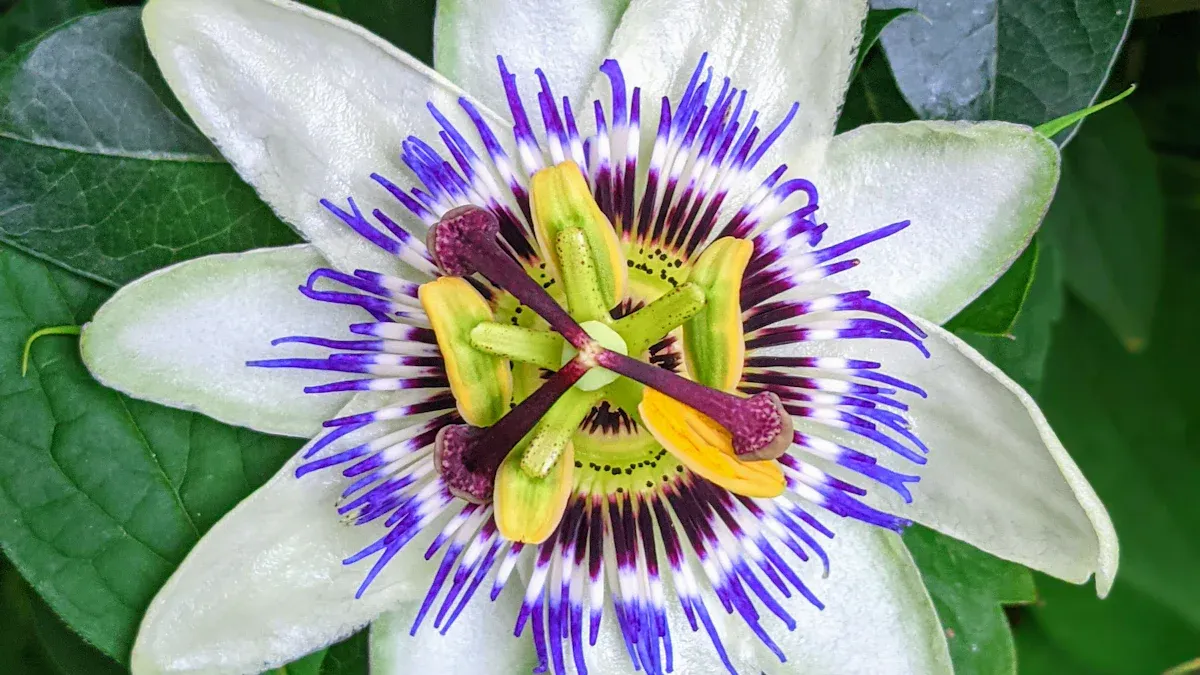
Botanical Identity
You might know this plant as passionflower, but its scientific name is Passiflora incarnata. This remarkable plant is a rapid-growing, trailing vine. It climbs using tendrils. In warm areas, Passiflora incarnata can be woody. In colder places, it dies back to the ground each winter. The plant spreads through root suckers. You can pinch it back to encourage a bushier shape.
The leaves of Passiflora incarnata are deciduous and green. They are simple, alternate, and have three lobes with serrated edges. The leaves are dark green on top and lighter underneath. You will see glands on the leaf stalks. These leaves turn yellow in the fall. They typically measure 3 to 6 inches wide. The flowers of this passionflower are showy and fragrant. They bloom from May to July. These flowers are 1 to 3 inches across. They are white with a purple crown. They have 10 white petals and sepals. A central crown of pinkish-purple filaments makes the passionflower unique. Its flowers can also be blue, pink, or lavender.
Passiflora incarnata produces edible fruits called maypops. These fruits appear from July to October. They are fleshy, leathery, and egg-shaped. They turn yellowish when ripe and contain brown seeds. Maypops are 1 to 3 inches long and make a ‘pop’ sound when you crush them. Their colors can be gold, green, or orange. The bark of this passionflower is green, smooth, and coarsely grained.
Traditional Uses
People have used Passiflora incarnata for centuries. Indigenous people in South America used this herb long before Europeans arrived. European folk medicine has mentioned Passiflora incarnata since the 16th century. They used it for stress, anxiety, and trouble sleeping. Polish medicine used this passionflower for hysteria. Turkish medicine used it for menstrual cramps and epilepsy. Brazilian medicine found uses for asthma and parasites. Indian ethnomedicine used Passiflora incarnata for morphine dependency and diabetes. Vietnamese ethnomedicine used it for high blood pressure. Many cultures, including Kenyan, Congolese, Rwandan, Iraqi, and Australian, used this herb as a sedative. Traditional medicine used Passiflora incarnata for anxiety, nervousness, and insomnia. It also helped with menopausal symptoms.
Benefits of Passionflower
Passionflower offers you many advantages. This natural herb provides significant benefits for your overall health. You can experience improvements in various aspects of your well-being.
Overall Wellness Support
Passiflora incarnata provides significant benefits for your overall wellness. People traditionally use this herb for its calming and healing properties. It helps you alleviate stress and anxiety. Passionflower increases gamma-aminobutyric acid (GABA) levels in your brain. This action reduces brain activity and promotes relaxation. Consuming passionflower tea or supplements can lead to a notable reduction in your stress levels. This makes it a natural remedy if you experience high stress or chronic anxiety.
Passiflora incarnata offers several general wellness benefits. It helps reduce anxiety symptoms and improves your sleep patterns. Studies show it can relieve menopause symptoms. You might see a reduction in headaches, depression, insomnia, and anger. Some findings also point to its anti-inflammatory properties. More research will fully explain these applications.
Natural Calming Properties
Passionflower is a recognized calming supplement. Its natural calming properties are well-supported. Several pharmacopoeias recognize Passiflora incarnata as an official plant drug. These include the British Herbal Pharmacopoeia and the United States Homoeopathic Pharmacopoeia. Research supports the plant’s anxiolytic and sedative properties. This research focuses on its active compounds. These compounds include flavonoids like apigenin and vitexin. Indole alkaloids like harman are also present.
Studies suggest that Passiflora incarnata provides its sedative and anxiolytic activities through specific brain receptors. It interacts with benzodiazepine and GABA receptors. This interaction helps you achieve anxiety relief. The calming effect of passionflower makes it a valuable natural option.
Passionflower for Anxiety
You can find significant relief from anxiety with passionflower. This natural herb offers a gentle way to manage your worries. Let’s explore how passionflower for anxiety can help you.
Reducing General Anxiety
Many people experience general anxiety in their daily lives. You might feel restless or constantly worried. Passiflora incarnata can help you reduce symptoms of anxiety. Studies show its effectiveness in easing these feelings. For example, researchers have looked at how passionflower compares to common anxiety medications.
Here is what some clinical trials found regarding passionflower’s ability to reduce anxiety:
Study (Year) | Participants | Intervention | Comparison | Key Findings |
|---|---|---|---|---|
Akhondzadeh et al. (2001) | 36 volunteers with Generalized Anxiety Disorder | Passiflora extract | Oxazepam | Passionflower was effective for generalized anxiety disorder. It caused fewer issues with work capacity than Oxazepam. |
Movafegh et al. (2008) | 60 healthy volunteers before surgery | 500 mg Passiflora 90 minutes pre-surgery | Placebo | Passionflower significantly reduced anxiety without making people sleepy. |
Kaviani et al. (2013) | 63 participants with dental anxiety | Passiflora extract (night before and 90 minutes pre-procedure) | Placebo, Control (no treatment) | Passionflower significantly reduced dental anxiety compared to placebo and no treatment. |
These studies suggest that passionflower can effectively relieve anxiety. It offers a natural option for managing generalized anxiety. You can experience a calmer state without some of the common side effects of other medications.
Calming Effects of Passionflower
The calming effects of passionflower come from its unique compounds. These compounds work with your brain’s natural systems. They help to quiet overactive brain signals. This action leads to a feeling of peace. You will notice a reduction in your anxious thoughts. This anxiolytic activity makes passionflower a valuable tool for anxiety relief. The calming effects of passionflower are well-documented. It helps you feel more relaxed and less stressed. This natural calming can improve your daily life if you struggle with anxiety problems.
Pre-Surgery Anxiety Relief
Facing surgery can be a stressful experience. Many people feel anxious before an operation. Passiflora incarnata can help you relieve anxiety in these situations. It offers a way to reduce anxiety without causing too much drowsiness.
One study looked at 60 patients having outpatient surgery. They received oral Passiflora incarnata 90 minutes before their procedure. The results showed that passionflower significantly reduced anxiety scores. This happened without making the patients too sleepy. Their recovery of normal movement and thinking was similar to those who received a placebo. This means you can reduce anxiety before surgery and still recover well.
Other research also supports using passionflower to relieve anxiety before medical procedures. You can see how it compares to other options:
Outcome | Passiflora incarnata (500 mg) | Midazolam (15 mg) | Erythrina mulungu (500 mg) | Placebo |
|---|---|---|---|---|
Anxiety Control | Similar to midazolam, effective | Effective | Unable to control | Unable to control |
Blood Pressure (BP) | No significant difference | No significant difference | No significant difference | No significant difference |
Heart Rate (HR) | No significant difference | No significant difference | No significant difference | No significant difference |
Oxygen Saturation (SpO2) | No significant difference | No significant difference | No significant difference | No significant difference |
Conclusion | Anxiolytic effect, suitable for third molar extractions | Anxiolytic effect | Not effective for anxiety | Not effective for anxiety |
This table shows that passionflower can reduce anxiety as effectively as some common medications. It does this without affecting your vital signs.
Another comparison looked at passionflower versus melatonin for anxiety reduction:
Outcome | Passiflora incarnata (1000 mg) | Melatonin (6 mg) |
|---|---|---|
Anxiety Reduction | Statistically significant | Statistically significant |
Sedation Score | Lower | Higher |
Cognitive Impairment | More impairment | Less cognitive impairment |
Conclusion | Reduces anxiety similar to melatonin, but causes more cognitive impairment | Reduces anxiety similar to passionflower, causes less cognitive impairment |
You can see that while passionflower reduces anxiety, it might cause more temporary thinking impairment than melatonin.
Finally, a study compared Passiflora incarnata to Oxazepam for pre-operative anxiety:
Outcome | Passiflora incarnata | Oxazepam (10 mg) |
|---|---|---|
Pre-operative Anxiety Reduction | Significant reduction (similar to oxazepam) | Significant reduction |
Psychomotor Function | Minimal impairment (desirable) | Not explicitly detailed, but the study aims for minimal impairment |
This shows that passionflower can reduce anxiety before surgery as well as a standard medication. It also causes minimal impact on your physical and mental functions. This makes it a good choice if you want to reduce anxiety before a procedure.
Passionflower for Improved Sleep

You can find significant support for your nightly rest with passionflower. This natural herb helps you achieve more peaceful and restorative sleep.
Promoting Relaxation
Passionflower helps you relax before bed. Its bioactivity comes from a combination of compounds. These compounds work together to create a calming effect. For example, GABA (gamma-aminobutyric acid) works with other compounds to help your brain calm down. Flavonoids, like apigenin and vitexin, also play a role. They can positively affect GABAA receptors in your brain. This action is similar to how some anxiety medications work. These flavonoids have anxiolytic properties. They modulate or inhibit GABAA and GABAC receptor currents.
Other flavonoids, especially chrysin, protect your brain cells. They can also ease neurological and psychological issues. Alkaloids such as harmine and harmaline inhibit the MAO (monoamine oxidase) enzyme. This increases levels of neurotransmitters like serotonin and norepinephrine. These neurotransmitters influence your mood and sleep. The combined action of these compounds makes passionflower an effective calming agent. It prepares your body and mind for rest.
Enhancing Sleep Quality
Passionflower can significantly enhance your sleep quality. You will experience more restful nights. A study on rats showed that Passiflora incarnata increased total sleep time. It did this mainly by extending slow-wave sleep (SWS) and reducing wakefulness. The time it took to enter SWS also shortened significantly. It went from 44.38 minutes to 25.92 minutes. This suggests that Passiflora incarnata acts as a sleep aid. It helps you fall asleep faster and increases deep sleep.
People also report better sleep quality when using passionflower. One study found that participants rated their sleep quality significantly better with passionflower compared to a placebo. These findings suggest that drinking a low dose of Passiflora incarnata tea provides short-term subjective sleep benefits. Healthy adults experiencing mild fluctuations in sleep quality saw these improvements. Another randomized controlled trial in 2011 involved 41 participants with sleeping disorders. It concluded that Passiflora incarnata herbal tea improved sleep quality.
Addressing Insomnia
If you struggle with insomnia disorder, passionflower may offer a solution. It can help you relieve insomnia symptoms. A systematic review indicates that Passiflora incarnata may provide a therapeutic effect for sleeping disorders, including chronic insomnia. Its sedative action helps individuals who have difficulty falling asleep. This makes passionflower a potential natural way to treat insomnia.
While many Passiflora incarnata products are sold for their sedative properties, some reviews note a need for more robust studies. The efficacy is not always fully supported by existing literature. This is often due to methodological shortcomings in clinical studies. However, the traditional use and some modern research still point to its potential. You can consider passionflower as a natural option to improve your sleep.
How Passionflower Works
You might wonder how passionflower helps you feel calm and sleep better. This natural herb works by affecting your brain’s chemistry. It interacts with important systems that control your mood and relaxation.
Boosting GABA Levels
Passionflower helps your brain by boosting levels of a chemical called GABA. GABA stands for gamma-aminobutyric acid. It is a natural calming agent in your brain. When you have more GABA, your brain activity slows down. This helps you relax. Animal studies show that passionflower can increase GABA levels in the brain. This leads to its calming effects. Passionflower extract also stops GABA from being taken up too quickly. It affects GABA(A) and GABA(B) receptors. This means it helps GABA work better in your brain.
Brain Activity Modulation
Passionflower does more than just boost GABA. It also changes how your brain works in other ways. This helps with its anxiolytic activity. It increases cell density in important brain areas like the hippocampus and amygdala. These areas are key for emotions and memory. Passionflower also affects neurotransmission in other parts of your brain. It can change levels of dopamine and noradrenaline. This helps to calm your nervous system. Its inhibitory effect on the GABAergic pathway suggests it can act as a sedative.
Key Active Compounds
The calming power of passionflower comes from its many active compounds. Flavonoids are important. These include vitexin, isovitexin, and apigenin. Indole alkaloids like harman and harmalin also play a role. These compounds work together. They give passionflower its anxiolytic effects and sedative properties. A special compound called a tri-substituted Benzoflavone Moiety (BZF) also contributes. It helps with various central nervous system effects. These compounds are what make passionflower an effective natural remedy.
Safety and Precautions
You should always consider safety when you use any natural remedy. While passionflower offers many benefits, you need to understand its potential risks.
Possible Side Effects
Most people tolerate passionflower well. However, some individuals can experience adverse reactions. A case report documented a 34-year-old woman. She experienced severe nausea, vomiting, drowsiness, a prolonged QTc interval, and episodes of nonsustained ventricular tachycardia after taking passionflower at therapeutic doses. These significant adverse effects required hospital care for cardiac monitoring and intravenous fluid therapy. Vasculitis, an inflammation of blood vessels, has also been linked to a herbal preparation containing passionflower extract. You should pay attention to any unusual symptoms or the effects of passionflower.
Important Contraindications
Certain conditions mean you should avoid passionflower. You should not use passionflower if you are pregnant or breastfeeding. This is because passionflower can act as a uterine stimulant. Alkaloids like harman and harmaline, and the compound gynocardin, contribute to this effect. Children under 12 years old should also avoid this herb. If you take sedatives, sleeping pills, or other medications that affect your central nervous system, you should not use passionflower supplements. People with cardiac arrhythmias or other heart abnormalities should generally avoid passionflower supplements.
Drug Interactions
Passionflower can interact with certain medications. You must be careful if you take other drugs. For example, a patient self-medicated with passionflower while undergoing lorazepam treatment. This led to adverse effects like handshaking, dizziness, throbbing, and muscular fatigue. This interaction likely happens because the active compounds in passionflower increase the inhibitory activity of benzodiazepines, like lorazepam, on GABA receptors. This creates an additive or synergistic effect. Always consult your doctor before combining passionflower supplements with any prescription medications. Understanding these interactions helps you use passionflower safely.
Dosage and Administration
Recommended Dosages
You need to know the right dosage for this herb. This helps you use it safely and effectively. For anxiety relief, you can brew dried passionflower herb into teas. Use 4 to 8 grams daily. If you prefer liquid extract, take 10 to 30 drops each day. Tinctures require 10 to 60 drops daily. Preliminary research suggests 45-90 mg of extract three times daily for 2 to 8 weeks for anxiety. A clinical trial found that 45 drops of the extract daily worked as well as 30 mg of oxazepam per day over four weeks. It also had fewer short-term side effects. This specific dosage proved effective.
For improved sleep, specific dosage guidelines also exist.
Form of Passiflora incarnata | Recommended Dosage | Timing Before Bed |
|---|---|---|
Capsules/Tablets | 500 mg | 1 hour |
Capsules/Tablets | 500-1000 mg | Before bedtime |
Tea (dried herb) | 1 teaspoon steeped in hot water | 1 hour |
Liquid Extracts | 10-30 drops | Before bed |
This table helps you choose the right dosage for your sleep needs.
Forms of Consumption
You can consume passionflower in several ways. The plant’s fresh aerial parts include leaves, vines, tendrils, and flowers. You can also use the dry aerial parts. Many people enjoy passionflower tea, made by steeping the dry herb. Tinctures and capsules are also popular forms. The plant produces ovoid, green fruits, often called maypops. These fruits are edible, though not particularly tasty. They typically reach 2 ½ to 3 inches in diameter and have spongy, white flesh. You can find various passionflower supplements on the market. These passionflower supplements offer convenience. Always check the ingredients of any passionflower supplements you choose.
When to Consult a Doctor
You should always talk to a doctor before using any herbal remedy. This is especially true if you have certain health conditions or take other medications.
Pregnancy: Avoid this herb if you are pregnant. It can cause uterine contractions. It might also affect your offspring’s behavior.
Medications: Do not combine it with certain drugs.
If you take Pentobarbital, it may have additive effects.
If you take Benzodiazepines (like Ativan® or Valium®), it can increase sedative effects.
If you take drugs that prolong the QT interval (like azithromycin, dasatinib, fingolimod), this herb may also prolong this interval. This can lead to added cardiac effects.
Health Concerns: Avoid large doses if you experience central nervous system depression or irregular heart rhythms. This herb can cause these side effects. Always consult a physician or other professional healthcare provider. Do this before making any health-related decisions.
Passionflower offers natural benefits for your sleep and anxiety relief. This natural herb, passionflower, works by boosting GABA levels in your brain. You can find a gentle, natural approach to wellness with passionflower. Always use passionflower responsibly. Consult your doctor before starting any new supplement, especially if you have existing conditions or take other medications. Embrace natural options for better sleep and overall well-being with passionflower.
FAQ
How quickly does passionflower start to work?
You may feel effects within 30 to 60 minutes after taking passionflower. Its calming properties can help you relax quickly. For sleep, take it about an hour before bedtime. Individual results can vary.
Can you take passionflower every day for anxiety or sleep?
You can use passionflower daily for a few weeks. Long-term use needs doctor consultation. Always follow recommended dosages. This helps you avoid potential issues.
What is the best way to consume passionflower?
You can consume passionflower as a tea, tincture, or capsule. Tea is a popular choice for relaxation. Capsules offer convenience. Choose the form that best suits your needs.
Are there any common side effects you should know about?
Most people tolerate passionflower well. You might experience mild drowsiness, dizziness, or confusion. Stop use if you notice severe reactions. Always consult your doctor if concerns arise.